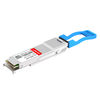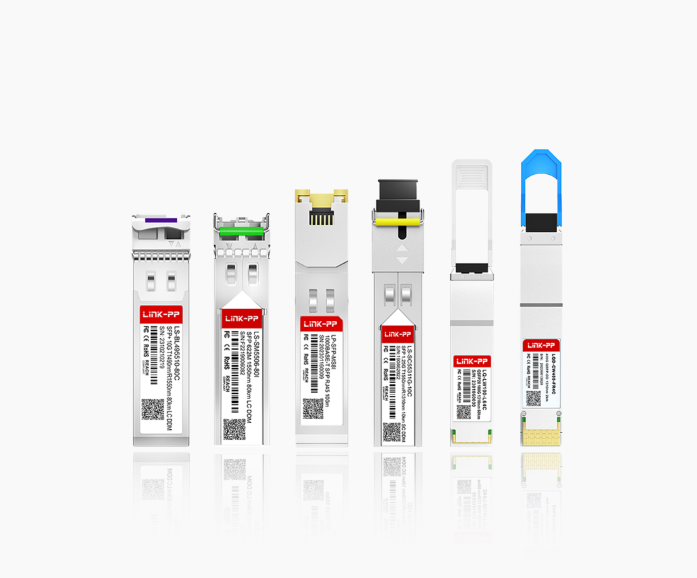
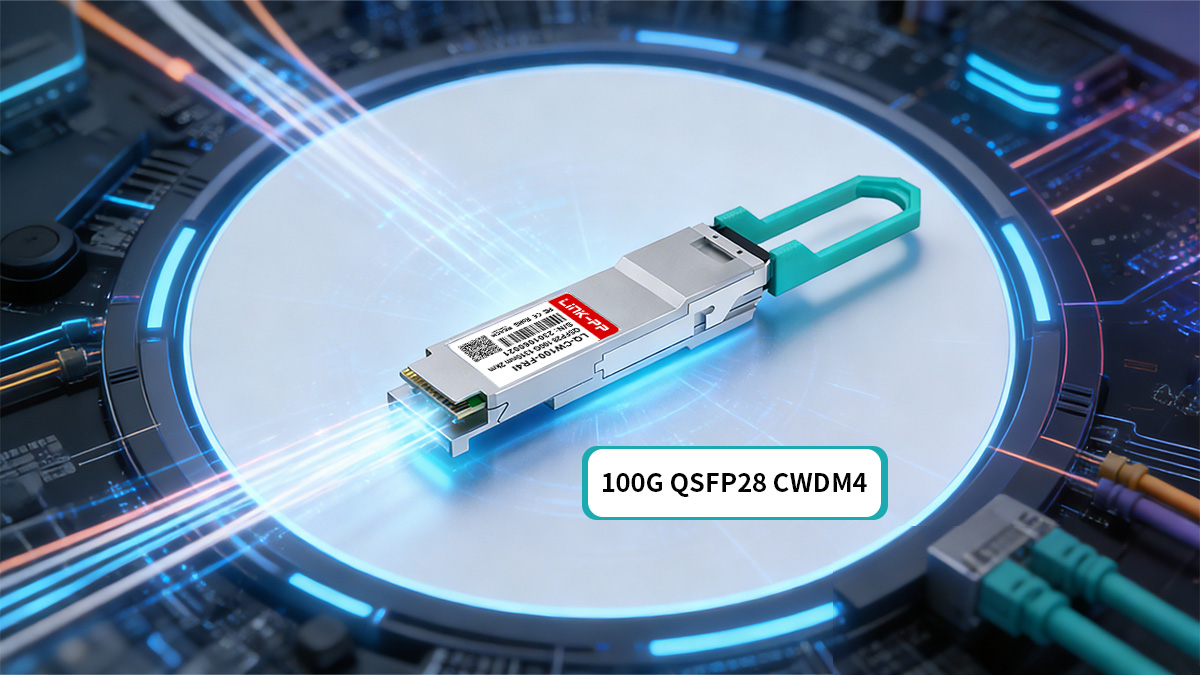
100G QSFP28 CWDM4 is a cost-efficient 100Gbps optical transceiver designed for links up to 2km over duplex single-mode fiber, making it one of the most practical choices for campus, data center, and metro interconnects. For organizations upgrading from 10G or 40G to 100G, CWDM4 enables high-speed connectivity without requiring complex DWDM systems or parallel fiber infrastructure. This balance of reach, cost, and cabling simplicity is why the 100G QSFP28 CWDM4 transceiver remains widely deployed across enterprise networks, cloud data centers, and edge facilities.
From a deployment perspective, 100G CWDM4 optics are commonly used for switch-to-switch links, spine-leaf architectures, and inter-building data center interconnect (DCI). Because they operate over standard duplex OS2 single-mode fiber with LC connectors, they allow network teams to reuse existing fiber infrastructure while scaling bandwidth to 100Gbps. Compared with alternatives like LR4 or PSM4, CWDM4 often provides the most balanced solution when distances fall within the 500m–2km range.
This article focuses on real-world applications and practical deployment solutions for 100G QSFP28 CWDM4, helping network architects and IT teams determine when to use CWDM4 optics, how to design reliable 100G links, and how to choose the right module for specific scenarios.
📝 What Is 100G QSFP28 CWDM4?
100G QSFP28 CWDM4 is a 100Gbps optical module that uses four CWDM wavelengths over duplex single-mode fiber to deliver up to 2km transmission distance. It is designed for high-speed switch-to-switch and data center interconnect links where cost, reach, and fiber efficiency must be balanced. In most enterprise and data center environments, CWDM4 is the preferred 100G module for distances between 500m and 2km.
At a technical level, a 100G QSFP28 CWDM4 module converts four 25Gbps electrical lanes into four optical wavelengths in the 1310nm CWDM range. These wavelengths are multiplexed onto a single pair of single-mode fibers and demultiplexed at the receiving end. This architecture allows 100Gbps transmission using standard duplex LC fiber instead of parallel MPO fiber, simplifying cabling and reducing infrastructure complexity.
Key Technical Characteristics
The defining feature of 100G QSFP28 CWDM4 is its ability to deliver 100Gbps over duplex SMF up to 2km with moderate power consumption and cost.
| Parameter |
Typical Value |
Industry Notes |
| Form factor |
QSFP28 |
Hot-pluggable 100G standard |
| Wavelengths |
1271–1331nm (4 CWDM lanes) |
25Gbps per lane |
| Connector |
Duplex LC |
Uses OS2 SMF |
| Max distance |
2km |
Depends on link loss |
These specifications make CWDM4 suitable for campus backbones, intra-data-center links, and metro edge connections where LR4 may be unnecessary and SR4 cannot reach.
How CWDM4 Differs from Other 100G Optics
CWDM4 occupies the middle ground between short-reach multimode optics and long-reach LR4 transceiver. It provides longer reach than SR4 while remaining more cost-effective than LR4 for sub-2km links.
| Optic Type |
Fiber Type |
Typical Reach |
Typical Use |
| 100G SR4 |
MMF + MPO |
70–100m |
Inside data center |
| 100G PSM4 |
SMF + MPO |
500m |
Parallel SMF links |
| 100G CWDM4 |
SMF + LC |
2km |
Campus/DCI |
| 100G LR4 |
SMF + LC |
10km |
Metro links |
Because CWDM4 uses duplex LC single-mode fiber, it allows network teams to reuse existing structured cabling while avoiding the higher cost of LR4 optics. This is the primary reason it has become a mainstream choice for 100G deployments in enterprise and cloud environments.
In practical terms, if a network requires 100Gbps connectivity beyond multimode limits but within 2km, 100G QSFP28 CWDM4 is typically the most balanced and widely deployed solution.
📝 Key Applications of 100G QSFP28 CWDM4
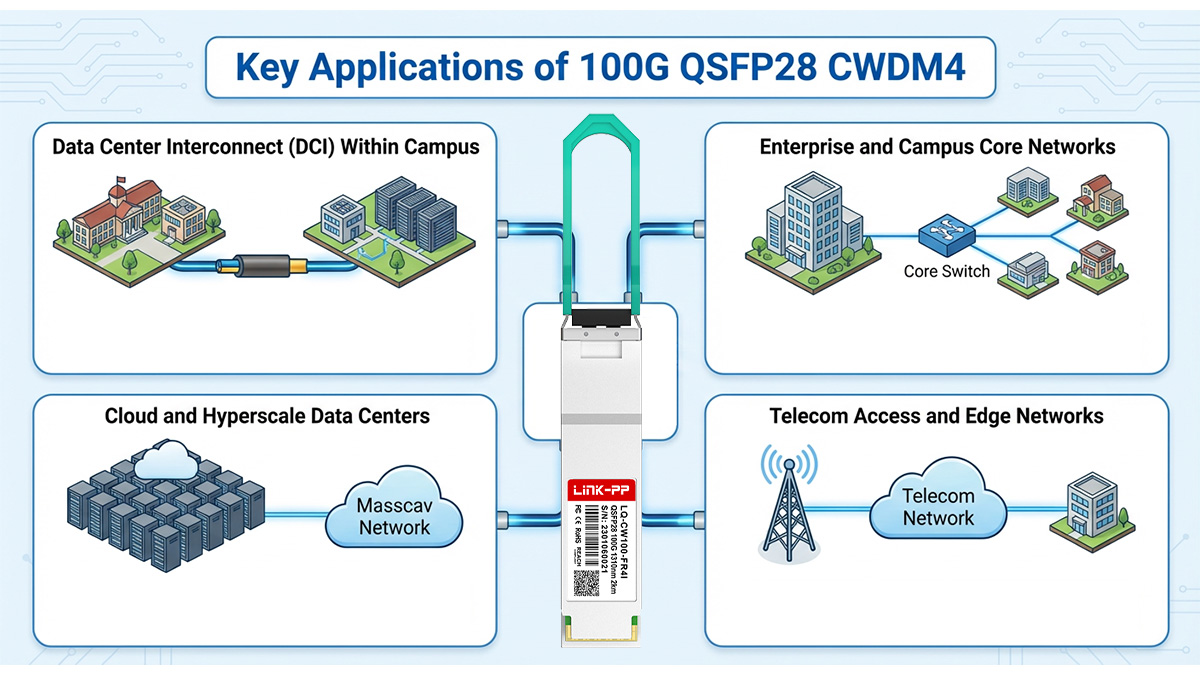
100G CWDM4 is most commonly used for 100G links up to 2km over duplex single-mode fiber, making it ideal for campus backbones, data center interconnects, and high-density switch connectivity. When a network requires more reach than SR4 but does not need the full 10km capability of LR4, CWDM4 typically delivers the best balance of cost, fiber efficiency, and deployment simplicity.
Below are the most relevant real-world application scenarios.
Data Center Interconnect (DCI) Within Campus
100G QSFP28 CWDM4 is widely used for inter-building data center links within a campus environment up to 2km. It allows organizations to scale bandwidth between facilities without deploying DWDM systems or higher-cost LR4 optics.
Typical use cases include:
-
Data center building-to-building links
-
Active-active data center architectures
-
Disaster recovery synchronization links
-
Campus core backbone upgrades
CWDM4 is especially practical when existing duplex OS2 fiber already connects buildings. Instead of installing new fiber infrastructure, network teams can upgrade to 100Gbps using the same fiber pairs.
Why CWDM4 fits campus DCI
| Requirement |
CWDM4 suitability |
Notes |
| Distance ≤2km |
Excellent |
Designed for this range |
| Duplex SMF available |
Ideal |
Reuses LC fiber |
| Cost sensitivity |
Strong |
Lower cost than LR4 |
| High port density |
Strong |
QSFP28 form factor |
Because most campus interconnect distances fall below 2km, CWDM4 has become a standard choice for enterprise and university DCI deployments.
Spine-Leaf and Switch-to-Switch Connectivity
CWDM4 is commonly deployed for 100G switch uplinks and spine-leaf connections when fiber runs exceed multimode limits. In medium to large data centers, structured cabling often uses single-mode fiber between rows or halls, making CWDM4 a natural fit.
Typical scenarios:
Compared with SR4, CWDM4 avoids MPO fiber management and supports longer structured cabling runs. Compared with LR4, it reduces cost for links that do not require 10km reach.
When CWDM4 is preferred in data centers
-
Fiber runs between 150m and 2km
-
Single-mode cabling already installed
-
Need to simplify fiber management
-
High-density 100G switch ports
In these scenarios, 100G QSFP28 CWDM4 provides predictable performance while keeping infrastructure simple.
Enterprise and Campus Core Networks
Enterprise networks use 100G QSFP28 CWDM4 for core-to-aggregation and building distribution links where distances exceed multimode limits but remain under 2km. As enterprises migrate from 10G and 40G to 100G, CWDM4 enables backbone upgrades without major fiber redesign.
Common enterprise applications:
-
Core-to-distribution switch links
-
Campus backbone upgrades
-
High-performance storage networking
-
Large office or industrial campuses
Because CWDM4 uses duplex LC fiber, it integrates easily into structured cabling systems already designed for single-mode operation.
Key benefits in enterprise deployments
-
Reuse of existing OS2 fiber
-
Simplified patch panel management
-
Scalable to future 400G migration paths
-
Predictable link budgeting
This makes CWDM4 particularly attractive for organizations seeking long-term infrastructure stability.
Cloud and Hyperscale Data Centers
Hyperscale operators deploy CWDM4 for structured single-mode 100G links where distances exceed SR4 but do not justify LR4 cost. In large cloud environments, standardized 2km-capable optics simplify design across multiple halls or buildings.
Typical hyperscale uses:
-
Cross-campus fabric links
-
Storage cluster interconnects
-
High-capacity east-west traffic paths
-
Modular data center expansion
CWDM4 allows operators to standardize on duplex SMF across facilities, reducing cable types and simplifying inventory management.
Telecom Edge and Metro Access Networks
Telecom and edge data centers use 100G QSFP28 CWDM4 for aggregation and metro edge links within a few kilometers. While longer metro links may require LR4 or DWDM, CWDM4 is often sufficient for intra-site and edge aggregation.
Examples:
In these cases, CWDM4 provides enough reach for urban deployments while maintaining lower cost and power consumption than long-haul optics.
📝 Typical Deployment Scenarios and Solutions
QSFP28 CWDM4 is best deployed in structured single-mode fiber environments where 100Gbps links must operate reliably within 2km using duplex LC cabling. In practice, it is most often used for switch uplinks, spine-leaf fabrics, and campus interconnects that require predictable performance without the cost of long-reach optics. The following scenarios outline how CWDM4 is typically implemented and how to design stable links.
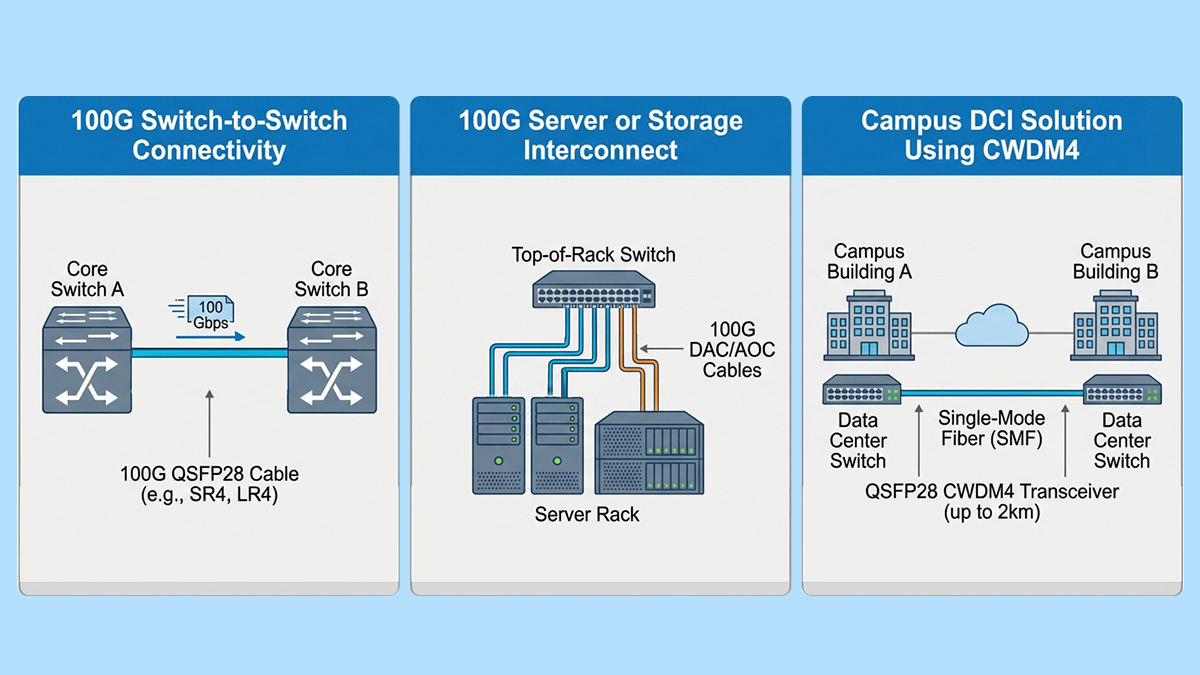
100G Switch-to-Switch Connectivity
The most common deployment for 100G QSFP28 CWDM4 is switch-to-switch interconnection within or between data center halls up to 2km. This includes leaf-to-spine, spine-to-spine, and core aggregation links.
Typical topology roles:
-
Leaf switch uplinks to spine layer
-
Core switch interconnects
-
Cross-row or cross-hall links
-
Redundant backbone paths
Deployment decision logic
-
Use CWDM4 when distance >100m and ≤2km
-
Use duplex OS2 single-mode fiber
-
Avoid MPO complexity where possible
-
Ensure link loss fits CWDM4 budget
Switch-to-switch design considerations
| Design factor |
Recommendation |
Notes |
| Fiber type |
OS2 SMF |
Duplex LC required |
| Link distance |
≤2km |
Ideal range 300m–2km |
| Patch panels |
Minimize connectors |
Reduce insertion loss |
| Redundancy |
Dual paths |
For core links |
CWDM4 simplifies operations because it uses the same duplex fiber model as LR4 while remaining more cost-efficient for short-to-medium distances.
100G Server or Storage Interconnect
CWDM4 is also used for high-capacity server clusters and storage networks when single-mode structured cabling is already in place. In modern data centers, storage fabrics and compute clusters often span multiple rows or rooms, exceeding multimode reach.
Common scenarios:
When CWDM4 is the right choice
-
Runs exceed 100m multimode limits
-
Single-mode fiber already deployed
-
Need stable 100Gbps throughput
-
High reliability required
Compared with SR4, CWDM4 reduces cable bulk and improves distance flexibility. Compared with LR4, it reduces cost where 10km reach is unnecessary.
Campus DCI Up to 2km
100G QSFP28 CWDM4 is one of the most practical solutions for campus data center interconnect (DCI) within a 2km range. It allows organizations to connect multiple buildings using standard duplex SMF without deploying DWDM transport equipment.
Typical campus DCI uses:
-
Building-to-building links
-
Active-active data centers
-
Backup and disaster recovery paths
-
Core network backbone
Campus DCI deployment steps
-
Verify fiber type (OS2 single-mode)
-
Measure total link loss
-
Confirm distance ≤2km
-
Minimize patch panel hops
-
Validate switch compatibility
Example campus link design
| Link element |
Typical value |
Notes |
| Distance |
500m–1.5km |
Common campus range |
| Fiber type |
OS2 SMF |
Existing infrastructure |
| Connectors |
LC |
Duplex patching |
| Redundancy |
Dual fiber paths |
For resilience |
This approach allows scalable 100G connectivity without requiring complex optical transport systems.
Structured Cabling Optimization
CWDM4 works best when integrated into structured single-mode cabling systems designed for predictable loss and simplified patching. Poor fiber management can reduce effective reach, so planning is essential.
Best practices:
-
Limit connector count
-
Use low-loss patch panels
-
Maintain clean fiber paths
-
Avoid unnecessary conversions
-
Validate optical power margins
Link budget awareness is critical. Although CWDM4 supports up to 2km, excessive connectors or poor fiber quality can reduce usable distance. Most deployments target a conservative loss margin to ensure long-term stability.
📝 100G CWDM4 Cabling and Infrastructure Requirements
100G QSFP28 CWDM4 requires duplex single-mode fiber (OS2) with LC connectors and a controlled link loss budget to reliably support distances up to 2km. In most deployments, the success of a CWDM4 link depends more on fiber quality, connector count, and total attenuation than on the module itself. Proper cabling design ensures predictable performance and avoids unexpected reach limitations.
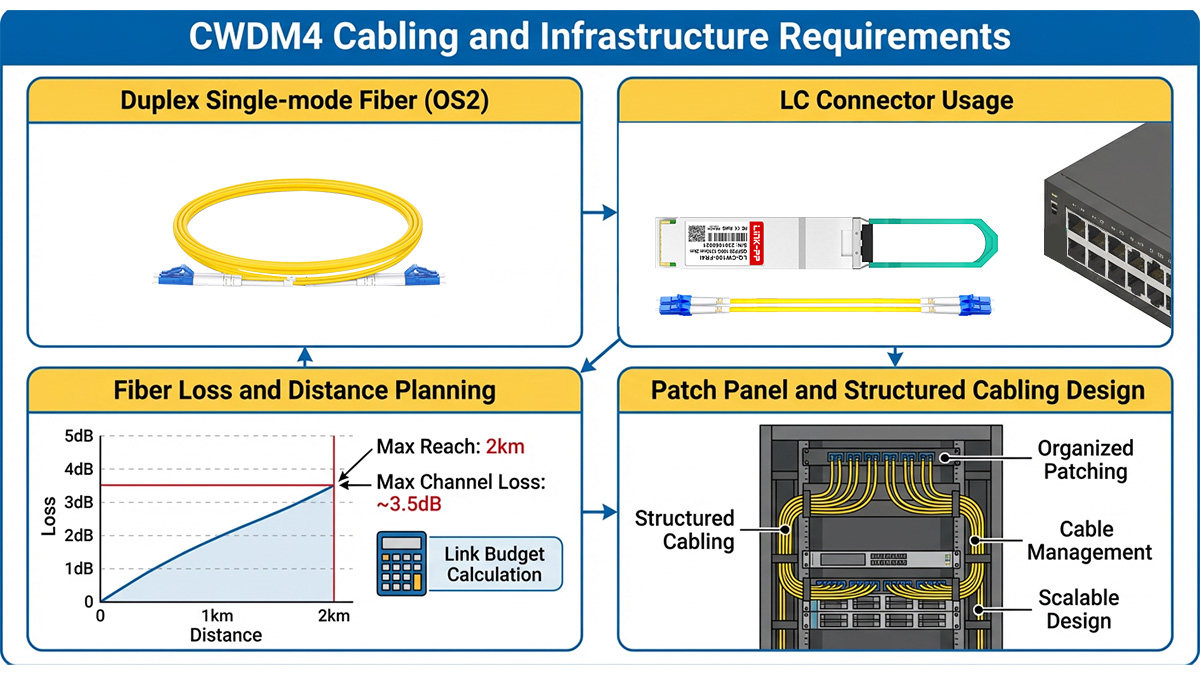
Fiber Type and Connector Standards
CWDM4 is designed specifically for duplex single-mode fiber rather than multimode or parallel MPO cabling. This allows networks to reuse standard LC-based structured cabling systems.
| Cabling element |
Requirement |
Notes |
| Fiber type |
OS2 single-mode |
Required for 2km reach |
| Connector type |
Duplex LC |
Standard CWDM4 interface |
| Fiber count |
2 fibers |
One transmit, one receive |
| Polarity |
Standard duplex |
Maintain consistency |
Using multimode fiber will not support CWDM4 transmission distance. For most campus and data center environments, OS2 fiber is already installed, making CWDM4 upgrades straightforward.
Link Loss Budget Planning
A CWDM4 link must stay within its optical loss budget to achieve the full 2km reach. Excessive connectors, patch panels, or poor fiber quality can reduce usable distance.
Typical planning factors:
Typical CWDM4 link budget considerations
| Component |
Typical loss |
Planning impact |
| Fiber attenuation |
~0.4dB/km |
Depends on distance |
| LC connector |
0.2–0.3dB each |
Add per connection |
| Patch panel |
0.3–0.5dB |
Varies by quality |
| Total budget |
~6–7dB |
Module dependent |
To maintain stability, many network designers target a conservative total loss below the maximum supported budget. This ensures reliable operation even as fiber ages or additional patching is introduced.
Patch Panels and Structured Cabling
CWDM4 performs best in structured cabling environments where connector counts are controlled and fiber paths are clearly documented. Each additional connection point increases attenuation and potential failure risk.
Recommended practices:
-
Minimize patch panel hops
-
Use low-loss connectors
-
Keep fiber paths direct
-
Label fiber routes clearly
-
Perform link testing before activation
In large campuses or multi-building deployments, documenting fiber routes and connector counts is critical for ensuring that CWDM4 links remain within supported distance limits.
Distance and Infrastructure Planning
CWDM4 is optimized for 100G links between roughly 300m and 2km over OS2 fiber. Outside this range, other optics may be more suitable.
| Distance range |
Recommended optic |
Reason |
| ≤100m |
SR4 |
Multimode cost efficiency |
| 100m–500m |
SR4 or CWDM4 |
Depends on fiber type |
| 500m–2km |
CWDM4 |
Optimal range |
| 2km | LR4 | Longer reach needed | |
Choosing CWDM4 when the link distance fits this range ensures the best balance between cost and performance.
Infrastructure Compatibility Considerations
Before deploying 100G QSFP28 CWDM4, network teams should confirm both optical and physical infrastructure readiness.
Checklist:
These checks help prevent deployment delays and ensure predictable link performance.
📝 100G QSFP28 CWDM4 vs Other 100G Optics
100G QSFP28 CWDM4 is typically the best choice for 100G links between 500m and 2km over duplex single-mode fiber, while SR4, PSM4, and LR4 serve shorter or longer distances. Choosing the right optic depends on fiber type, distance, cabling complexity, and cost sensitivity. In most structured SMF environments within 2km, CWDM4 provides the most balanced solution.
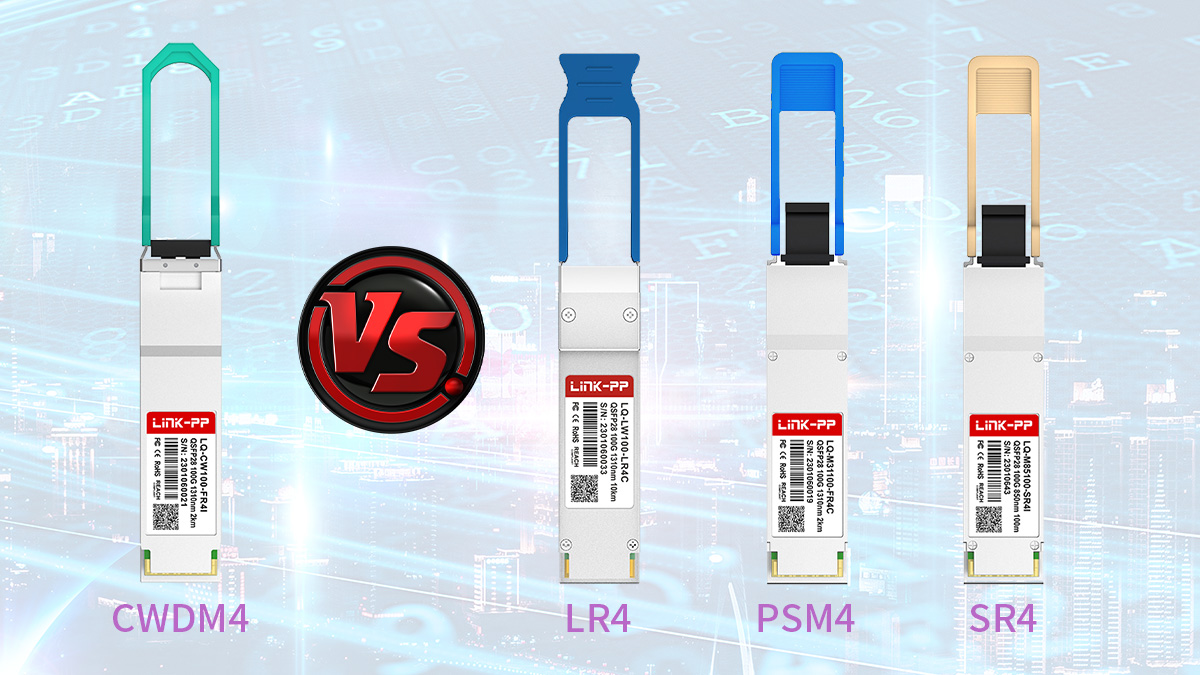
Below is a practical comparison of CWDM4 with the most commonly deployed 100G optical modules.
100G CWDM4 vs 100G LR4
CWDM4 is more cost-efficient for links under 2km, while LR4 is required for distances up to 10km. Both use duplex LC single-mode fiber, making them physically compatible with similar cabling infrastructure.
| Factor |
100G CWDM4 |
100G LR4 |
| Max reach |
2km |
10km |
| Fiber type |
Duplex SMF |
Duplex SMF |
| Typical cost |
Lower |
Higher |
| Use case |
Campus/DCI |
Metro links |
When to choose CWDM4 instead of LR4:
When LR4 is necessary:
For most campus and intra-data-center interconnects, CWDM4 delivers sufficient reach without the higher cost of LR4 optics.
100G CWDM4 vs 100G SR4
CWDM4 supports much longer distances over single-mode fiber, while SR4 transceiver is optimized for short-reach multimode connections inside a single data hall.
| Factor |
100G CWDM4 |
100G SR4 |
| Fiber type |
SMF + LC |
MMF + MPO |
| Max reach |
2km |
70–100m |
| Cabling |
Duplex |
Parallel MPO |
| Typical use |
Campus/DCI |
Rack-level |
Choose SR4 when:
-
Distance <100m
-
Multimode fiber already installed
-
Lowest cost per link needed
-
High port density inside a hall
Choose CWDM4 when:
-
Distance exceeds SR4 limits
-
Single-mode fiber available
-
Simplified LC cabling preferred
-
Cross-building or cross-hall links
SR4 is ideal for short intra-row connections, while CWDM4 is better suited for longer structured cabling runs.
100G CWDM4 vs 100G PSM4
CWDM4 uses duplex SMF with wavelength multiplexing, while PSM4 uses parallel single-mode fiber with MPO connector. Both support similar reach, but infrastructure requirements differ significantly.
| Factor |
100G CWDM4 |
100G PSM4 |
| Fiber count |
2 fibers |
8 fibers |
| Connector |
LC |
MPO |
| Max reach |
2km |
500m |
| Cabling complexity |
Low |
Higher |
Choose CWDM4 when:
-
Duplex SMF available
-
Fiber count must be minimized
-
Distance up to 2km required
-
Simpler patching preferred
Choose PSM4 when:
-
MPO SMF infrastructure already deployed
-
Shorter distances (<500m)
-
Parallel fiber architecture in place
In most enterprise environments, CWDM4 is easier to deploy because duplex LC cabling is more common than parallel SMF.
Quick Selection Guide
The right 100G optic depends primarily on distance and fiber type. CWDM4 is the default choice when duplex single-mode fiber is available and link distances fall within 2km.
| Scenario |
Recommended optic |
Reason |
| Rack-level links |
SR4 |
Short MMF runs |
| Parallel SMF links |
PSM4 |
MPO infrastructure |
| Campus ≤2km |
CWDM4 |
Cost + reach balance |
| Metro ≤10km |
LR4 |
Longer reach |
This positioning explains why 100G QSFP28 CWDM4 has become one of the most widely deployed 100G modules in enterprise and cloud networks.
📝 Key Advantages of 100G QSFP28 CWDM4
100G QSFP28 CWDM4 provides the most balanced combination of reach, cost, and cabling simplicity for 100Gbps links up to 2km over duplex single-mode fiber. For many enterprise, campus, and data center networks, it delivers enough distance to connect buildings and network layers without the higher cost or complexity of long-reach optics. This positioning has made CWDM4 one of the most widely adopted 100G transceiver in real-world deployments.
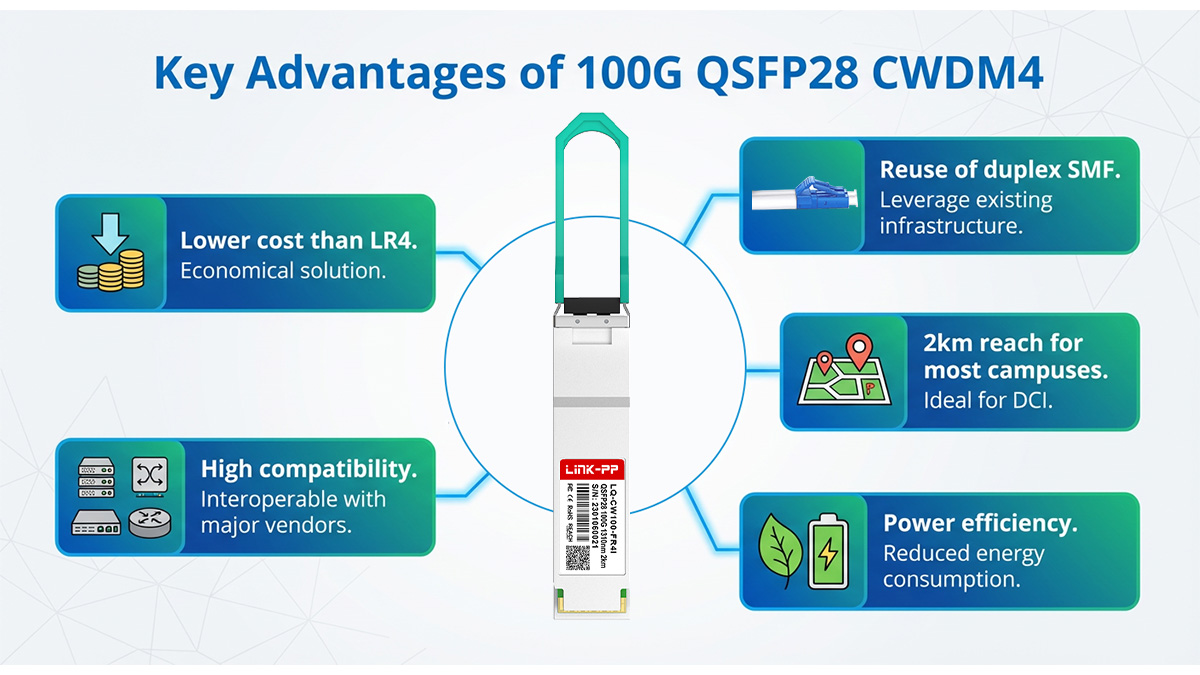
Balanced Cost-to-Distance Efficiency
CWDM4 is significantly more cost-efficient than LR4 for sub-2km links while offering far greater reach than SR4. This makes it the default choice for networks that need more than short-reach multimode but less than metro-scale optics.
| Optic type |
Typical reach |
Relative cost efficiency |
Best use range |
| 100G SR4 |
≤100m |
Highest for short links |
Rack/row |
| 100G CWDM4 |
≤2km |
Strong balance |
Campus/DCI |
| 100G LR4 |
≤10km |
Lower for short links |
Metro |
Because most enterprise and campus links fall within the 500m–2km range, CWDM4 often provides the optimal price-to-performance ratio.
Duplex Single-Mode Fiber Simplicity
CWDM4 uses standard duplex LC single-mode fiber, allowing easy reuse of existing structured cabling infrastructure. This is a major operational advantage compared with parallel MPO-based optics.
Key cabling benefits:
For organizations already running OS2 fiber between buildings or network zones, upgrading to 100G with CWDM4 typically requires minimal cabling changes.
Suitable for Most Campus and Data Center Distances
CWDM4 is optimized for the most common 100G deployment distances: hundreds of meters to around 2km. This range covers the majority of real-world enterprise and cloud interconnect scenarios.
Typical environments where CWDM4 excels:
-
Building-to-building links
-
Cross-hall data center connections
-
Spine-leaf uplinks beyond multimode limits
-
Core network aggregation
-
Edge data center connectivity
By matching these distance requirements, CWDM4 avoids overpaying for unnecessary reach.
Lower Power and Thermal Impact vs Long-Reach Optics
Compared with longer-reach 100G modules, CWDM4 generally consumes less power and generates less heat than LR4 optics. This is important in high-density switch environments where thermal and power budgets matter.
Operational advantages:
-
Improved switch port density
-
Reduced cooling requirements
-
Better energy efficiency
-
Predictable thermal performance
These factors make CWDM4 practical for large-scale deployments in enterprise and hyperscale environments.
High Compatibility and Broad Ecosystem Support
100G QSFP28 CWDM4 is widely supported across major switch and router platforms, making interoperability straightforward. It has become a standardized option across data center and enterprise ecosystems.
Compatibility strengths:
-
Works across most QSFP28 switches
-
Supported by major vendors
-
Available from multiple optical suppliers
-
Easy integration into mixed environments
Because of this broad support, CWDM4 modules are commonly used in both original-vendor and third-party optical strategies.
Scalability and Migration Readiness
CWDM4 supports gradual network upgrades by enabling 100G backbone links without requiring major infrastructure redesign. It fits well into long-term migration paths toward higher-speed architectures.
Scalability benefits:
-
Enables 40G → 100G upgrades
-
Supports campus backbone expansion
-
Integrates with future 400G aggregation
-
Reuses single-mode infrastructure
This makes CWDM4 a practical stepping stone for networks planning long-term bandwidth growth.
📝 Limitations and Considerations of 100G CWDM4 Links
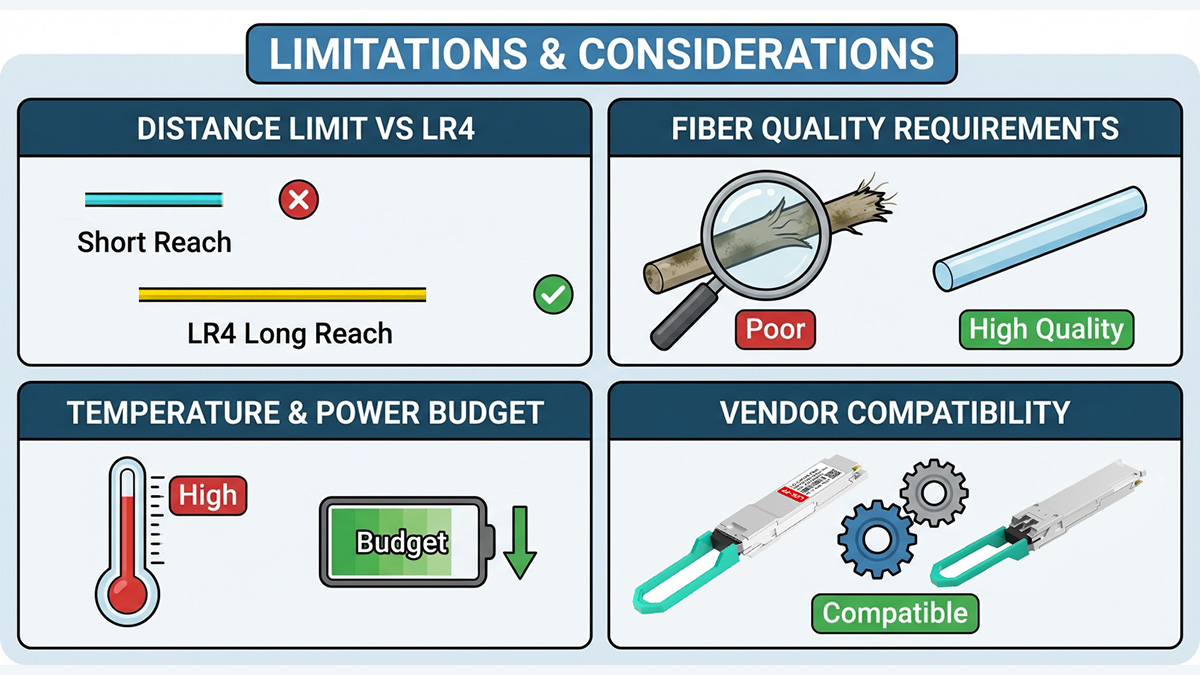
100G QSFP28 CWDM4 is ideal for duplex single-mode links up to 2km, but it has distance, loss, and infrastructure limits that must be considered during network design. While it offers a strong balance of cost and reach, it is not the right choice for every 100G scenario. Understanding these constraints helps avoid deployment issues and ensures stable long-term operation.
Distance Limit Compared with LR4
CWDM4 is limited to approximately 2km, making it unsuitable for longer metro or regional links where LR4 or coherent optics are required. If link distance approaches or exceeds this range, signal margin can become insufficient.
When CWDM4 may not be suitable
-
Links beyond 2km
-
Metro transport networks
-
High-loss fiber routes
-
Multi-patch long paths
In these cases, LR4 or transport-layer optics provide better reliability.
Sensitivity to Link Loss and Patch Complexity
CWDM4 performance depends heavily on total link loss, including fiber attenuation, connectors, and patch panels. Excessive insertion loss can reduce achievable distance even if the physical span is under 2km.
Common loss contributors:
| Factor |
Impact on CWDM4 |
Planning approach |
| High connector count |
Reduces margin |
Minimize patching |
| Low-quality fiber |
Higher attenuation |
Test before deploy |
| Splices |
Adds loss |
Document routes |
| Long patch paths |
Limits reach |
Optimize routing |
Most deployments aim to stay comfortably within the module’s optical budget rather than pushing to the theoretical maximum distance.
Not Ideal for Very Short Links
For very short distances inside a single rack row or hall, CWDM4 may be unnecessary and less cost-efficient than SR4 or AOC options. Using CWDM4 in these cases can increase cost without providing meaningful benefits.
When alternatives are better:
-
Distance <100m → SR4 or DAC
-
Multimode fiber already installed
-
High-density rack-level links
-
Short intra-row connections
Selecting optics based on actual distance prevents overspending and simplifies inventory planning.
Parallel Fiber Environments May Prefer PSM4
In data centers that already use MPO-based parallel single-mode fiber, QSFP28 PSM4 can be simpler to integrate than CWDM4. CWDM4 is optimized for duplex SMF environments, not parallel fiber architectures.
| Infrastructure type |
Better choice |
Reason |
| Duplex SMF |
CWDM4 |
Uses LC fiber |
| Parallel SMF (MPO) |
PSM4 |
Matches cabling |
| MMF |
SR4 |
Short reach |
Choosing optics that match existing cabling reduces conversion complexity and patching overhead.
Compatibility and Vendor Coding
Although widely supported, CWDM4 modules must be compatible with the target switch platform and firmware. Some network equipment may require specific coding or vendor-approved optics.
Compatibility checks:
Ensuring compatibility before deployment avoids link bring-up issues and operational delays.
Power and Thermal Considerations
CWDM4 generally consumes less power than LR4, but still requires proper thermal planning in high-density switch environments. Dense 100G deployments can impact cooling and power budgets.
Operational considerations:
While not excessive, CWDM4 power consumption should still be included in capacity planning.
📝 How to Choose the Right 100G QSFP28 CWDM4 Module
The right 100G QSFP28 CWDM4 module should match your link distance, fiber infrastructure, switch compatibility, and long-term scalability requirements. Although most CWDM4 optics share the same core specifications, selecting the correct module for a specific deployment ensures stable performance, predictable link margins, and cost efficiency.
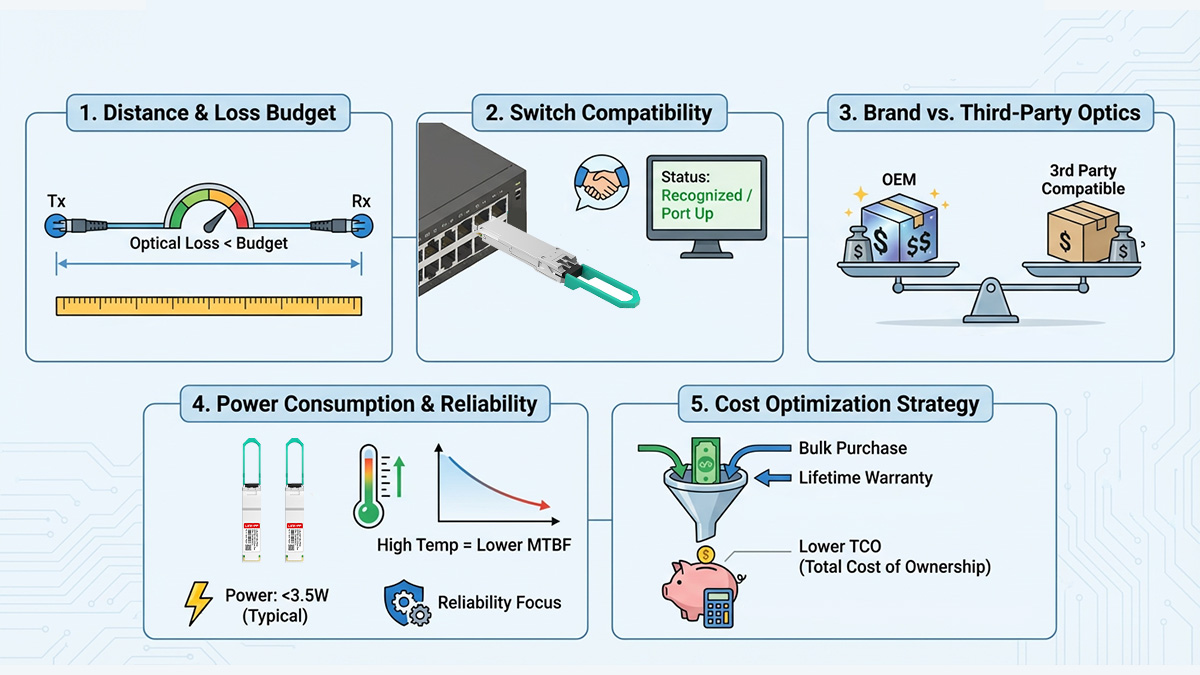
Below is a structured decision framework used in real 100G network planning.
Step 1: Confirm Distance and Link Budget
CWDM4 should be selected when the total fiber distance and link loss fall within the supported 2km range and optical budget. Distance alone is not enough—connector count and patching must also be considered.
| Factor |
Recommended range |
Why it matters |
| Distance |
≤2km |
CWDM4 design limit |
| Connector count |
Low to moderate |
Reduces loss |
| Patch panels |
Minimized |
Preserves margin |
| Loss budget |
Within spec |
Ensures stability |
Choose CWDM4 when:
-
Link distance is 300m–2km
-
Duplex OS2 fiber is available
-
Total attenuation fits module budget
-
LR4 reach is unnecessary
If distance approaches or exceeds 2km, LR4 should be evaluated instead.
Step 2: Verify Fiber Infrastructure
CWDM4 is optimized for duplex single-mode fiber with LC connectors, so infrastructure compatibility must be confirmed before selection.
Checklist:
| Infrastructure scenario |
Best choice |
| Duplex SMF campus links |
CWDM4 |
| Parallel SMF (MPO) |
PSM4 |
| Multimode only |
SR4 |
| 2km SMF | LR4 | |
Selecting a module aligned with the existing cabling environment avoids unnecessary conversion or re-cabling.
Step 3: Check Switch and Platform Compatibility
Ensure the CWDM4 module is fully compatible with the target switch or router platform, including firmware and vendor coding. Even standardized QSFP28 optics may require specific EEPROM coding for optimal operation.
Key checks:
| Compatibility factor |
Why it matters |
| Vendor coding |
Prevents link issues |
| Firmware support |
Ensures stability |
| DOM support |
Enables monitoring |
| Thermal spec |
Fits environment |
Verifying compatibility early prevents deployment delays and troubleshooting later.
Step 4: Evaluate Power and Thermal Requirements
In high-density 100G environments, module power consumption and thermal output can affect switch performance. CWDM4 typically consumes less power than LR4 but still requires planning.
Considerations:
-
Switch power budget
-
Port density
-
Rack airflow
-
Ambient temperature
If deploying many 100G ports in a single chassis, ensure the switch can support the combined thermal load.
Step 5: Assess Cost Strategy and Vendor Options
CWDM4 modules are available from original equipment vendors and third-party suppliers, with significant price differences. Choosing the right sourcing strategy can impact total network cost.
| Option |
Typical use |
Consideration |
| OEM optics |
Strict vendor environments |
Higher cost |
| Third-party optics |
Cost optimization |
Must ensure compatibility |
| Mixed deployment |
Large networks |
Balance cost and support |
Key evaluation points:
For large-scale deployments, validated third-party CWDM4 modules can significantly reduce capital expenditure while maintaining performance.
Step 6: Plan for Future Scalability
Choosing CWDM4 should align with long-term network upgrade plans, including migration toward higher-speed backbone links. While CWDM4 serves current 100G needs, it should fit into a broader architecture roadmap.
Future planning considerations:
Selecting modules that match long-term cabling strategies helps avoid costly redesigns later.
📝 Practical Solution Design Examples of QSFP28 CWDM4
The most effective 100G QSFP28 CWDM4 deployments are built around structured duplex single-mode fiber, predictable link loss, and scalable network architecture. The following solution designs illustrate how CWDM4 is used in real enterprise and data center environments, with clear planning logic for distance, redundancy, and future growth.
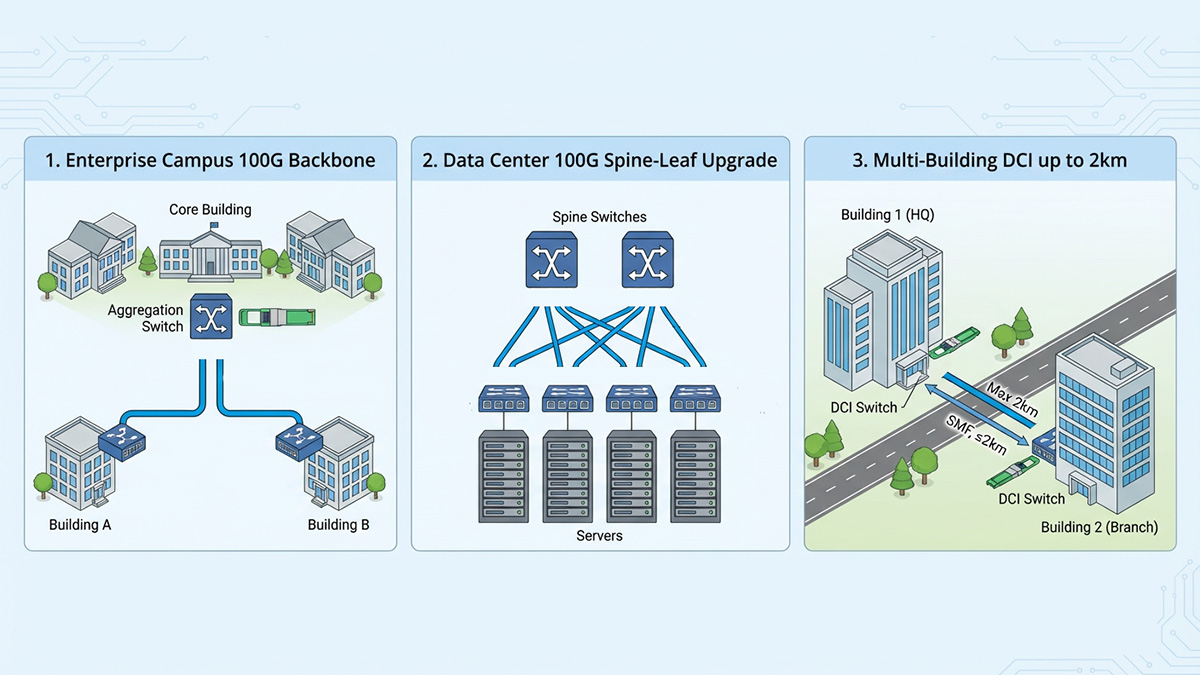
Enterprise Campus 100G Backbone
CWDM4 is widely used for enterprise campus backbones where multiple buildings must be connected with reliable 100Gbps links over existing OS2 fiber. It allows organizations to upgrade from 10G or 40G without redesigning the fiber plant.
Architecture diagram explanation
In a typical campus backbone:
-
Core switches are located in a central data center
-
Distribution switches are placed in separate buildings
-
Duplex OS2 fiber connects all buildings
-
100G CWDM4 modules provide backbone uplinks
CWDM4 enables a simple point-to-point architecture using LC fiber pairs while maintaining sufficient reach for most campus layouts under 2km.
Recommended modules and cabling
CWDM4 modules with OS2 duplex LC cabling provide the most straightforward campus backbone upgrade path.
| Component |
Recommendation |
Reason |
| Optic module |
100G QSFP28 CWDM4 |
Up to 2km reach |
| Fiber |
OS2 SMF |
Campus standard |
| Connector |
LC duplex |
Easy patching |
| Topology |
Core–distribution |
Scalable design |
Using structured fiber routes and minimizing patch panels helps maintain a stable link budget across campus buildings.
Scalability planning
To support future growth:
-
Deploy redundant fiber paths
-
Leave spare fiber pairs for expansion
-
Standardize on QSFP28 ports
-
Plan aggregation toward 400G core
This ensures the campus backbone can scale without major infrastructure changes.
Data Center 100G Spine-Leaf Upgrade
CWDM4 is commonly used when upgrading from 40G to 100G in spine-leaf data center architectures that already use single-mode structured cabling.
Migrating from 40G
Typical migration path:
-
Replace 40G QSFP+ uplinks with 100G QSFP28 ports
-
Maintain existing OS2 fiber plant
-
Deploy CWDM4 for leaf-to-spine links
-
Gradually phase out 40G aggregation
This approach allows incremental upgrades without disrupting existing cabling.
Port density planning
Switch port density and thermal capacity must be evaluated when deploying multiple 100G CWDM4 links.
| Planning factor |
Recommendation |
Impact |
| Switch ports |
QSFP28-ready |
Supports 100G |
| Cooling |
Adequate airflow |
Prevent overheating |
| Power budget |
Validate per chassis |
High-density links |
| Cable management |
Structured LC |
Simplifies operations |
CWDM4 supports high-density 100G ports while avoiding MPO cable congestion.
Cost-efficient deployment
To optimize cost:
-
Use CWDM4 only where distance requires
-
Retain SR4 for very short links
-
Standardize module types per layer
-
Validate third-party compatibility
This hybrid approach balances performance and budget across the data center fabric.
Multi-Building DCI up to 2km
CWDM4 is one of the most practical solutions for multi-building data center interconnects within a 2km radius. It supports high-capacity links without requiring DWDM transport systems.
Fiber routing
Effective routing design includes:
| Routing factor |
Best practice |
Result |
| Fiber type |
OS2 SMF |
Full reach support |
| Connector count |
Minimized |
Lower loss |
| Distance |
≤2km |
Within CWDM4 range |
| Testing |
OTDR + power test |
Reliable links |
Proper routing ensures the CWDM4 link remains within its optical budget.
Redundancy design
Redundant CWDM4 links improve availability for critical DCI connections.
Recommended approach:
This design maintains service continuity even if one path fails.
Future-proofing
To prepare for future bandwidth growth:
-
Install additional fiber pairs
-
Use modular patch panels
-
Reserve rack space for higher-speed optics
-
Plan aggregation toward 400G
These steps allow the DCI architecture to scale without re-cabling.
📝 FAQs About 100G QSFP28 CWDM4
Is 100G QSFP28 CWDM4 suitable for single-mode fiber?
Yes. 100G QSFP28 CWDM4 is designed specifically for single-mode fiber (OS2) and typically supports links up to2km over duplex LC connections.
Can CWDM4 replace 100G LR4 modules?
Often yes for short-to-medium distances. CWDM4 is a cost-efficient alternative to LR4 for links within2km, but LR4 remains preferable for distances up to10km.
Does CWDM4 require MPO/MTP cabling?
No. Unlike SR4 or PSM4, CWDM4 uses duplex LC connectors, making it easier to deploy over existing duplex single-mode fiber infrastructure.
Is 100G CWDM4 compatible with most switches?
Generally yes. Most mainstream switches supporting QSFP28 100G ports can use CWDM4 modules, but vendor compatibility coding or qualification may be required.
Can CWDM4 interoperate with LR4 optics?
In most cases, yes. CWDM4 and LR4 both operate over duplex SMF with similar wavelengths, so interoperability is commonly supported if transmit power and receiver sensitivity ranges overlap.
What is the typical power consumption of CWDM4 modules?
Around3.5W. CWDM4 modules usually consume less power than LR4, making them suitable for high-density deployments.
When should I choose PSM4 instead of CWDM4?
Choose PSM4 when MPO fiber infrastructure already exists or for parallel fiber breakout scenarios. Choose CWDM4 when using duplex LC single-mode fiber and distances up to2km.
Is CWDM4 future-proof for 400G upgrades?
Partially. CWDM4 aligns well with duplex SMF architectures used in many 400G DR4/FR4 upgrade paths, but planning fiber counts and switch port strategy remains essential.
📝 Conclusion
100G QSFP28 CWDM4 is the most practical and cost-efficient 100G optical module for duplex single-mode links up to2km, making it a standard choice for data center interconnects, campus backbones, and short-reach metro deployments where LC fiber infrastructure already exists.
By balancing reach, cost, power consumption, and deployment simplicity, CWDM4 optics fill the gap between short-reach multimode solutions and longer-distance LR4 modules. When planned correctly—matching fiber type, switch compatibility, and future upgrade paths—100G QSFP28 CWDM4 enables scalable 100G networks without requiring complex MPO cabling or expensive long-haul optics.
For organizations planning new 100G deployments or upgrading from40G to100G, selecting a reliable, fully compatible CWDM4 module supplier is critical to ensuring long-term network stability and cost control. Explore verified and interoperability-tested 100G QSFP28 CWDM4 solutions at the LINK-PP Official Store to support your next-generation 100G infrastructure with confidence.