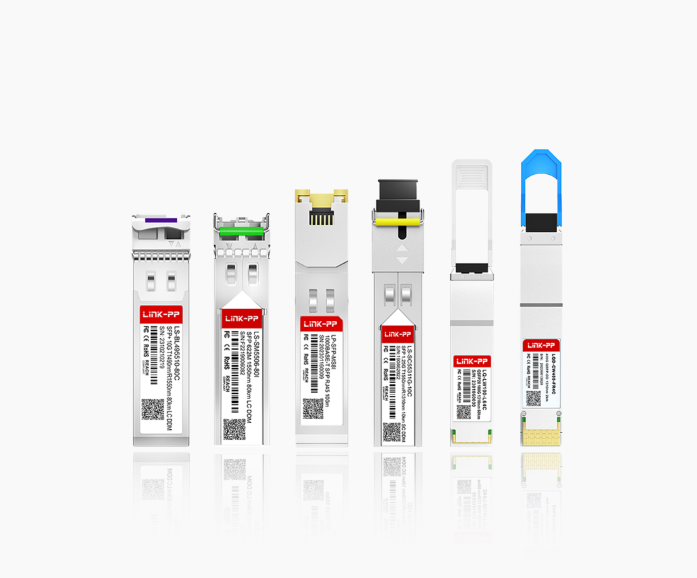


























📜 What Is 100G SWDM4?
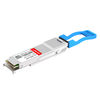
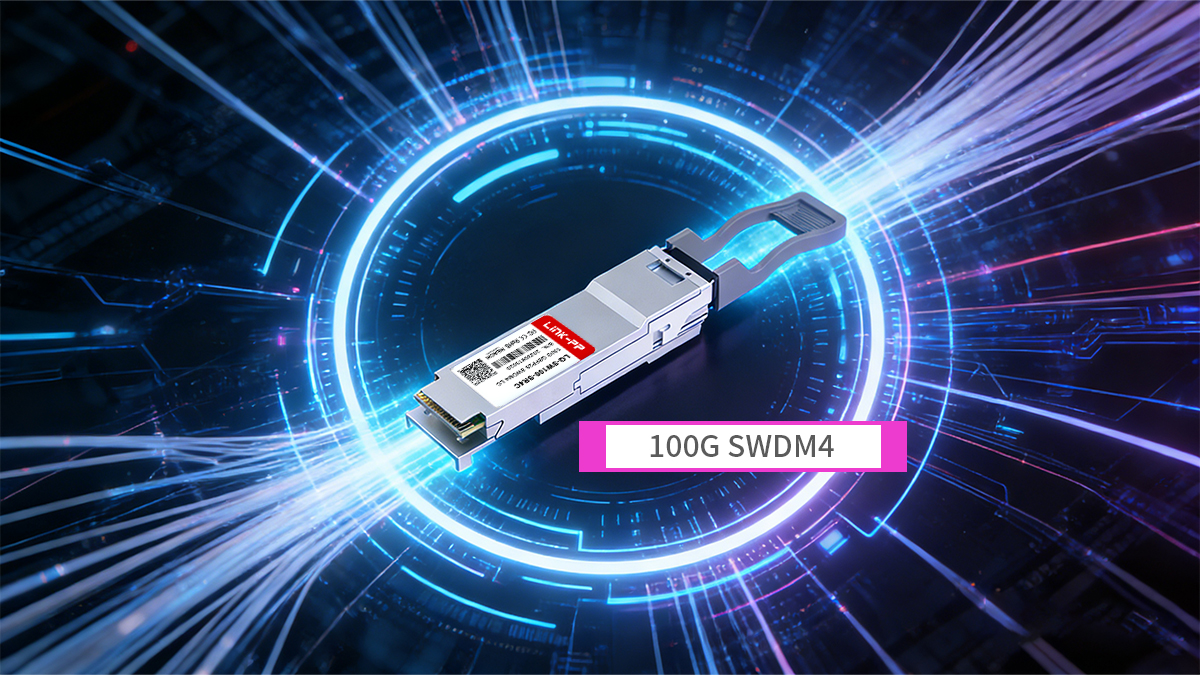
100G SWDM4 is a short-reach 100GbE optical transceiver that delivers 100Gbps over duplex multimode fiber by multiplexing four shortwave wavelengths onto a single LC fiber pair. It is typically implemented in QSFP28 form factor and is designed for data center and enterprise environments that want to upgrade to 100G without deploying MPO parallel fiber.
Core Definition and Positioning
100G SWDM4 (Shortwave Wavelength Division Multiplexing 4) uses four optical lanes in the 850–940nm range and combines them internally so that transmission occurs over standard duplex multimode fiber (MMF). Unlike 100G SR4, which requires 8 parallel fibers via MPO connector, SWDM4 allows 100GbE links to run over the same two-fiber LC infrastructure commonly used for 10G and 25G links.
This makes SWDM4 particularly relevant for:
-
Data center upgrades from 10G/40G to 100G
-
Environments with existing OM3/OM4 duplex MMF
-
High-density switch deployments using LC patching
Key Characteristics
100G SWDM4 enables 100GbE over duplex MMF with wavelength multiplexing rather than parallel fiber lanes.
| Parameter | 100G SWDM4 | Typical Implementation |
|---|---|---|
| Form factor | QSFP28 | 100GbE switches/routers |
| Fiber type | Duplex MMF (OM3/OM4/OM5) | LC patching |
| Wavelengths | 4 shortwave lanes | 850–940nm range |
| Connector | LC duplex | Standard MMF cabling |
SWDM4 modules integrate internal multiplexers and demultiplexers to combine and separate the four optical channels, allowing a single fiber pair to carry the full 100Gbps data stream.
Why It Exists
The primary purpose of 100G SWDM4 is to enable 100GbE migration while preserving duplex multimode fiber infrastructure. Many facilities already have extensive LC-based MMF cabling from 10G and 40G deployments. Replacing this with MPO trunks can increase cost and installation complexity. SWDM4 provides a way to achieve 100GbE speeds while maintaining existing cabling layouts.
In practice, SWDM4 sits between parallel multimode optics and single-mode 100G optics:
-
Compared to SR4: reduces fiber count and simplifies cabling
-
Compared to CWDM4/PSM4: optimized for short-reach multimode environments
-
Compared to SR (25G/10G): supports higher aggregate bandwidth
Understanding this positioning helps determine when SWDM4 is the most efficient option for short-reach 100G connectivity.
📜 How 100G SWDM4 Technology Works
100G SWDM4 works by multiplexing four shortwave optical wavelengths onto a single pair of multimode fiber, allowing 100Gbps transmission over a duplex LC link instead of parallel MPO fibers. This approach combines wavelength division multiplexing with multimode optics to reduce fiber count while maintaining short-reach performance.
Wavelength Multiplexing Mechanism
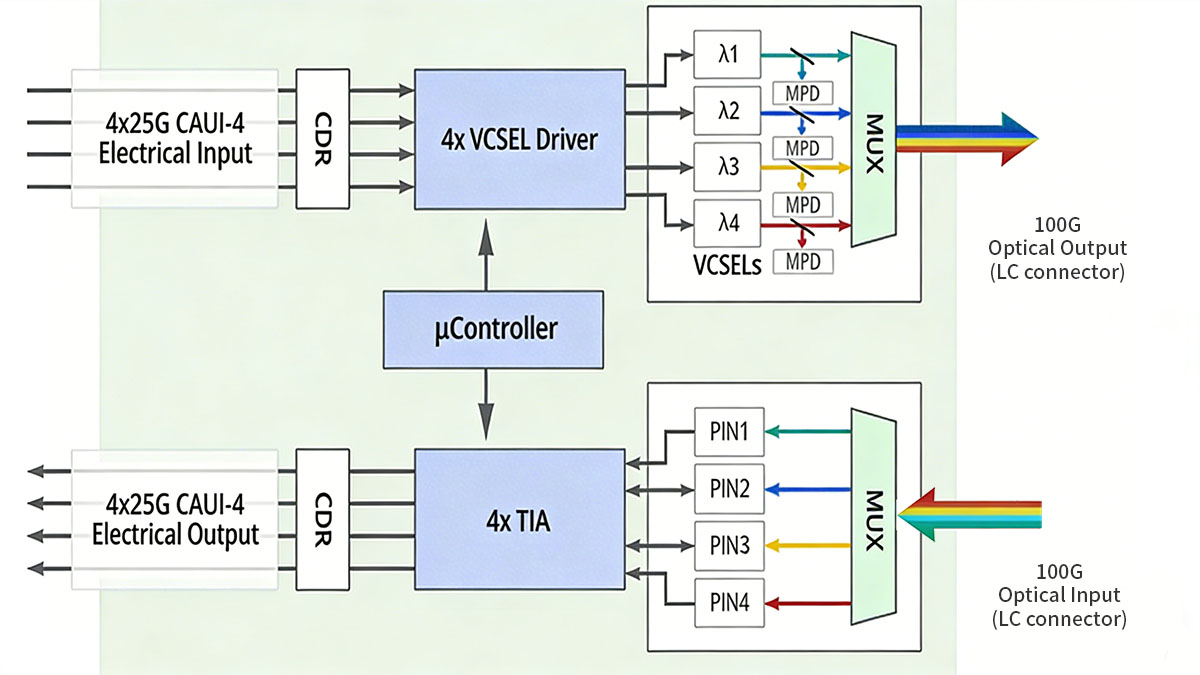
SWDM4 transmits four optical lanes over different wavelengths in the 850–940nm range and combines them into one duplex MMF link. Each wavelength carries a portion of the total data rate, and an internal multiplexer merges them before transmission.
| Optical Lane | Approx. Wavelength | Function |
|---|---|---|
| Lane 1 | ~850nm | Data channel |
| Lane 2 | ~880nm | Data channel |
| Lane 3 | ~910nm | Data channel |
| Lane 4 | ~940nm | Data channel |
At the receiver side, a demultiplexer separates these wavelengths and converts them back into electrical signals, reconstructing the full 100Gbps data stream.
Because all four lanes share the same fiber pair, SWDM4 can operate over standard duplex multimode cabling instead of requiring multiple parallel fibers.
Duplex Multimode Fiber Operation
Unlike SR4 transceiver, which uses multiple fibers in parallel, SWDM4 uses only two fibers—one for transmit and one for receive.
| Aspect | SWDM4 | SR4 |
|---|---|---|
| Fiber count | 2 fibers | 8 fibers |
| Connector type | LC duplex | MPO |
| Transmission method | WDM over MMF | Parallel optics |
This reduction in fiber count simplifies patch panel design and allows reuse of existing LC-based cabling infrastructure.
Internal Optical Architecture
SWDM4 modules integrate several key optical components to enable wavelength multiplexing over multimode fiber:
-
Laser array generating four shortwave wavelengths
-
Optical multiplexer combining transmit channels
-
Optical demultiplexer separating receive channels
-
Photodiode for signal conversion
-
DSP for signal alignment and error correction
These components are packaged within a QSFP28 module, enabling plug-and-play deployment in standard 100GbE ports.
Distance and Fiber Considerations
SWDM4 relies on multimode fiber bandwidth and wavelength characteristics, so achievable distance depends on fiber type.
| Fiber type | Typical reach |
|---|---|
| OM3 | ~75m |
| OM4 | ~100m |
| OM5 | ~150m |
OM5 fiber is optimized for wideband multimode operation and can extend SWDM4 reach beyond traditional OM3/OM4 limits.
Why This Architecture Matters
By combining WDM with multimode fiber, SWDM4 provides a middle path between parallel multimode optics and single-mode 100G solutions. It reduces fiber requirements while preserving compatibility with existing duplex MMF infrastructure, making it particularly useful for short-reach 100GbE upgrades in data centers and enterprise networks.
📜 Key Specifications of 100G SWDM4 Transceivers
100G SWDM4 are QSFP28 transceiver that deliver 100Gbps over duplex multimode fiber using four shortwave wavelengths, typically reaching up to 150m depending on fiber type. Their specifications are optimized for short-reach data center links that want to reuse LC-based multimode cabling.
Core Optical and Electrical Parameters
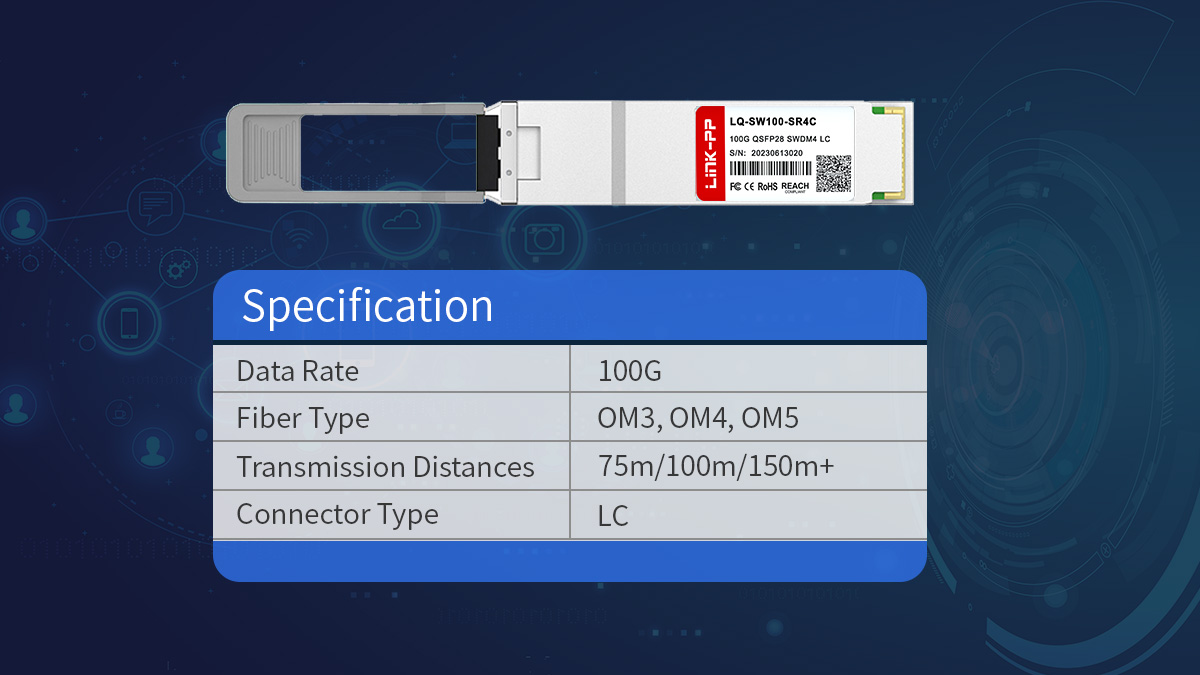
The defining characteristics of 100G SWDM4 include four multiplexed wavelengths, duplex MMF operation, and QSFP28 electrical interfaces.
| Parameter | Typical Value | Notes |
|---|---|---|
| Form factor | QSFP28 | 100GbE interface |
| Aggregate data rate | 100Gbps | 4×25Gbps lanes |
| Wavelength range | 850–940nm | SWDM spectrum |
| Connector | LC duplex | MMF patching |
| Fiber type | OM3/OM4/OM5 | Multimode only |
These parameters allow SWDM4 to integrate directly into standard 100GbE switch ports while maintaining compatibility with common multimode fiber infrastructure.
Transmission Distance by Fiber Type
Reach varies based on multimode fiber grade, with OM5 providing the longest supported distance.
| Fiber type | Maximum reach | Typical environment |
|---|---|---|
| OM3 | ~75m | Legacy MMF |
| OM4 | ~100m | Most data centers |
| OM5 | ~150m | Wideband MMF |
Distance can vary slightly by vendor implementation and link conditions, but these ranges represent typical deployment planning values.
Power, Temperature, and Compliance
SWDM4 modules generally consume more power than SR4 but remain within standard QSFP28 thermal budgets.
| Specification | Typical Range |
|---|---|
| Power consumption | 3.5–5W |
| Operating temp | 0–70°C (commercial) |
| Standards | MSA-compliant |
| Diagnostics | DDM/DOM supported |
Most SWDM4 transceivers support digital diagnostics monitoring (DDM), enabling real-time visibility into temperature, voltage, optical power, and laser bias current.
Compatibility and Interface Considerations
100G SWDM4 uses standard QSFP28 electrical interfaces and is compatible with most 100GbE switch platforms that support SWDM4 optics.
Key compatibility points:
-
Requires switch support for SWDM4 optics
-
Works with duplex LC multimode patching
-
Does not require MPO infrastructure
-
Interoperates with other SWDM4 modules (same type)
Because SWDM4 is defined by a multi-source agreement rather than a single IEEE standard, vendor compatibility testing is recommended for large-scale deployments.
📜 100G SWDM4 vs Other 100G Optical Modules
100G SWDM4 is best suited for short-reach 100GbE over existing duplex multimode fiber, while SR4, CWDM4, and PSM4 target different fiber types, distances, and upgrade strategies. Choosing between them depends primarily on fiber infrastructure, required reach, and cabling architecture.
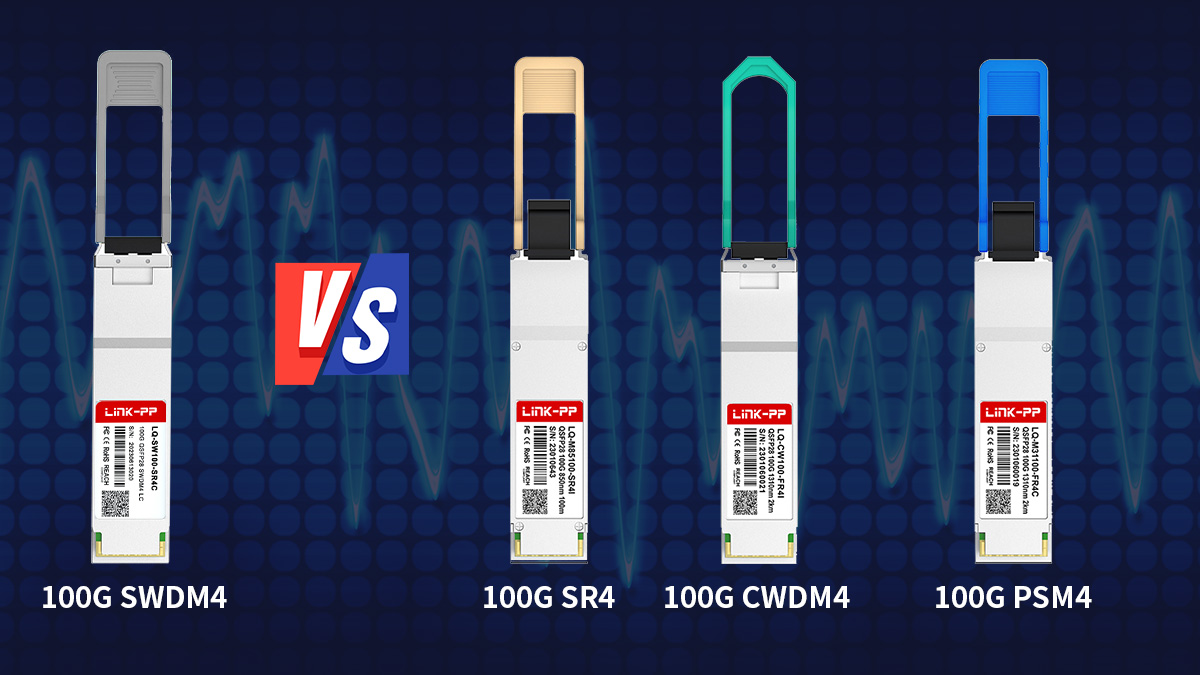
SWDM4 vs 100G SR4
SWDM4 reduces fiber count and enables 100G over LC duplex MMF, whereas SR4 requires MPO parallel fiber but typically has lower module cost.
| Parameter | 100G SWDM4 | 100G SR4 |
|---|---|---|
| Fiber type | Duplex MMF | Parallel MMF |
| Connector | LC | MPO |
| Fiber count | 2 fibers | 8 fibers |
| Typical reach (OM4) | ~100m | ~100m |
SWDM4 is often selected when existing LC multimode cabling must be reused. SR4 is more common in new builds where MPO trunks are already deployed and cost per module is a primary concern.
SWDM4 vs 100G CWDM4
SWDM4 is optimized for short-reach multimode environments, while CWDM4 targets longer distances over single-mode fiber.
| Parameter | 100G SWDM4 | 100G CWDM4 |
|---|---|---|
| Fiber type | Multimode | Single-mode |
| Connector | LC duplex | LC duplex |
| Typical reach | 75–150m | ~2km |
| Use case | In-rack / row | Building / campus |
CWDM4 is chosen when distance exceeds multimode limits or when single-mode fiber is already deployed. SWDM4 remains more practical for short data center links that rely on multimode infrastructure.
SWDM4 vs 100G PSM4
SWDM4 uses wavelength multiplexing over duplex MMF, while PSM4 uses parallel single-mode fibers for short-to-medium reach links.
| Parameter | 100G SWDM4 | 100G PSM4 |
|---|---|---|
| Fiber type | Duplex MMF | Parallel SMF |
| Connector | LC | MPO |
| Typical reach | ≤150m | ~500m |
| Deployment focus | MMF reuse | SMF short reach |
PSM4 is often used when single-mode fiber is available and distances exceed multimode limits but do not justify CWDM4. SWDM4 is typically preferred when maintaining existing multimode cabling is the priority.
Decision Guidance: When to Choose Each
Module selection should align with fiber infrastructure first, then distance and cabling strategy.
Choose 100G SWDM4 when:
-
Existing duplex OM3/OM4/OM5 fiber must be reused
-
MPO deployment is not desirable
-
Distances are within 150m
-
High-density LC patching is preferred
Choose 100G SR4 when:
-
MPO infrastructure already exists
-
Cost per module must be minimized
-
Parallel MMF cabling is acceptable
Choose 100G CWDM4 when:
-
Distance exceeds multimode limits
-
Single-mode fiber is available
-
Inter-building or campus links are required
Choose 100G PSM4 when:
-
Short-to-medium reach over single-mode fiber is needed
-
Parallel SMF infrastructure is acceptable
In short, 100G SWDM4 fills the niche for short-reach 100GbE upgrades over duplex multimode fiber, bridging the gap between SR4 parallel MMF and single-mode 100G optics.
📜 Advantages of 100G SWDM4
The primary advantage of 100G SWDM4 is that it enables 100GbE over existing duplex multimode fiber, reducing cabling changes while supporting high-density 100G upgrades. This makes it particularly useful in data centers and enterprise networks that already rely on LC-based MMF infrastructure.
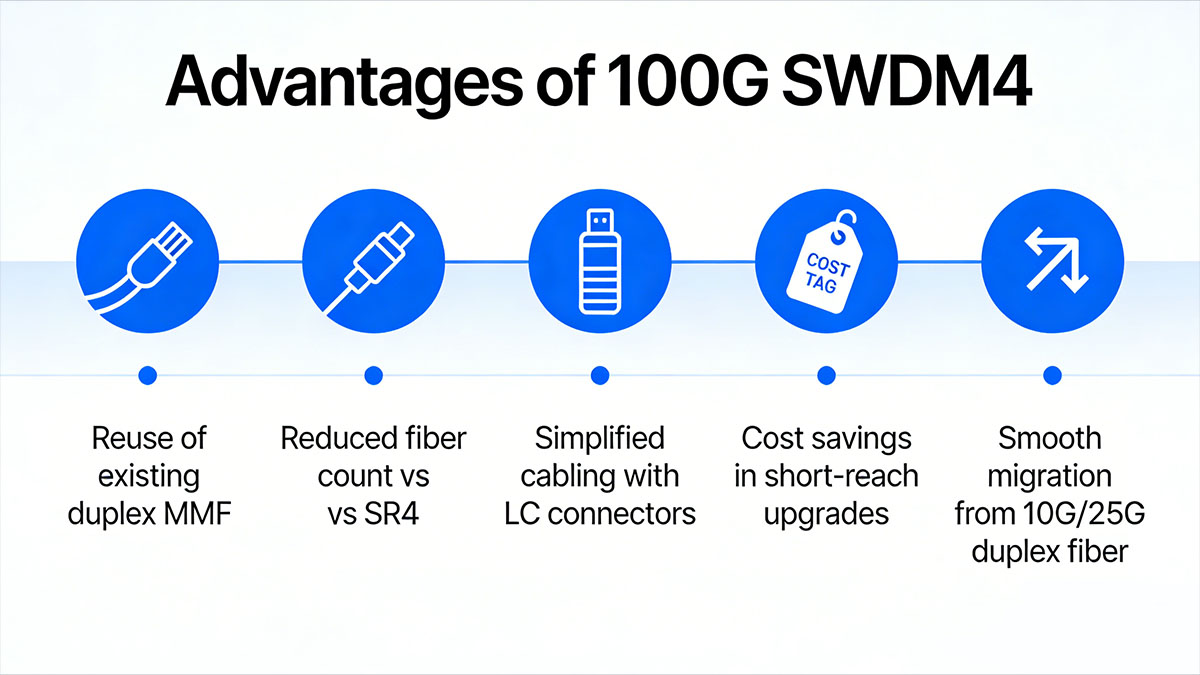
Reuse of Existing Duplex Multimode Fiber
SWDM4 allows organizations to upgrade to 100G without replacing LC duplex multimode cabling.
| Factor | SWDM4 Impact | Result |
|---|---|---|
| Existing MMF | Reusable | Lower retrofit cost |
| Connector type | LC duplex | No MPO migration |
| Cabling changes | Minimal | Faster deployment |
This capability is often the main reason SWDM4 is selected for upgrades from 10G or 40G environments where duplex MMF is already installed.
Reduced Fiber Count vs Parallel Optics
Compared with SR4, SWDM4 significantly reduces the number of fibers required for a 100G link.
| Parameter | SWDM4 | SR4 |
|---|---|---|
| Fibers per link | 2 | 8 |
| Connector | LC | MPO |
| Patch complexity | Lower | Higher |
Fewer fibers simplify patch panel management, reduce congestion in high-density racks, and make cable tracing easier during operations.
Simplified Cabling and High Port Density
Using LC connectors helps maintain familiar patching practices while enabling dense 100G switch deployments.
Benefits include:
-
Compatibility with standard LC patch panels
-
Easier cable routing in crowded racks
-
Reduced need for MPO trunk planning
-
Consistent cabling across 10G, 25G, and 100G links
This consistency helps operations teams maintain uniform cabling strategies across multiple speed generations.
Efficient Upgrade Path from 10G/40G
SWDM4 provides a migration path that aligns with existing duplex MMF used by earlier Ethernet speeds.
Typical upgrade scenarios:
-
10G LC → 100G SWDM4
-
40G LC-based links → 100G SWDM4
-
Mixed-speed data center environments
Because the same fiber type and connector format can be retained, upgrade planning becomes more straightforward compared with parallel fiber solutions.
Balanced Performance for Short-Reach Links
SWDM4 offers sufficient reach for most in-row and leaf-spine connections while maintaining manageable power and thermal requirements.
| Aspect | SWDM4 Benefit |
|---|---|
| Reach | Up to ~150m (OM5) |
| Density | High QSFP28 port density |
| Cabling | Duplex LC simplicity |
This makes SWDM4 particularly suitable for short-reach 100GbE links inside data centers where distances are typically well under 150m.
📜 Limitations and Considerations
100G SWDM4 is effective for short-reach duplex MMF upgrades, but its distance limits, module cost, and compatibility factors must be evaluated before deployment. It is not a universal replacement for all 100G optics and is best used when its infrastructure advantages outweigh its constraints.
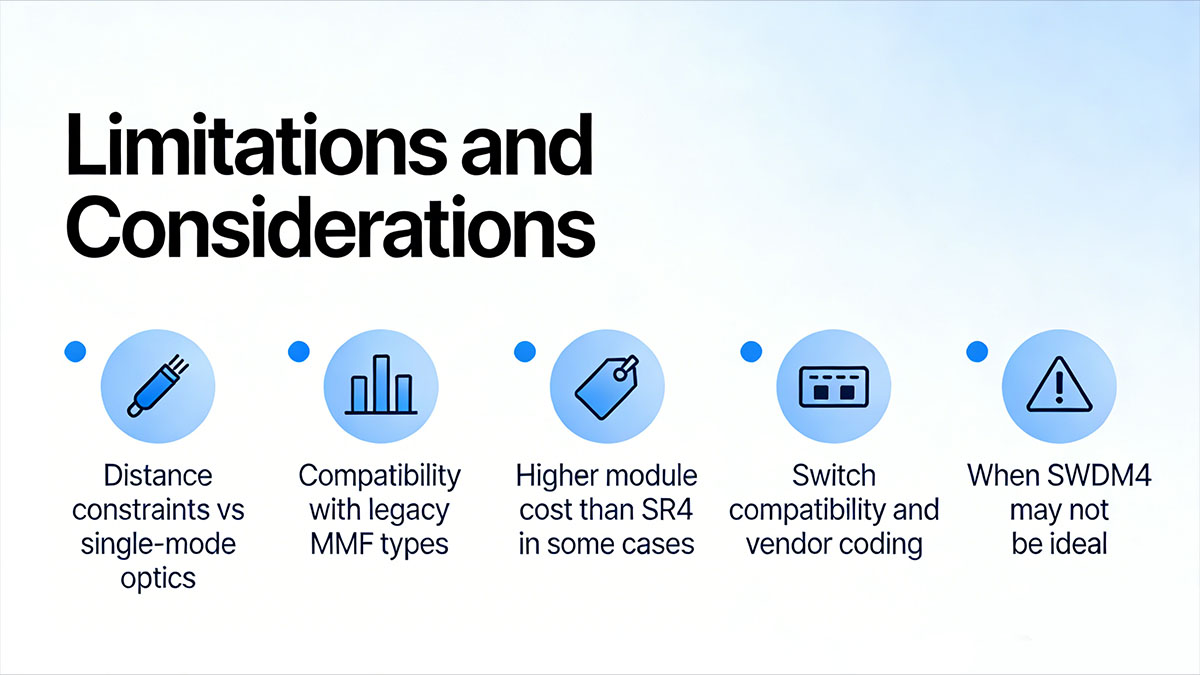
Distance Constraints vs Single-Mode Optics
SWDM4 is limited to short-reach multimode distances and cannot match the reach of single-mode 100G modules.
| Module type | Typical reach | Fiber type |
|---|---|---|
| SWDM4 | 75–150m | MMF |
| SR4 | ~100m | MMF |
| CWDM4 | ~2km | SMF |
| PSM4 | ~500m | SMF |
If link distance exceeds ~150m or involves building-to-building connectivity, CWDM4 or LR4 solutions are generally more appropriate.
Fiber Type and Quality Sensitivity
SWDM4 performance depends heavily on multimode fiber grade and link quality.
Key considerations:
-
OM3 supports shorter reach than OM4/OM5
-
Older MMF installations may have higher attenuation
-
Patch panel and connector quality affect performance
-
Link budgeting is important for longer MMF runs
Because SWDM4 uses multiple wavelengths over MMF, link margin planning is important in environments with aging fiber infrastructure.
Module Cost vs SR4
SWDM4 modules are typically more expensive than SR4 due to integrated wavelength multiplexing components.
| Cost factor | SWDM4 | SR4 |
|---|---|---|
| Optical complexity | Higher | Lower |
| Fiber savings | Yes | No |
| Module price | Higher | Lower |
While SWDM4 can reduce cabling costs, the transceiver itself may carry a higher price point. Total cost evaluation should include both optics and cabling infrastructure.
Switch Compatibility and Support
SWDM4 is defined by MSA specifications rather than a single IEEE standard, so compatibility should be verified.
Deployment checks:
-
Confirm switch support for SWDM4 optics
-
Validate firmware compatibility
-
Ensure DDM monitoring support
-
Perform interoperability testing
Most modern 100GbE switches support SWDM4, but verification is recommended for large-scale deployments or mixed-vendor environments.
Power Consumption and Thermal Budget
SWDM4 modules often consume slightly more power than SR4 due to internal multiplexing components.
| Parameter | SWDM4 | SR4 |
|---|---|---|
| Power usage | Higher | Lower |
| Thermal output | Moderate | Lower |
High-density switch environments should confirm that thermal and power budgets can support the selected modules.
📜 Typical Applications of 100G SWDM4
100G SWDM4 is primarily used for short-reach 100GbE links in environments that already have duplex multimode fiber and want to upgrade to 100G without deploying MPO cabling. Its ability to run 100Gbps over LC-based MMF makes it especially practical in data centers and enterprise networks where infrastructure reuse is a priority.
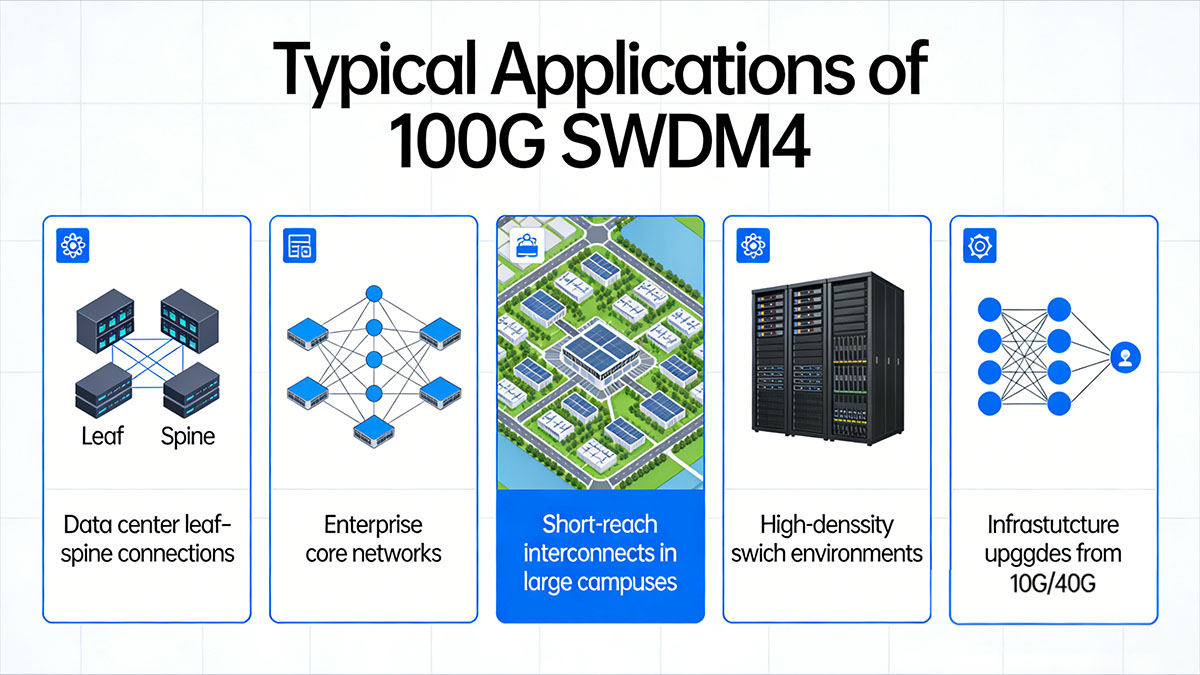
Data Center Leaf–Spine Links
SWDM4 is well suited for leaf–spine connections within the same row or between adjacent rows where distances stay within multimode limits.
| Scenario | Why SWDM4 fits | Result |
|---|---|---|
| Same-row switching | Short distance | Stable 100G link |
| Row-to-row | ≤100–150m | MMF reuse |
| LC patching | Existing panels | Minimal changes |
Because many leaf–spine links fall within 30–100m, SWDM4 can deliver 100GbE speeds while keeping the existing LC multimode patching system intact.
10G/40G to 100G Infrastructure Upgrades
SWDM4 is commonly deployed when upgrading legacy duplex MMF networks to 100GbE without re-cabling.
Typical upgrade paths:
-
10G LC multimode → 100G SWDM4
-
40G duplex MMF links → 100G SWDM4
-
Incremental 100G rollout in existing data centers
This approach allows network operators to increase bandwidth while avoiding the cost and disruption of installing MPO trunk cables.
Enterprise Core and Aggregation Layers
Enterprise campuses with multimode backbone links often use SWDM4 to introduce 100GbE within buildings.
| Environment | Link distance | Deployment reason |
|---|---|---|
| Campus core | <150m | Fiber reuse |
| Aggregation | Short reach | LC compatibility |
| Equipment rooms | In-building | Simple patching |
SWDM4 enables 100GbE aggregation between distribution switches and core switches without replacing existing MMF infrastructure.
High-Density Switch Environments
SWDM4 supports high port density because it uses standard QSFP28 form factors and duplex LC cabling.
Benefits in dense racks:
-
Simplified cable management
-
Lower fiber count per link
-
Easier tracing and maintenance
-
Consistent LC patching across speeds
This consistency helps operations teams maintain a uniform cabling approach across 10G, 25G, and 100G connections.
Mixed-Speed Data Center Environments
SWDM4 is useful in environments where 10G, 25G, 40G, and 100G links coexist over duplex multimode fiber.
Common scenarios:
-
Gradual migration to 100G
-
Hybrid switch generations
-
Staged infrastructure upgrades
-
Maintaining LC-based patch panels
Because it aligns with existing duplex MMF cabling, SWDM4 can be introduced incrementally without forcing a full infrastructure redesign.
📜 Cabling and Deployment Guidelines of 100G SWDM4
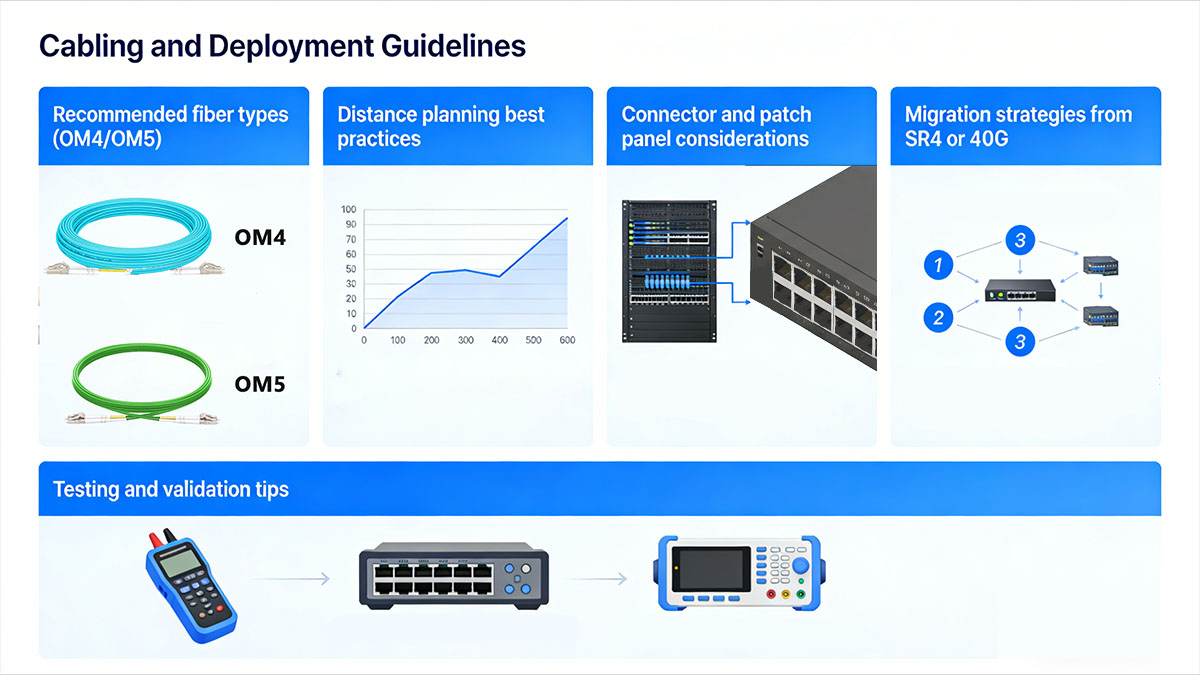
Successful 100G SWDM4 deployment depends on verifying multimode fiber type, confirming link distance, and ensuring switch compatibility before installation. Because SWDM4 operates over duplex MMF rather than MPO trunks, careful planning helps maximize reach and reliability.
Choose the Right Multimode Fiber Grade
OM4 and OM5 are generally preferred for SWDM4 to ensure sufficient link margin, especially near maximum distances.
| Fiber type | Recommended use | Typical reach |
|---|---|---|
| OM3 | Legacy links | ~75m |
| OM4 | Standard choice | ~100m |
| OM5 | Extended reach | ~150m |
If existing fiber is OM3 and link distance approaches its limit, consider shorter runs, improved patch quality, or upgrading to OM4/OM5 where feasible.
Verify Link Distance and Loss Budget
Accurate distance measurement and loss budgeting are essential to avoid marginal links.
Deployment checks:
-
Measure total fiber length including patch cords
-
Account for connectors and patch panels
-
Check insertion loss against module specifications
-
Avoid exceeding recommended distance thresholds
Maintaining adequate optical margin improves stability and reduces the risk of intermittent errors.
Maintain LC Patch Panel Consistency
SWDM4 works best when LC-based patching is consistent across the link.
| Component | Recommendation | Reason |
|---|---|---|
| Patch panels | LC duplex | Match transceiver |
| Patch cords | OM4/OM5 | Lower loss |
| Cable routing | Organized | Easier maintenance |
Using uniform LC patching simplifies operations and avoids the complexity of mixing connector types within the same environment.
Migration from SR4 or 40G Links
SWDM4 can be introduced gradually in environments transitioning from SR4 or lower-speed duplex MMF links.
Typical migration steps:
-
Audit existing fiber type and length
-
Identify links within SWDM4 distance limits
-
Replace optics at both ends with SWDM4 modules
-
Retain existing LC duplex patching
-
Validate link stability and DDM readings
This staged approach allows incremental upgrades without full infrastructure replacement.
Switch and Optics Compatibility Checks
Before deployment, confirm that the switch platform supports SWDM4 modules and firmware recognition.
Key checks:
-
Vendor compatibility lists
-
Port power budget
-
Firmware support for SWDM4
-
DDM monitoring functionality
-
Interoperability testing between modules
Most modern QSFP28 switches support SWDM4, but verification reduces risk in mixed-vendor networks.
Testing and Validation Best Practices
Post-installation testing ensures that SWDM4 links perform within expected parameters.
Recommended steps:
-
Verify optical power levels via DDM
-
Check for CRC or packet errors
-
Confirm negotiated 100GbE link
-
Monitor temperature and voltage
-
Document link performance
Routine monitoring helps identify marginal fiber or connector issues early.
📜 How to Choose the Right 100G SWDM4 Module
The right 100G SWDM4 module is determined by fiber type, link distance, switch compatibility, and thermal budget rather than brand alone. Because SWDM4 is typically used to reuse existing duplex multimode fiber, selection should begin with infrastructure validation and then move to compatibility and reliability checks.
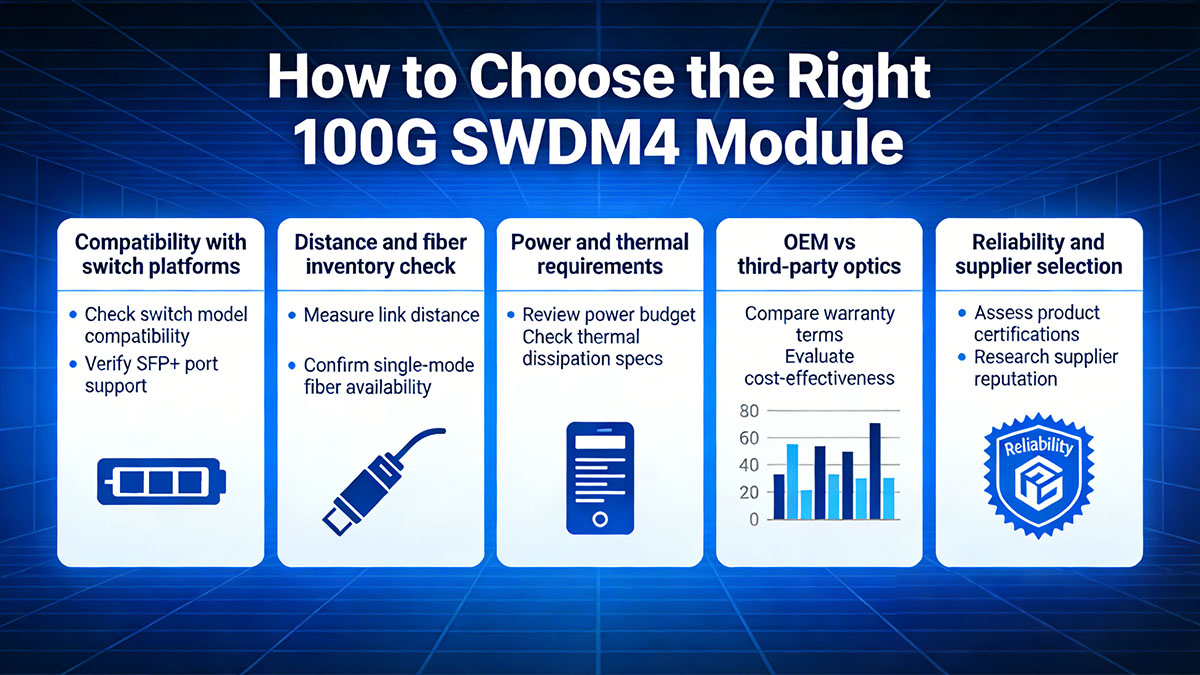
Step 1: Verify Fiber Type and Link Distance
SWDM4 selection must match the installed multimode fiber grade and the actual link length.
| Fiber type | Practical reach | Selection note |
|---|---|---|
| OM3 | ~75m | Use for short links |
| OM4 | ~100m | Standard choice |
| OM5 | ~150m | For longer MMF runs |
If the link distance approaches the upper limit of a given fiber type, prioritize modules with stable optical performance and confirm loss margins before deployment.
Step 2: Confirm Switch and Platform Compatibility
Not all switches automatically support SWDM4 optics, so compatibility verification is required.
Compatibility checklist:
-
Confirm QSFP28 port support for SWDM4
-
Check vendor compatibility documentation
-
Verify firmware recognition
-
Ensure DDM/DOM monitoring support
-
Validate interoperability in mixed-vendor setups
Testing a small batch before large-scale rollout helps avoid unexpected compatibility issues.
Step 3: Evaluate Power and Thermal Budget
SWDM4 modules typically consume more power than SR4, so switch thermal capacity should be reviewed.
| Factor | Why it matters | Checkpoint |
|---|---|---|
| Power draw | Higher than SR4 | Switch spec |
| Thermal output | Affects density | Rack airflow |
| Port density | Impacts cooling | High-density switches |
High-density switch deployments should ensure adequate airflow and power headroom for multiple SWDM4 modules.
Step 4: Consider Deployment Environment
Module selection should align with the operational environment and network design.
Choose SWDM4 when:
-
Existing LC duplex MMF must be reused
-
Link distance is within 150m
-
High port density is required
-
Migration from 10G/40G is planned
Consider alternatives when:
-
Distance exceeds MMF limits
-
Single-mode fiber is already installed
-
MPO infrastructure is available
Step 5: Assess Reliability and Interoperability
Consistent performance across links is critical in large-scale deployments.
Evaluation points:
-
Manufacturing quality and testing standards
-
DDM accuracy and monitoring stability
-
Interoperability with other SWDM4 modules
-
Warranty and lifecycle consistency
Standardized modules across the same network segment simplify operations and troubleshooting.
📜 FAQs About 100G SWDM4
What distance can 100G SWDM4 support?
100G SWDM4 typically supports up to ~75m on OM3, ~100m on OM4, and up to ~150m on OM5 multimode fiber. Actual reach depends on link loss, connector quality, and overall fiber condition.
Is 100G SWDM4 better than 100G SR4?
Neither is universally better—SWDM4 is preferred when duplex LC multimode fiber must be reused, while SR4 is often chosen when MPO infrastructure already exists and lower module cost is a priority. The decision mainly depends on cabling architecture and upgrade strategy.
Can 100G SWDM4 run over OM3 fiber?
Yes, 100G SWDM4 can operate over OM3 multimode fiber, but the maximum reach is shorter—typically around 75m. For longer links, OM4 or OM5 provides more margin and stability.
Is 100G SWDM4 widely supported by switches?
Most modern QSFP28 switch platforms support SWDM4 optics, but compatibility should still be verified through vendor documentation or testing. This is especially important in mixed-vendor environments.
Can SWDM4 interoperate between different vendors?
SWDM4 modules from different vendors often interoperate if they follow common MSA specifications, but interoperability testing is recommended for production networks. Using consistent module types across both ends simplifies deployment.
📜 Conclusion

100G SWDM4 is the most practical short-reach 100GbE solution when existing duplex multimode fiber must be reused without migrating to MPO cabling. By delivering 100Gbps over LC-based MMF with wavelength multiplexing, it provides a balanced path for data centers and enterprise networks upgrading from 10G or 40G while keeping cabling changes minimal. When link distance falls within multimode limits and switch compatibility is confirmed, 100G SWDM4 enables high-density, simplified, and scalable 100GbE deployments across modern network infrastructures.
For teams evaluating deployment options or comparing optics for duplex-fiber 100G upgrades, reviewing compatible module choices and infrastructure requirements in advance helps ensure stable long-term operation. You can explore detailed specifications and implementation-ready options through the LINK-PP Official Store to support planning, validation, and large-scale rollout of 100G SWDM4 connectivity.