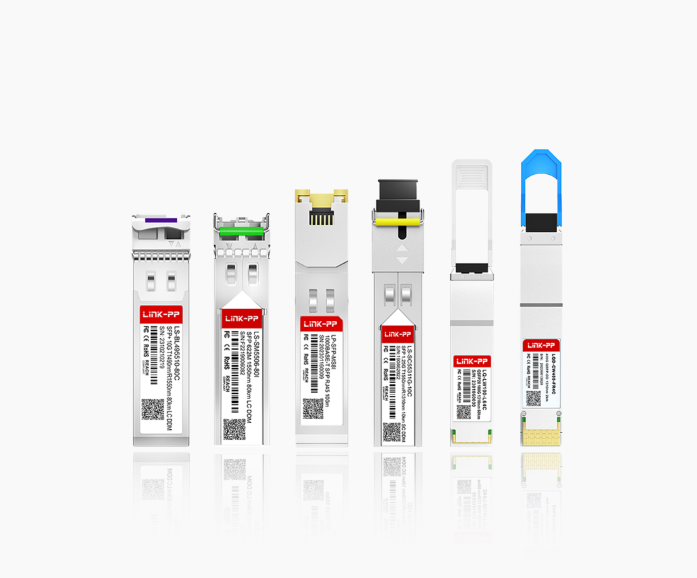
As network speeds continue to increase, many enterprises and data centers are transitioning toward 10 Gigabit Ethernet to support higher bandwidth demands, virtualization, and cloud-based applications. In this process, 10G SFP+ to RJ45 transceiver modules have emerged as a practical solution for delivering 10G performance over traditional copper cabling. By enabling 10GBASE-T connectivity through standard SFP+ ports, these modules help bridge the gap between modern high-speed switches and existing RJ45-based network infrastructure.
In this article, you will gain a comprehensive understanding of what a 10G SFP+ to RJ45 transceiver is, how it works, and its key features in real-world network deployments. We will explore its advantages, compare it with SFP+ fiber modules, discuss common use cases, and provide guidance on how to choose the ideal transceiver for your network infrastructure— helping you make cost-effective decisions when optimizing overall 10G network performance.
💎 What Is a 10G SFP+ to RJ45 Transceiver
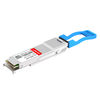
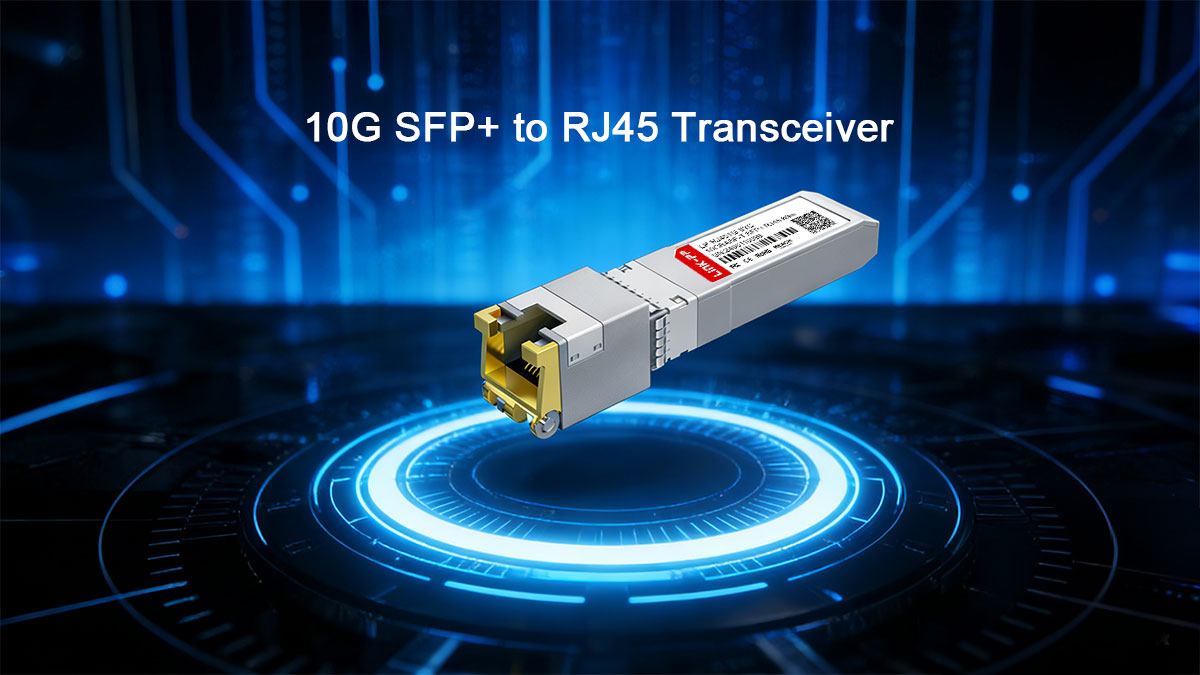
A 10G SFP+ to RJ45 transceiver is a vital component for enabling high-speed Ethernet connections over copper cabling. It allows network devices with SFP+ ports—such as switches, routers, or servers—to connect directly to standard RJ45 copper interfaces at 10-gigabit speeds.
Definition and Terminology of 10G SFP+ to RJ45
The term 10G SFP+ to RJ45 refers to a hot-pluggable transceiver module designed to convert a switch or network device’s SFP+ port into a 10GBASE-T Ethernet interface, allowing data transmission over twisted-pair copper cables such as Cat6a or Cat7. It combines the compact form factor of SFP+ with the widespread compatibility of RJ45 connectors, making it ideal for copper-based 10G deployments.
From a standards perspective, these transceivers typically comply with IEEE 802.3an (10GBASE-T) and support auto-negotiation, backward compatibility with lower data rates (such as 1G or 2.5G, depending on the model), and hot-swappable operation. Common terms associated with these modules include SFP+ 10GBASE-T Module, 10G Copper SFP Module, and 10G SFP+ RJ45 Copper Transceiver.
How Does a 10G SFP+ to RJ45 Transceiver Work
A 10G SFP+ to RJ45 transceiver operates by converting high-speed electrical signals from an SFP+ interface into 10GBASE-T—compliant Ethernet signals suitable for transmission over twisted-pair copper cabling. Unlike fiber transceivers that rely on optical signaling, this module performs complex electrical signal processing to ensure reliable 10Gbps data transfer over copper media.
Inside the transceiver, the SFP+ host interface delivers serialized 10G data to an integrated 10GBASE-T PHY chip, which is responsible for encoding the data using PAM-16 modulation and applying advanced error correction techniques. The signal then passes through digital signal processing stages—such as echo cancellation, crosstalk suppression, and equalization—to compensate for signal loss and interference commonly found in copper cables. Finally, the conditioned signal is transmitted through the RJ45 connector and Ethernet magnetics to the connected device. On the receive path, the process is reversed to recover clean digital data for the host system.
Key functional components involved in this process include:
- 10GBASE-T PHY: Executes modulation, demodulation, and forward error correction required by the IEEE 802.3an standard.
- Digital Signal Processing Engine: Actively mitigates noise, attenuation, and alien crosstalk over Cat6a or higher cables.
- Ethernet Magnetics: Provides impedance matching and electrical isolation between the transceiver and the copper network.
- Thermal and Power Control Circuits: Regulate power consumption and maintain stable operation under higher thermal loads typical of 10G copper transmission.
Key Features of a 10G SFP+ to RJ45 Transceiver
The 10G SFP+ to RJ45 transceiver integrates multiple advanced hardware and performance features that make it suitable for high-speed copper connections within data centers and enterprise networks. These features ensure compliance, reliability, and efficient operation across various environments.
- 10GBASE-T Compliance: Fully meets IEEE 802.3an standards to guarantee interoperability with switches, servers, and network interface cards supporting 10G copper Ethernet.
- Auto-Negotiation and Backward Compatibility: Seamlessly supports 10G/5G/2.5G/1G connection speeds, automatically adjusting to the highest mutually supported rate for connected devices.
- Low Power Consumption (≤2.5 W): Incorporates efficient PHY and DSP chipsets that reduce heat generation and power draw compared to earlier copper solutions.
- Integrated Signal Conditioning: Includes echo cancellation, NEXT/FEXT suppression, and adaptive equalization algorithms to maintain signal clarity and link stability even under electrical noise.
- Advanced Thermal Management: Built with a metal-housing shell and internal heat-sink design to dissipate heat effectively and ensure stable operation in high-density switch ports.
- Hot-Pluggable SFP+ Interface: Allows the module to be inserted or removed without shutting down equipment, enabling quick upgrades and replacements.
- Robust EMI Shielding: Ensures electromagnetic compatibility in rack-dense environments, reducing interference with adjacent copper and optical connections.
💎 Why Use a 10G SFP+ to RJ45 Transceiver in Your Network
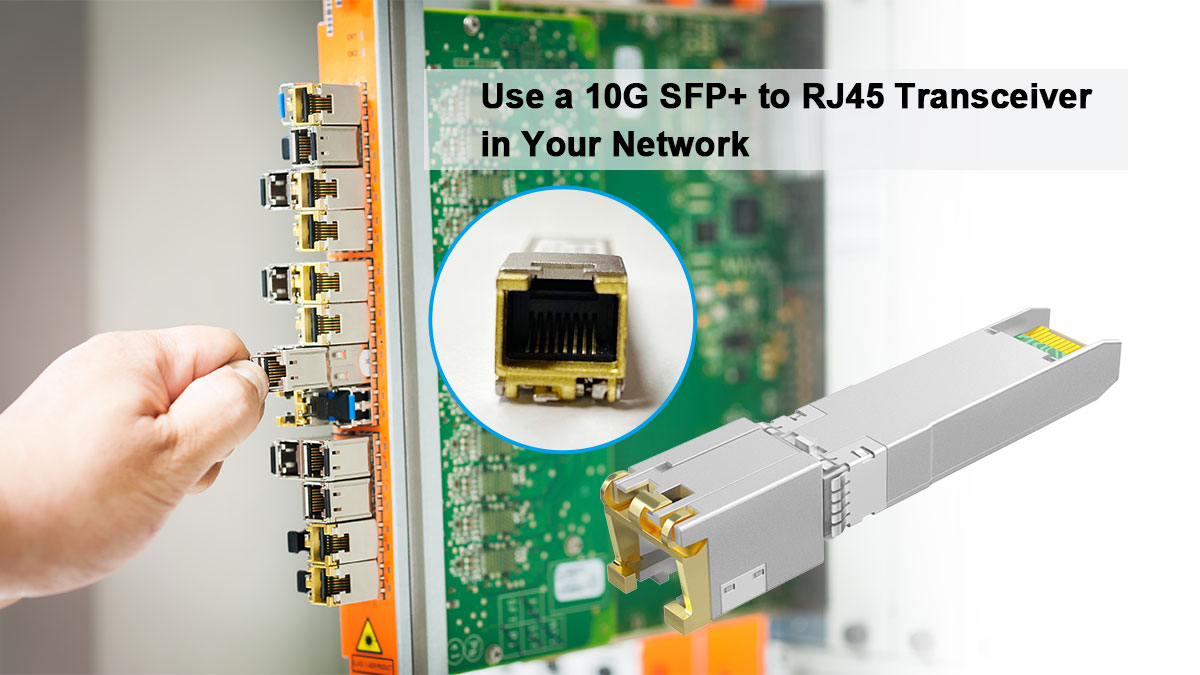
The 10G SFP+ to RJ45 transceiver offers a convenient bridge between fiber-based SFP+ ports and copper cabling systems. It allows businesses to achieve 10G Ethernet speeds while keeping their existing copper infrastructure intact, reducing both cost and complexity.
Seamless Integration with Existing Copper Cabling
The 10G SFP+ to RJ45 transceiver enables seamless integration with existing Cat6a or Cat7 copper cabling. It eliminates the need for a complete infrastructure overhaul, allowing network administrators to increase bandwidth without replacing cables. This plug-and-play solution reduces disruption, installation time, and overall deployment complexity.
Cost-Effective Alternative to Fiber Deployment
Compared to running new fiber optics, a 10G SFP+ to RJ45 transceiver offers major cost savings in both materials and labor. Copper Ethernet cables are more affordable, easier to install, and require no specialized termination. This makes them ideal for short-distance 10G connections, providing a practical balance between speed, reliability, and budget efficiency.
Compatibility and Network Flexibility
These 10G SFP+ to RJ45 transceivers are compatible with a wide range of switches, servers, and network hardware featuring SFP+ slots. Their ability to support auto-negotiation and backward compatibility with lower speeds ensures flexible deployment. This versatility allows businesses to expand or reconfigure their networks easily, adapting to evolving bandwidth and performance needs.
💎 10G SFP+ to RJ45 Transceiver vs SFP+ Fiber Module: Key Differences
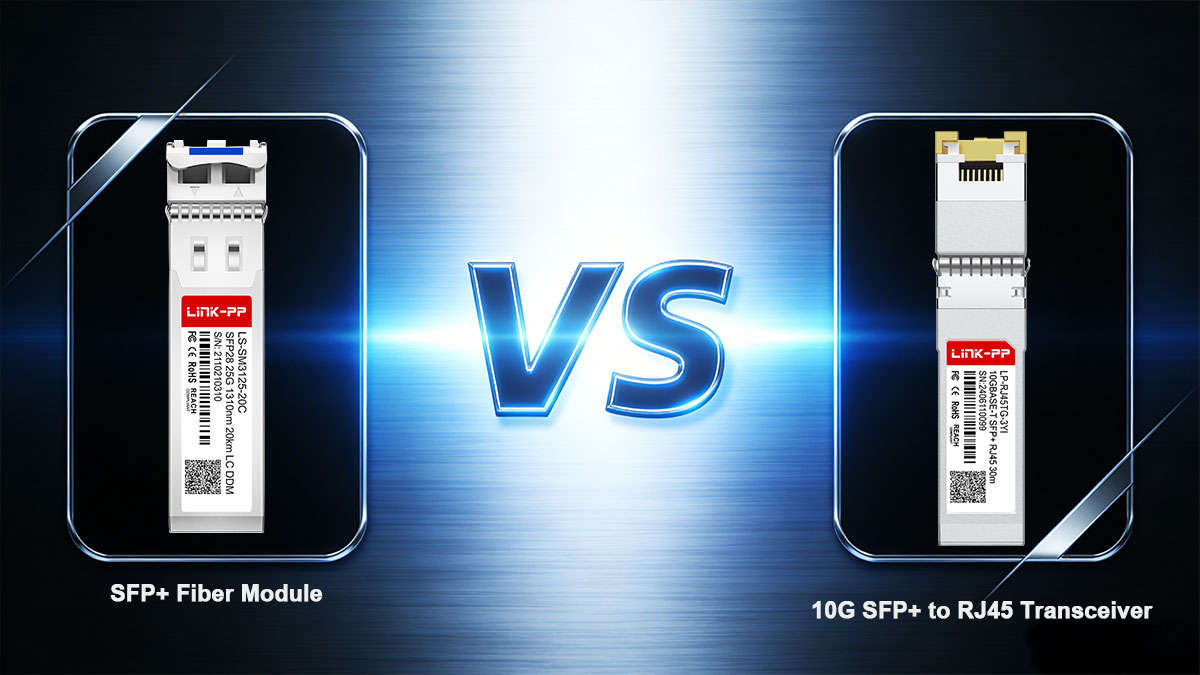
While both 10G SFP+ to RJ45 transceivers and SFP+ fiber modules enable high-speed 10 Gigabit Ethernet connectivity, they differ in transmission media, performance, and deployment suitability. The choice between them depends primarily on network distance, infrastructure type, power requirements, and overall cost. Understanding these distinctions helps ensure you select the most efficient and compatible solution for your network.
The following table provides a detailed comparison to highlight these key differences.
| Feature |
10G SFP+ to RJ45 Transceiver |
10G SFP+ Fiber Module |
| Transmission Medium |
Copper cable (Cat6a/7 Ethernet cable) |
Optical fiber cable (MMF or SMF) |
| Maximum Distance |
Up to 100m |
300m to 80km |
| Latency |
Slightly higher due to signal conversion |
Lower latency and faster signal propagation |
| EMI Resistance |
More prone to electromagnetic interference |
Immune to EMI |
| Typical Deployment |
Short-distance connections in copper networks |
Long-distance or high-performance fiber networks |
| Cost Efficiency |
Lower initial cost when reusing existing copper cabling |
Higher setup cost, but ideal for large-scale infrastructure |
Transmission Media: Copper vs Fiber
The most fundamental distinction between these two transceivers lies in their physical transmission media.
A 10G SFP+ to RJ45 transceiver uses twisted-pair copper Ethernet cables, typically Cat6a or Cat7, to deliver 10GBASE-T connectivity. This makes it an ideal choice for environments where copper infrastructure already exists, allowing seamless upgrades to 10G without replacing cabling.
By contrast, an SFP+ fiber module transmits data using light signals over optical fiber cable. Fiber offers superior bandwidth stability, complete immunity to electromagnetic interference (EMI), and is better suited for environments with high electrical noise or long-distance requirements.
Transmission Distance and Latency
Transmission distance is one of the most noticeable differences between copper and fiber-based solutions.
10G SFP+ to RJ45 transceivers are designed for short-range applications, supporting distances of up to 100m over Cat6a cabling. Due to signal encoding and digital signal processing (DSP), they typically introduce slightly higher latency.
In contrast, SFP+ fiber modules support much longer distances—from 300m with multimode fiber to tens of kilometers with single mode fiber—while maintaining extremely low latency. This makes fiber modules the preferred option for latency-sensitive applications such as data center backbones and inter-building connections.
Deployment Scenarios and Cost Comparison
From a deployment perspective, 10G SFP+ to RJ45 transceivers excel in scenarios where simplicity and cost efficiency are priorities. They are commonly used in data center top-of-rack connections, enterprise access networks, and incremental upgrades from 1G to 10G, as they leverage existing copper cabling and reduce installation complexity.
SFP+ fiber modules, while typically involving higher upfront costs for fiber cabling and optical components, provide greater scalability, lower power consumption, and long-term performance advantages. They are best suited for core networks, aggregation layers, and long-distance links where reliability and future-proofing are critical.
💎 Typical Use Cases for 10G SFP+ to RJ45 Transceiver
As organizations migrate toward higher-speed networks, 10G SFP+ to RJ45 transceivers serve a critical role in bridging modern high-bandwidth infrastructure with existing copper-based systems. These modules enable 10G performance over standard Cat6a or higher copper cabling, reducing the need for a full fiber overhaul. Below are the primary deployment scenarios where these copper transceivers offer measurable advantages.
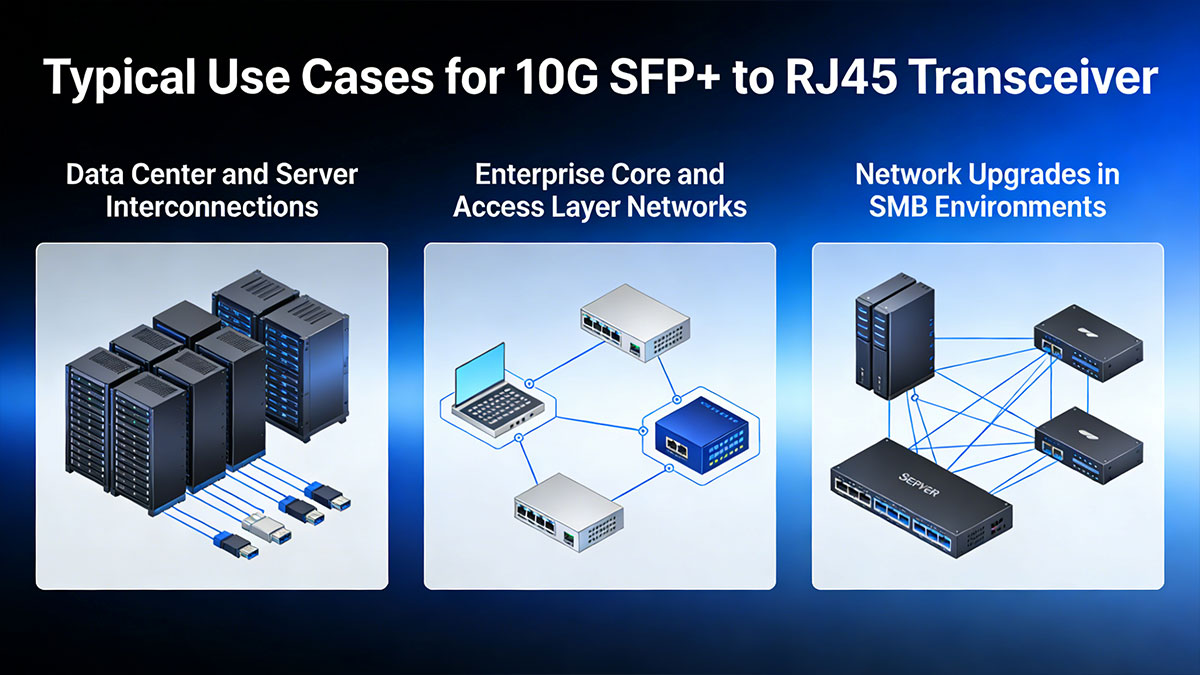
Data Center and Server Interconnections
In data center environments, 10G SFP+ to RJ45 transceivers are commonly used for short-reach server connections, particularly in top-of-rack (ToR) or end-of-row (EoR) architectures. Many servers are equipped with 10GBASE-T network interface cards (NICs), making RJ45-based connectivity a practical choice. By installing 10G SFP+ to RJ45 modules in ToR switches, operators can directly connect servers using Cat6a copper cables without deploying additional fiber transceivers or DACs.
Enterprise Core and Access Layer Networks
In enterprise networks, 10G SFP+ to RJ45 transceivers are frequently deployed to link access switches to core or aggregation switches over existing copper cabling. Many enterprise buildings are already wired with Cat6a or Cat7 cables, and replacing them with fiber can be disruptive and expensive.
Using SFP+ 10GBASE-T modules allows businesses to upgrade backbone or uplink speeds to 10GbE while maintaining the current cabling infrastructure. These transceivers are particularly effective for access-to-distribution connections within a single floor or between nearby wiring closets, where cable lengths typically remain under 100m.
Network Upgrades in SMB Environments
Small and medium-sized businesses (SMBs) often face budget and resource constraints when upgrading network performance. In these environments, 10G SFP+ to RJ45 transceivers provide a practical upgrade path from Gigabit Ethernet to 10GbE without the complexity of fiber deployment.
Typical applications include upgrading switch uplinks, connecting high-performance workstations, or supporting bandwidth-intensive applications such as network-attached storage (NAS), virtualization hosts, or video editing systems. With shorter cable runs and lower port density than large data centers, SMBs can effectively manage the higher power draw of 10GBASE-T modules while benefiting from significantly improved network throughput.
💎 How to Select the Ideal 10G SFP+ to RJ45 Transceiver for Your Network
Choosing the right 10G SFP+ to RJ45 transceiver goes beyond just matching speed and connector type. The right module ensures stable performance, compatibility with your devices, and efficient energy use—critical factors for maintaining a reliable 10G network.
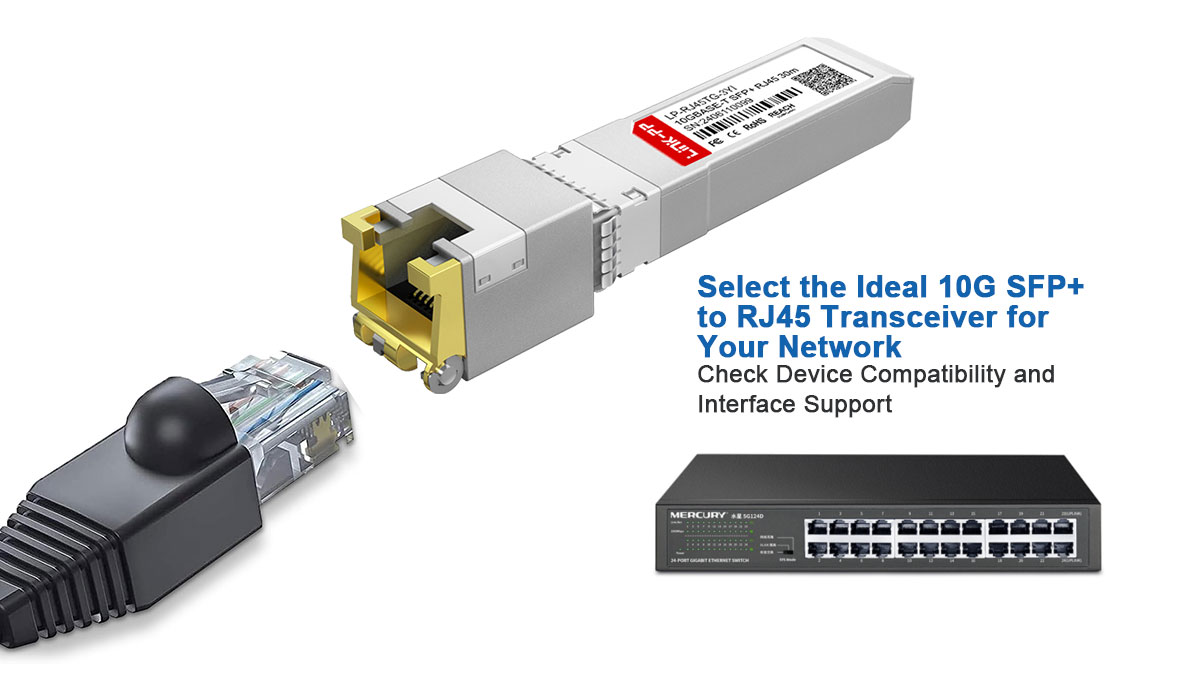
Check Device Compatibility and Interface Support
Before choosing a 10G SFP+ to RJ45 transceiver, verify that your switch, router, or NIC explicitly supports 10GBASE-T over SFP+. Some SFP+ ports are designed primarily for fiber transceiver modules and may not provide sufficient power or firmware support for copper-based transceivers.
It is also important to confirm vendor compatibility—many network devices enforce vendor ID checks, which may require either OEM-coded or fully compatible third-party modules. Checking the device’s hardware compatibility list and supported transceiver matrix can prevent link failures or disabled ports after installation.
Supported Cable Types and Maximum Reach
Not all copper cabling delivers the same performance at 10Gbps. When selecting a 10G SFP+ to RJ45 module, ensure it supports the cable category used in your network. Most modern modules support Cat6a up to 100m, while Cat6 is typically limited to 30–55m depending on cable quality and electromagnetic interference.
Using lower-grade cables such as Cat5e can result in unstable links or forced speed downgrades. Understanding your existing cable plant and required link distance is critical to selecting a module that can operate reliably without excessive retransmissions or errors.
Power Consumption and Thermal Performance
10G SFP+ to RJ45 transceivers consume significantly more power than fiber-based SFP+ modules due to the signal processing required for copper Ethernet. Typical power consumption ranges from 1.5W to 2.5W per module, which can impact switch thermal design and port density.
When deploying multiple copper transceivers in adjacent SFP+ ports, ensure the host device can dissipate the additional heat. Choosing low-power or short-reach variants can help reduce thermal stress, improve port stability, and extend the lifespan of both the module and the host equipment.
Compliance with IEEE and Industry Standards
A reliable 10G SFP+ to RJ45 transceiver should fully comply with IEEE 802.3an (10GBASE-T) standards to guarantee interoperability across different vendors and network devices. Standards compliance ensures correct auto-negotiation, error correction, and signal integrity over copper cabling.
In addition, 10G SFP+ to RJ45 modules that adhere to MSA (Multi-Source Agreement) specifications are more likely to work consistently across various platforms. Selecting standards-compliant transceivers reduces the risk of compatibility issues during network expansion or equipment replacement.
💎 Common Issues to Avoid When Using 10G SFP+ to RJ45 Transceivers
Integrating 10G SFP+ to RJ45 transceivers into your network can significantly enhance performance and flexibility, but improper installation or configuration can cause serious performance bottlenecks or connectivity failures. Understanding common pitfalls helps ensure stable operation, full 10G throughput, and extended module lifespan.
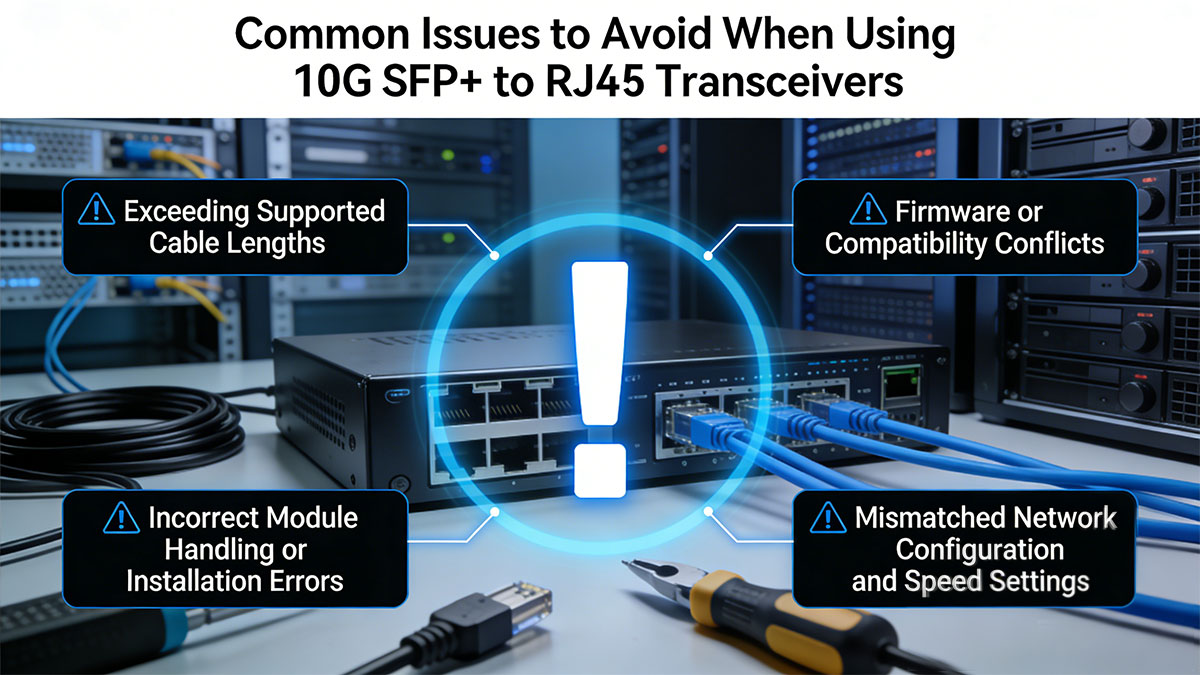
Exceeding Supported Cable Lengths
10G SFP+ to RJ45 transceivers use copper cabling (typically Cat6a or Cat7) to deliver 10G speeds up to 100m. Exceeding this distance can introduce signal loss and increased bit error rates, leading to reduced throughput or link flapping. Using lower-grade cables such as Cat5e or Cat6 at longer distances can further degrade performance. Always verify the maximum supported cable length and quality before installation, and avoid coiling or bundling cables tightly, which increases crosstalk and attenuation.
Firmware or Compatibility Conflicts
Certain switches or network devices require specific firmware versions to recognize or correctly operate with 10G SFP+ to RJ45 transceivers. Incompatible firmware can trigger random link drops or cause the module to fail initialization. Before installation, confirm that both the host device firmware and transceiver firmware align with the vendor’s compatibility matrix.
Incorrect Module Handling or Installation Errors
10G SFP+ transceivers are sensitive to electrostatic discharge (ESD) and physical stress. Improper handling, such as touching the electrical contacts or forcing the module into the cage, can damage internal circuitry. Always use an ESD wrist strap when handling transceivers, insert them gently until fully latched, and ensure the latch mechanism is secure before connecting the cable. Avoid frequent hot-swapping across different devices unless specified as supported.
Mismatched Network Configuration and Speed Settings
Failure to align network interface settings often results in link negotiation errors or performance mismatches. For instance, forcing a port to 1G or 2.5G while the transceiver and peer device expect 10G can prevent link establishment. Verify that all connected ports share the same duplex mode, speed, and auto‑negotiation parameters. Use proper driver settings and check device logs to confirm stable 10G operation once the module is online.
💎 Get The Best 10G SFP+ to RJ45 Transceiver at LINK-PP
For reliable and high-performance 10G SFP+ to RJ45 transceivers, LINK-PP is a trusted third-party supplier recognized for excellent quality and cost-effectiveness. Leveraging years of expertise in optical transceiver production, LINK-PP offers enterprise-grade modules designed to enhance your network's performance.
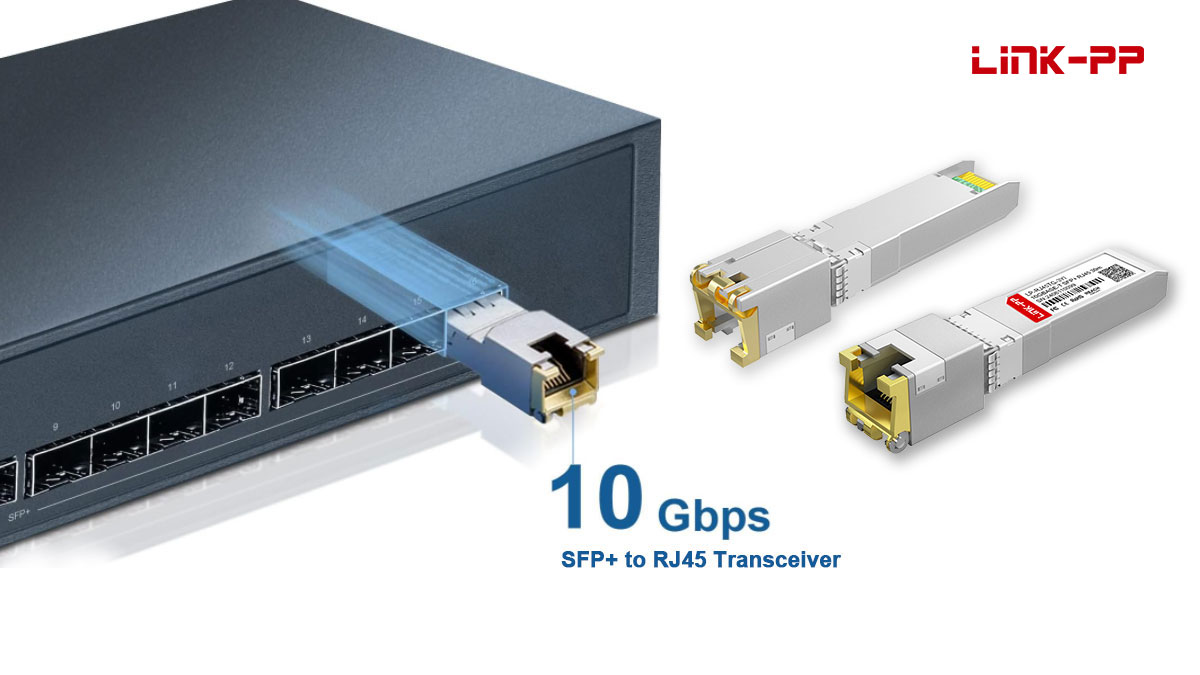
Why Choose LINK-PP as Your Supplier
Choosing LINK-PP means working with a supplier that focuses on engineering consistency, verified compatibility, and manufacturing control for 10G SFP+ to RJ45 transceivers. The key advantages include:
In-House Design and Manufacturing Control
LINK-PP designs and manufactures 10GBASE-T SFP+ modules in-house, covering PCB layout, component selection, assembly, and final inspection. This end-to-end control ensures consistent electrical performance, stable power consumption, and traceable product quality across different production batches.
Proven Multi-Vendor Compatibility
LINK-PP 10G SFP+ to RJ45 transceivers are validated on a wide range of mainstream switches, routers, and network interface cards. Compatibility testing helps reduce issues such as module rejection, link instability, or speed negotiation failures commonly encountered in mixed-vendor environments.
Strict Quality Control and Reliability Testing
Each module is subject to electrical performance tests, temperature aging, and functional verification before shipment. This testing process minimizes early failures and ensures long-term reliability in continuous 24/7 network operation scenarios.
Flexible OEM/ODM and Supply Support
LINK-PP supports OEM labeling, customized coding, and volume production planning. This makes LINK-PP a suitable long-term supplier for system integrators, equipment brands, and enterprise customers requiring consistent supply and product lifecycle stability.
Product Features and Testing Standards
LINK-PP 10G SFP+ to RJ45 transceivers are designed to fully comply with IEEE 802.3an (10GBASE-T) standards and support Cat6a cabling up to 80m. Each module integrates advanced PHY chips with optimized power management to balance performance and thermal efficiency in dense switch environments.
To ensure reliability, every module undergoes comprehensive testing, including:
- Electrical performance and signal integrity verification
- Compatibility testing with mainstream switches and network interface cards
- High-temperature aging and thermal stress tests
- EMI and ESD compliance checks
These strict testing standards help guarantee stable 10G transmission, low packet loss, and consistent performance even under continuous operation in data center or enterprise environments.
Recommended 10G SFP+ to RJ45 Transceiver Module
The LINK-PP LP-RJ45TG-8YC is a robust 10GBASE-T SFP+ module optimized for high-speed network connections in data centers and enterprise environments. It supports bi-directional data links up to 10Gb/s over extended Cat 6a/7 cable runs, combining low power use with reliable operation across a wide temperature range.
Key Features of LINK-PP LP-RJ45TG-8YC:
- 10Gbps Bi-Directional Data Transmission: Supports up to 10Gb/s full-duplex data links, ensuring consistent high-throughput performance for bandwidth-intensive applications.
- Hot-Pluggable SFP+ Form Factor: Designed with a standard SFP+ footprint, the module supports hot-plug operation, allowing installation or replacement without interrupting network operation.
- Extended Copper Reach up to 80m: Supports link distances of up to 80m when used with Cat6a or Cat7 cables, providing greater flexibility for access layer, aggregation, and top-of-rack deployments.
- Fully Metallic Enclosure for EMI Protection: The all-metal housing minimizes electromagnetic interference (EMI), helping maintain signal integrity in electrically noisy environments.
- Low Power Dissipation Design: Optimized for reduced power consumption compared to traditional 10G copper solutions, making it suitable for high-density switch ports with thermal constraints.
- RoHS Compliance: Fully compliant with RoHS requirements, meeting environmental and regulatory standards for global deployment.
💎 FAQs About 10G SFP+ to RJ45 Transceiver
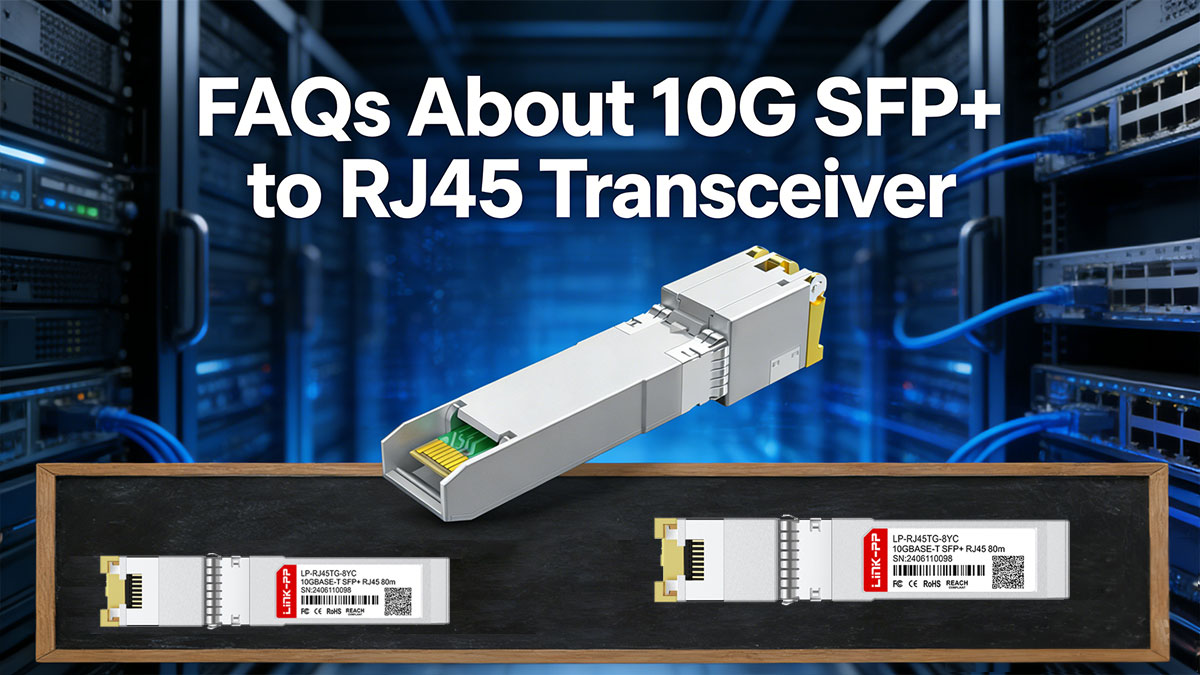
What is the maximum distance for 10G SFP+ to RJ45 modules?
Most 10G SFP+ to RJ45 transceivers support a maximum distance of 100m over Cat6a or Cat7 copper cables. When using Cat6 cables, the supported reach is typically limited to 30–55m, depending on cable quality and environmental conditions.
What cable types are supported by 10G SFP+ to RJ45 transceivers?
10G SFP+ to RJ45 transceivers typically support Cat6a and Cat7 cables for full 10GbE performance. Some modules may also work with Cat6 cables, but the achievable distance and stability can be reduced.
Is the 10G SFP+ to RJ45 transceiver backward compatible with 1G or 2.5G speeds?
Yes, most 10G SFP+ to RJ45 modules are backward compatible with lower speeds like 1G and 2.5G, but this depends on the switch’s chipset and firmware support.
Are 10G SFP+ to RJ45 transceivers hot-swappable?
Yes, 10G SFP+ to RJ45 transceivers are hot-swappable, allowing installation or replacement without powering down the switch. Proper ESD protection and handling practices should still be followed during insertion or removal.
How do I know if my switch supports 10G SFP+ to RJ45 transceivers?
Check the switch’s hardware compatibility list or vendor documentation to confirm support for 10GBase-T SFP+ modules. You can also verify with the manufacturer or test using a supported module to confirm recognition.
💎 Conclusion: Choose the Right 10G SFP+ to RJ45 Transceiver
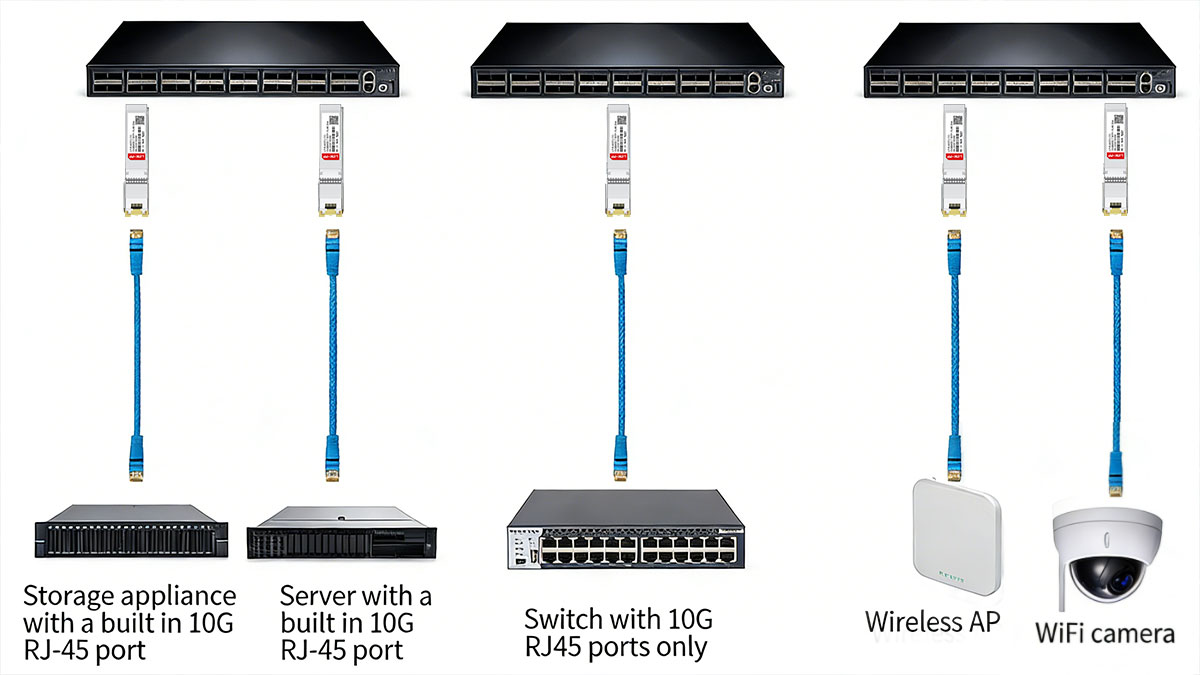
In conclusion, selecting the right 10G SFP+ to RJ45 transceiver is essential for achieving a reliable, cost-effective, and scalable 10GbE network. By carefully evaluating factors such as device compatibility, cable type and distance, power consumption, thermal performance, and standards compliance, you can ensure stable performance while maximizing the value of your existing copper infrastructure.
Whether you are upgrading a data center, enterprise network, or SMB environment, choosing a proven and well-tested solution will significantly reduce deployment risks and long-term operational costs. For high-quality, standards-compliant 10G SFP+ to RJ45 transceivers backed by rigorous testing and broad compatibility, explore the solutions available at the LINK-PP Official Store to support your 10G network upgrade with confidence.