In modern enterprise networks, the demand for higher bandwidth and longer transmission distances continues to increase, driven by the rapid expansion of data traffic, cloud services, and virtualization technologies. To meet these evolving needs, enterprises have been upgrading their Ethernet infrastructure to support high-speed interconnections between data centers, core switches, and aggregation layers.
Among the various 40G optical transceiver solutions, the QSFP 40G LR4 module stands out as a versatile and efficient option for long-reach applications. It offers a cost-effective approach to achieving 40 Gigabit Ethernet (40GbE) connectivity over single mode fiber, providing extended reach without compromising on power consumption or port density.
This article explores the key aspects of the QSFP 40G LR4, including its working principles, unique features, advantages for enterprise Ethernet environments, and deployment scenarios. It also examines differences between the LR4 and other 40G modules, and offers guidance on ensuring compatibility with existing network devices.
📝 What Is The QSFP 40G LR4
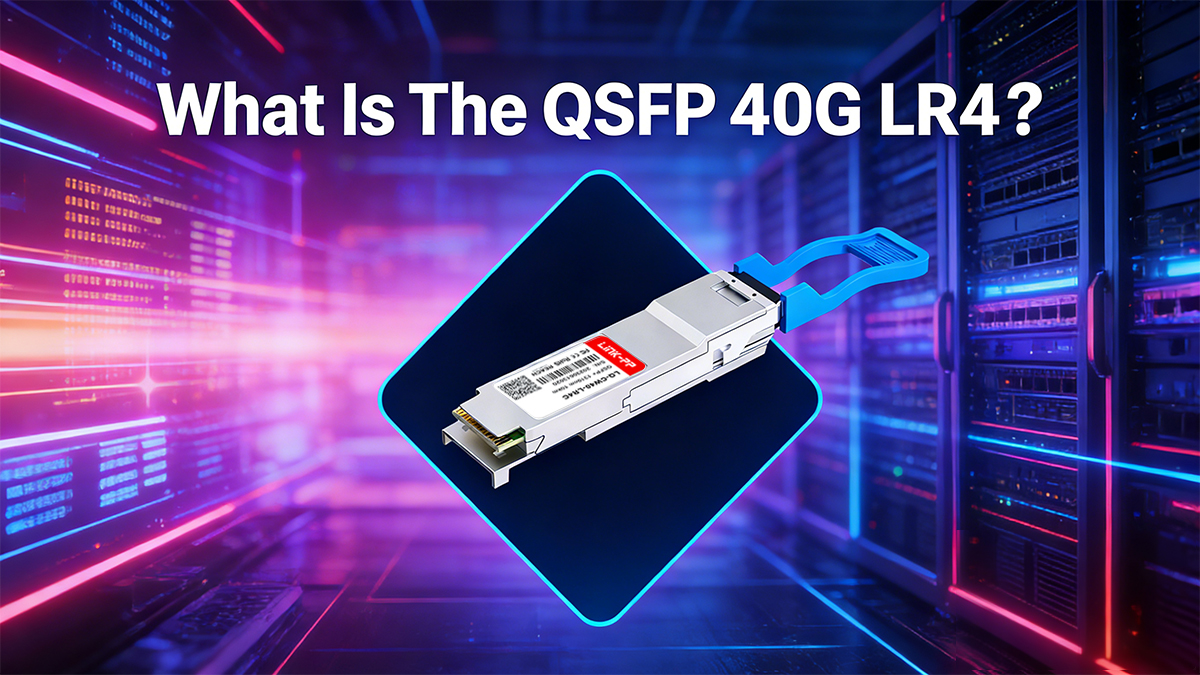
The QSFP 40G LR4 is a hot-pluggable optical transceiver module designed for long-range Ethernet communications. It fundamentally enables high-speed data transmission over single mode fiber (SMF) for distances critical to enterprise Ethernet networks.
Introduction to QSFP 40G LR4 Transceiver
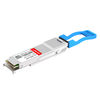
The QSFP 40G LR4 transceiver is a pluggable optical module that complies with the QSFP+ form factor and supports 40 Gigabit Ethernet (40GbE). It is primarily used for long-distance transmission, typically up to 10km, over single mode fiber (SMF). Thanks to its compact design and hot-swappable capability, QSFP 40G LR4 can be easily deployed in switches, routers, and core network equipment without disrupting existing network operations.
In enterprise Ethernet environments, QSFP 40G LR4 transceivers are commonly deployed in data center interconnects, core network links, and backbone infrastructure. Their ability to deliver stable high-speed performance over long distances makes them a preferred choice for organizations seeking to expand network coverage while maintaining high reliability.
Working Principle of QSFP 40G LR4 Module
The QSFP 40G LR4 module operates by transmitting and receiving four parallel optical signals, each carrying 10Gbps of data. These four signals are combined into a single 40Gbps data stream using wavelength division multiplexing at the transmitting end and separated back into individual channels at the receiving end.
On the transmission side, electrical signals from the host device are converted into optical signals and modulated onto four different wavelengths. These wavelengths are then multiplexed and sent over a single pair of single mode fibers. At the receiving end, the module demultiplexes the wavelengths and converts the optical signals back into electrical signals, ensuring accurate data delivery with minimal signal degradation.
Wavelength Division Multiplexing (WDM) in LR4
Wavelength Division Multiplexing (WDM) is the core technology that enables QSFP 40G LR4 to achieve long-reach, high-capacity transmission over single-mode fiber. In an LR4 module, four distinct wavelengths — typically around 1271nm, 1291nm, 1311nm, and 1331nm — are used to carry four independent 10Gbps data channels simultaneously.
By transmitting multiple wavelengths over the same fiber pair, WDM significantly increases bandwidth efficiency and reduces the need for additional fiber infrastructure. This approach not only lowers deployment costs but also simplifies network design, making QSFP 40G LR4 an efficient and scalable solution for enterprise Ethernet networks that demand long-distance, high-speed optical connectivity.
📝 Key Features and Specifications of QSFP 40G LR4
QSFP 40G LR4 transceivers are designed to deliver stable, high-speed optical transmission over long distances in enterprise Ethernet networks. They combine advanced optical technologies to meet the performance, compatibility, and scalability requirements of modern network infrastructures.
Transmission Distance and Wavelength Allocation
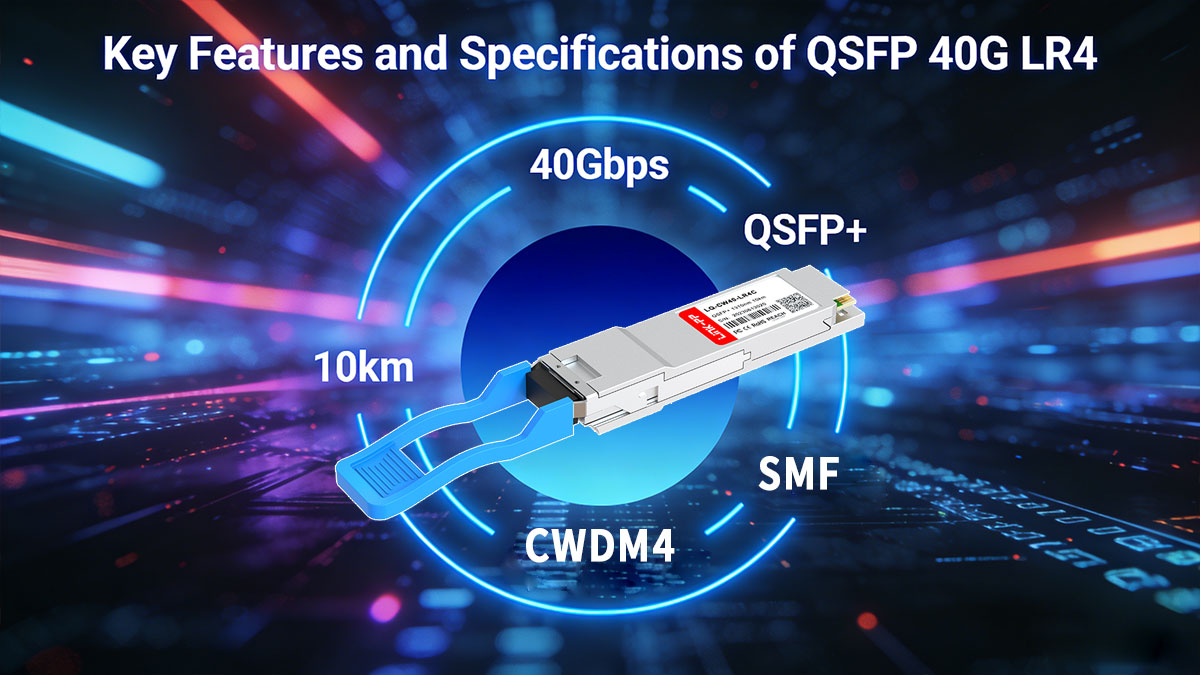
QSFP 40G LR4 modules support a maximum transmission distance of up to 10km over single mode fiber (SMF), making them ideal for long-reach enterprise and data center interconnections. They utilize four distinct wavelengths—typically around 1271nm, 1291nm, 1311nm, and 1331nm—to transmit data simultaneously. By multiplexing these wavelengths onto a single fiber pair, LR4 modules achieve high bandwidth efficiency while minimizing fiber usage.
Modulation Method and Data Rate Performance
Each lane of the QSFP 40G LR4 uses non-return-to-zero (NRZ) modulation to ensure efficient and stable data encoding at 10Gbps per wavelength. The module thus achieves a total aggregated throughput of 40Gbps full duplex. This modulation scheme, combined with forward error correction (FEC) support in many network devices, helps maintain minimal signal distortion and a low bit error rate (BER) across long distances.
Optical Standards and Protocol Compatibility
The QSFP 40G LR4 complies with the IEEE 802.3ba 40GBASE-LR4 standard and the QSFP+ Multi-Source Agreement (MSA), ensuring wide interoperability across various network vendors. It supports key communication protocols such as Ethernet, InfiniBand, and OTN, providing flexible deployment options for different network environments. With its standardized optical interface and modular design, the QSFP 40G LR4 can be easily integrated into existing 40G high-speed network infrastructures.
📝 Benefits of Deploying QSFP 40G LR4 in Enterprise Ethernet
The deployment of QSFP 40G LR4 transceivers in enterprise networks provides a powerful combination of extended reach, high port density, and excellent performance. These advantages make it an ideal solution for critical infrastructure links demanding reliability and scalability.
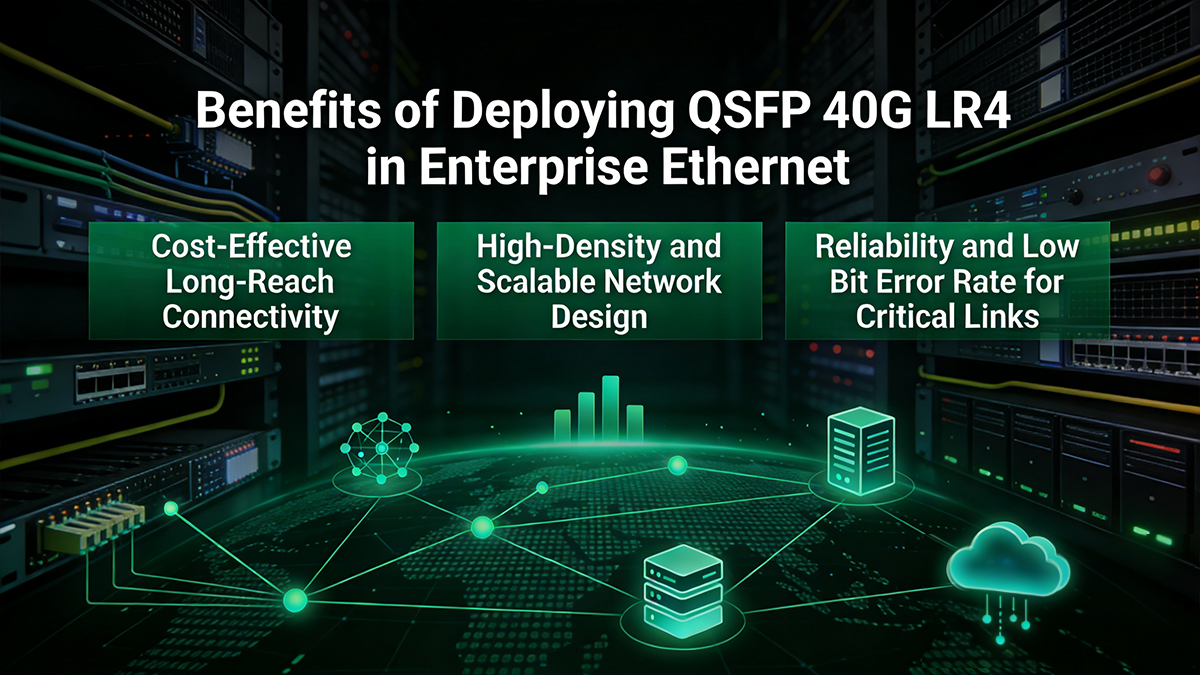
Cost-Effective Long-Reach Connectivity
QSFP 40G LR4 enables enterprises to achieve up to 10km transmission over single-mode fiber, reducing the need for intermediate equipment such as repeaters or additional aggregation switches. By leveraging existing SMF infrastructure and consolidating multiple 10G links into a single 40G connection, organizations can significantly lower both capital expenditures and operational costs while maintaining high bandwidth for growing data demands.
High-Density and Scalable Network Design
The QSFP 40G LR4 transceiver offers high port density, enabling enterprises to maximize rack space by combining multiple high-bandwidth links into one module. This reduces the number of physical ports needed, streamlines cable management, and cuts down on power consumption. Additionally, its ability to support long-distance transmission using a single fiber pair for 40G connectivity ensures scalability.
Reliability and Low Bit Error Rate for Critical Links
QSFP 40G LR4 modules are designed to deliver stable optical performance with a low bit error rate, which is essential for mission-critical enterprise applications such as data center interconnects and core network links. Their mature optical technology, strict compliance with IEEE standards, and robust signal integrity ensure consistent performance, reduced packet loss, and higher overall network reliability even over long distances.
📝 Comparing QSFP 40G LR4 with Other 40G Transceiver Modules
The QSFP 40G LR4 offers long-range transmission and wavelength multiplexing advantages that distinguish it from other 40G modules. To better understand its strengths and applications, it’s important to compare it with common 40G QSFP modules such as QSFP 40G SR4 and QSFP 40G ER4.
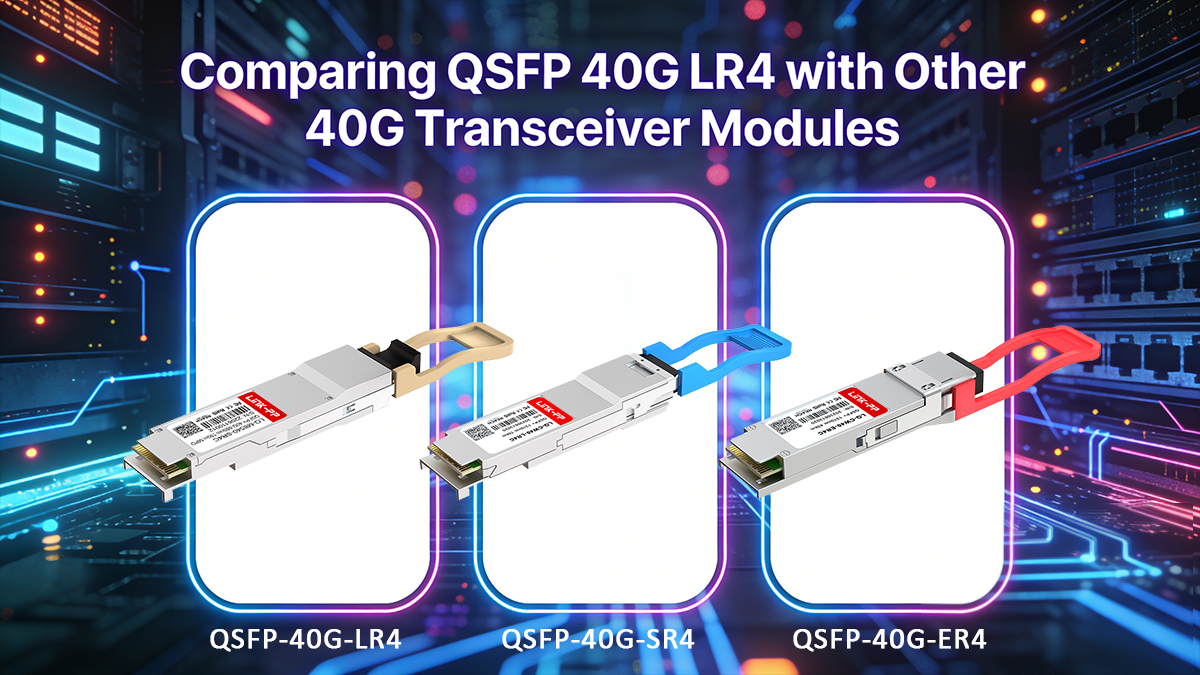
QSFP-40G-LR4 vs. QSFP-40G-SR4
While both modules deliver 40Gbps performance, they are designed for different types of optical links. The QSFP 40G LR4 supports single-mode fiber (SMF) with up to 10km reach, making it ideal for inter-building or data center interconnects. In contrast, the QSFP 40G SR4 is optimized for short-distance multimode fiber (MMF) applications, typically up to 150m on OM4 cable.
40GBASE SR4 modules have lower cost and power consumption but cannot meet long-reach requirements. 40GBASE LR4’s dense wavelength division multiplexing (DWDM) technique enables it to send four 10G channels simultaneously over a single pair of fibers, significantly reducing cabling complexity in long-haul environments.
The following table highlights the key differences between the QSFP 40G LR4 and QSFP 40G SR4 in terms of performance, optical design, and deployment use cases.
| Feature |
QSFP 40G LR4 |
QSFP 40G SR4 |
| Fiber Type |
Single Mode Fiber (SMF) |
Multimode Fiber (MMF) |
| Transmission Distance |
Up to 10km |
Up to 150m (OM4) |
| Wavelengths |
1271nm, 1291nm, 1311nm, 1331nm |
850nm |
| Optical Technology |
CWDM (4 Wavelengths on 2 Fibers) |
Parallel Optics (4x10G Lanes on 8 Fibers) |
| Connector Type |
Duplex LC |
MPO/MTP |
| Application |
Data Center Interconnects, Enterprise Backbone |
Short-reach Intra–data Center Links |
| Deployment Cost |
Higher Module Cost, Simpler Cabling |
Lower Module Cost, Higher Cabling Density |
QSFP-40G-LR4 vs. QSFP-40G-ER4
The QSFP 40G LR4 and QSFP 40G ER4 share a similar four-wavelength CWDM design over single-mode fiber at 1310nm, but differ significantly in reach and cost. 40GBASE LR4 achieves up to 10km using DFB lasers with direct modulation, while 40GBASE ER4 reaches 40km using EML lasers or optimized high-power DFBs with superior chirp performance and extinction ratio.
ER4 modules, though more expensive and power-intensive, are suited for metro and long-distance backbone connections. By comparison, LR4 offers an excellent balance between performance, cost, and energy efficiency for most enterprise applications.
To further illustrate their differences, the table below summarizes the key performance and design parameters of both QSFP 40G modules.
| Feature |
QSFP 40G LR4 |
QSFP 40G ER4 |
| Fiber Type |
Single Mode Fiber (SMF) |
Single Mode Fiber (SMF) |
| Transmission Distance |
Up to 10km |
Up to 40km |
| Wavelengths |
1271nm, 1291nm, 1311nm, 1331nm |
1271nm, 1291nm, 1311nm, 1331nm |
| Modulation |
CWDM |
CWDM with Higher Laser Output |
| Connector type |
Duplex LC |
Duplex LC |
| Application |
Data Center Interconnects, Enterprise Backbone |
Metro Networks, Long-haul Enterprise Links |
| Deployment Cost |
Moderate |
Higher |
📝 Deployment Scenarios for QSFP 40G LR4 in Enterprise Networks
The QSFP 40G LR4 transceiver is designed for high-speed, long-distance optical connectivity within enterprise environments. It enables seamless communication between network layers and sites, ensuring stable 40Gbps transmission across single mode fiber links up to 10km.
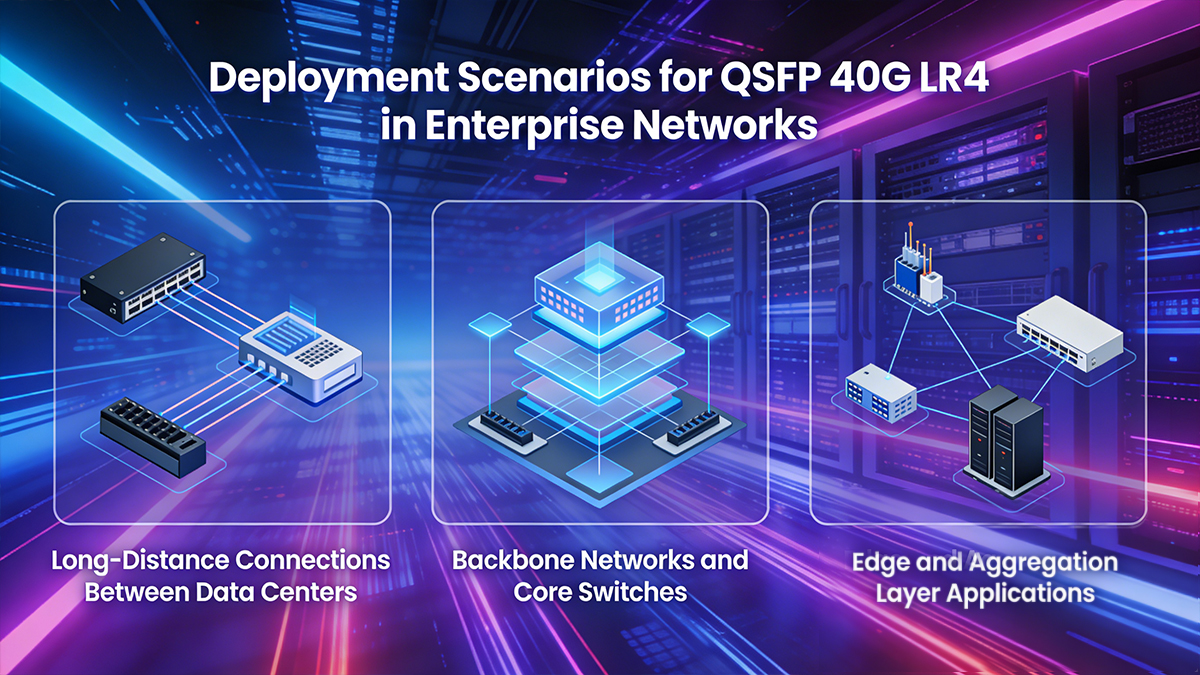
Long-Distance Connections Between Data Centers
QSFP 40G LR4 is ideal for establishing high-capacity, long-distance fiber optic links between data centers. It supports transmission distances of up to 10km over single mode fiber, making it suitable for interconnecting geographically dispersed data centers. By utilizing the LR4 module, enterprise networks can ensure reliable and cost-efficient connectivity, avoiding the high costs of shorter-range solutions like QSFP SR4 or leveraging more expensive long-range solutions like QSFP ER4.
Backbone Networks and Core Switches
In large enterprise networks, the backbone layer serves as the central hub for connecting multiple access and aggregation layers. QSFP 40G LR4 is commonly deployed in these backbone networks due to its high throughput and long-range capabilities, ensuring smooth data flow across the network's core. The transceiver's 40G speed is particularly beneficial for handling the heavy traffic demands of core switches and routers.
Edge and Aggregation Layer Applications
At the edge and aggregation layers of an enterprise network, where various departmental and regional networks are aggregated, the QSFP 40G LR4 is employed to provide high-bandwidth connectivity across multiple segments. Its high data rates ensure that edge and aggregation layers maintain sufficient capacity for heavy traffic, especially in networks with demanding applications like cloud computing, VoIP, and video conferencing.
📝 QSFP 40G LR4 Compatibility with Switches & Routers in Enterprise Ethernet
Ensuring seamless compatibility between QSFP-40G-LR4 transceivers and network devices is fundamental for a successful 40G deployment. This involves verifying hardware support, adhering to multi-source agreements (MSA), and performing pre-deployment checks to guarantee interoperability and optimal performance within the existing infrastructure.
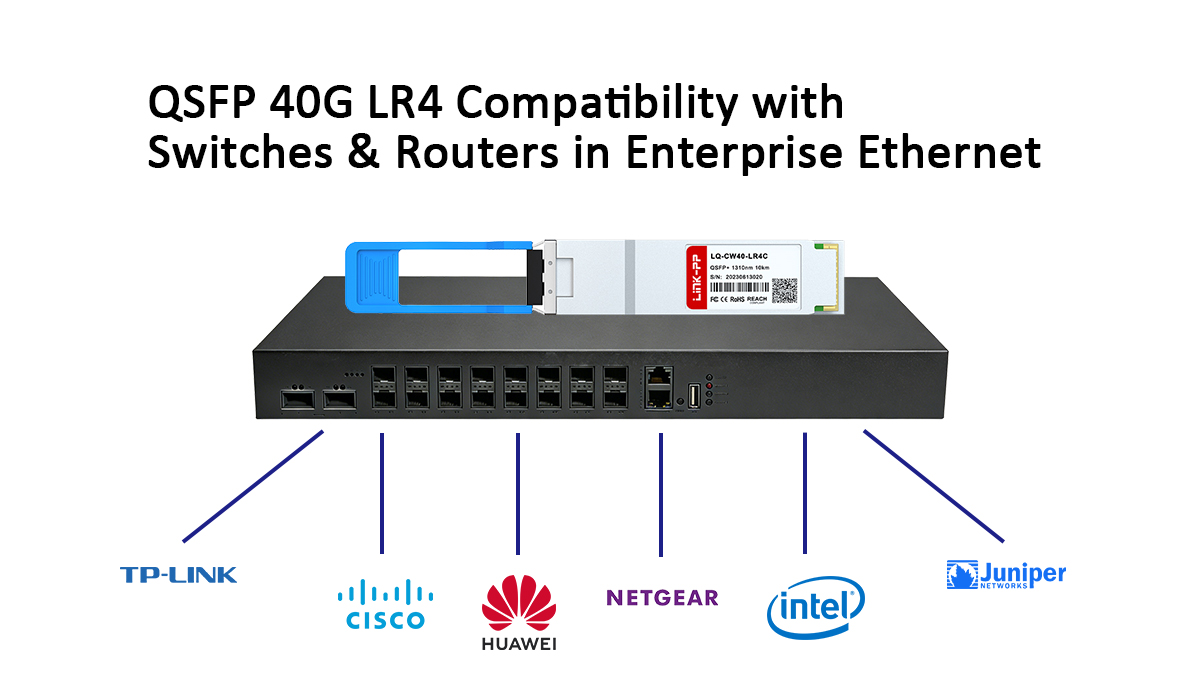
Ensuring Compatibility with Existing Network Hardware
Before deploying QSFP 40G LR4 transceivers in an enterprise network, it is important to verify that the existing switches and routers can support these high-performance modules. Compatibility is determined by factors such as the physical interface, signal protocols, and hardware capabilities. Most switches and routers may require firmware upgrades or specific slot configurations to properly accommodate the LR4 module. Additionally, certain optical modules might require specific transceiver ports on the devices, making it essential to check if these ports are available and configured correctly.
Switch and Router Models Supporting QSFP 40G LR4
A range of enterprise-grade switches and routers support QSFP 40G LR4 modules, especially those designed for high-density, long-range Ethernet connectivity. Major manufacturers such as Cisco, Juniper, Arista, and Dell offer models with 40G capabilities that are compatible with LR4 optics. For instance, Cisco’s Nexus series and Arista’s 7500 series are well-known for their support of QSFP 40G LR4 transceivers. It is important to cross-reference the specifications of your network hardware to ensure that the desired models offer the appropriate transceiver slots and support for long-reach optics.
Importance of MSA Compliance
The Multi-Source Agreement (MSA) is an industry standard that ensures interoperability between various vendors’ equipment and transceivers. The QSFP 40G LR4 module complies with the MSA for optical transceivers, meaning that devices from different manufacturers should be able to communicate seamlessly, provided they are also MSA compliant. This standard is particularly important in enterprise environments where equipment from multiple vendors may be used. Verifying that the switches, routers, and QSFP modules are MSA compliant helps prevent issues related to performance degradation or lack of functionality during deployment.
Tips for Verifying Compatibility Before Deployment
By confirming compatibility at both hardware and software levels, enterprises can ensure stable and efficient 40G link operation with minimal post-deployment troubleshooting. Before installation, administrators should perform several verification steps:
- Check the switch/router transceiver compatibility list for approved 40GBASE-LR4 models and firmware versions.
- Run optical diagnostics using test tools like optical power meters or loopback units to confirm link budgets match design expectations.
- Inspect module labeling and coding to ensure correct vendor ID, serial number, and specification details are read correctly by the switch OS.
- Perform a lab validation test on at least one port pair to simulate real network conditions, verifying signal integrity and DDM reporting.
📝 Pick LINK-PP QSFP 40G LR4 solutions for Your Enterprise Networks
Choosing LINK-PP QSFP 40G LR4 solutions ensures high performance, reliability, and compatibility for modern enterprise Ethernet networks. These optical transceivers are designed for stable 40G long-range data transmission over single mode fiber, adapting smoothly to various environmental conditions and deployment scenarios.
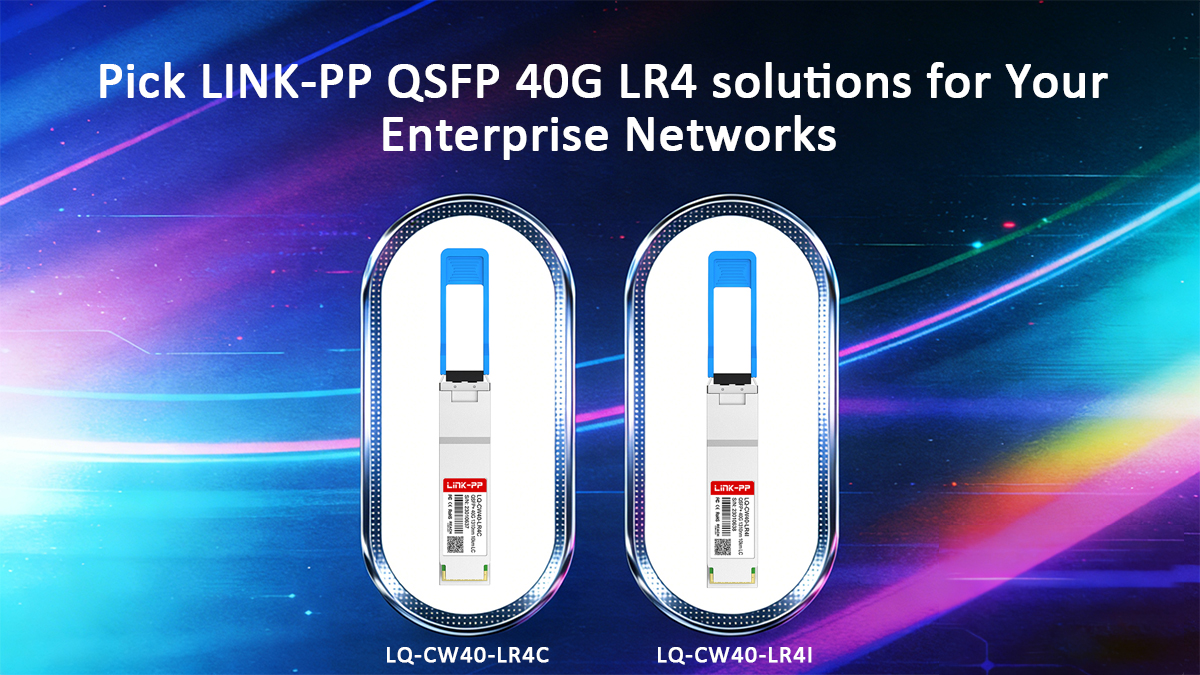
LQ-CW40-LR4C 40GBASE LR4 Module
The LINK-PP LQ-CW40-LR4C is a 40GBASE LR4 optical transceiver designed for long-distance connectivity, supporting transmission distances of up to 10km over single mode fiber (SMF) with LC duplex connectors. It aggregates four 10Gbps channels into a total bandwidth of 40Gbps.
The transceiver utilizes CWDM technology across four wavelengths ranging from 1270nm to 1330nm and complies with the IEEE 802.3ba 40GBASE-LR4 standard. Suitable for enterprise core networks and data center interconnects, this QSFP+ module delivers stable, high-bandwidth performance under standard operating conditions.
Key Specifications of LQ-CW40-LR4C 40GBASE LR4 Module
- Data Rate: 40Gbps
- Reach: Up to 10km on SMF
- Wavelengths: 1271nm, 1291nm, 1311nm, 1331nm
- Connector: Duplex LC
- Transmitter Type: DFB
- Receiver Type: PIN
- Power consumption: ≤3.5W
- Operating temperature: 0°C to +70°C (Commercial Grade)
- Protocols: OTN OTU3, 40G Ethernet, Fiber Channel, SATA/SAS3, MSA Compliant
LQ-CW40-LR4I QSFP+ 40G LR4 Module
The LINK-PP LQ-CW40-LR4I QSFP+ 40G LR4 module shares the same optical design and performance metrics as the commercial-grade LQ-CW40-LR4C model but is optimized for extended-temperature industrial environments. It maintains reliable operation from –40°C to +85°C, making it suitable for deployment in outdoor cabinets, industrial automation networks, or harsh environmental sites.
Key Specifications of LQ-CW40-LR4I QSFP+ 40G LR4 Module
- Data rate: 40Gbps
- Reach: Up to 10km over SMF
- Wavelengths: 1271nm, 1291nm, 1311nm, 1331nm
- Connector: Duplex LC
- Transmitter Type: DFB
- Receiver Type: PIN
- Host FEC: Supported
- Power consumption: ≤ 3.5 W
- Operating temperature: –40°C to +85°C (Industrial Grade)
- Protocols: OTN OTU3, 40G Ethernet, Fiber Channel, SATA/SAS3, MSA Compliant
📝 Frequently Asked Questions Regarding QSFP 40G LR4
What type of fiber and connector does a QSFP 40G LR4 module require?
The QSFP 40G LR4 module requires a duplex single-mode fiber (SMF) patch cable with LC connectors. Specifically, you need two SMF strands (one for transmit, one for receive) to achieve the full 40Gbps data rate over its 10km distance.
Which wavelengths does a QSFP 40G LR4 module use for 40G transmission?
QSFP 40G LR4 modules transmit data across four separate wavelengths—typically 1271nm, 1291nm, 1311nm, and 1331nm. Each wavelength carries a 10G signal that is multiplexed into a single 40G data stream over the same fiber pair.
Can a QSFP 40G LR4 module interoperate with 4×10G links via break-out cables or other transceivers?
The QSFP 40G LR4 module cannot interoperate directly with 4×10G links using break-out cables, because it transmits four 10G lanes multiplexed by wavelength over a single pair of single‑mode fibers. Unlike parallel optics modules such as QSFP 40G SR4, the LR4’s WDM design prevents lane separation into individual 10G channels, so it must connect to another QSFP 40G LR4 of the same type for proper communication.
Is forward error correction (FEC) required for QSFP 40G LR4 links?
FEC is not mandatory for standard 10km operation per the IEEE 802.3ba standard. However, some switch platforms may enable FEC by default for 40G links to improve the link budget and reduce the Bit Error Rate (BER), especially in harsh environmental conditions.
What testing is required before deploying QSFP 40G LR4 modules?
Before deployment, QSFP 40G LR4 modules should undergo performance testing to verify the integrity of the optical link, checking parameters like signal strength, loss, and bit error rate (BER). Ensuring compatibility with the network infrastructure is also critical.
What factors most commonly affect QSFP 40G LR4 link performance?
Key factors include fiber cleanliness, connector quality, and optical alignment accuracy. Additionally, excessive link loss, temperature fluctuations, and mismatched patch cords can degrade optical power levels and increase bit error rates (BER).
📝Building Reliable Enterprise Ethernet with QSFP 40G LR4
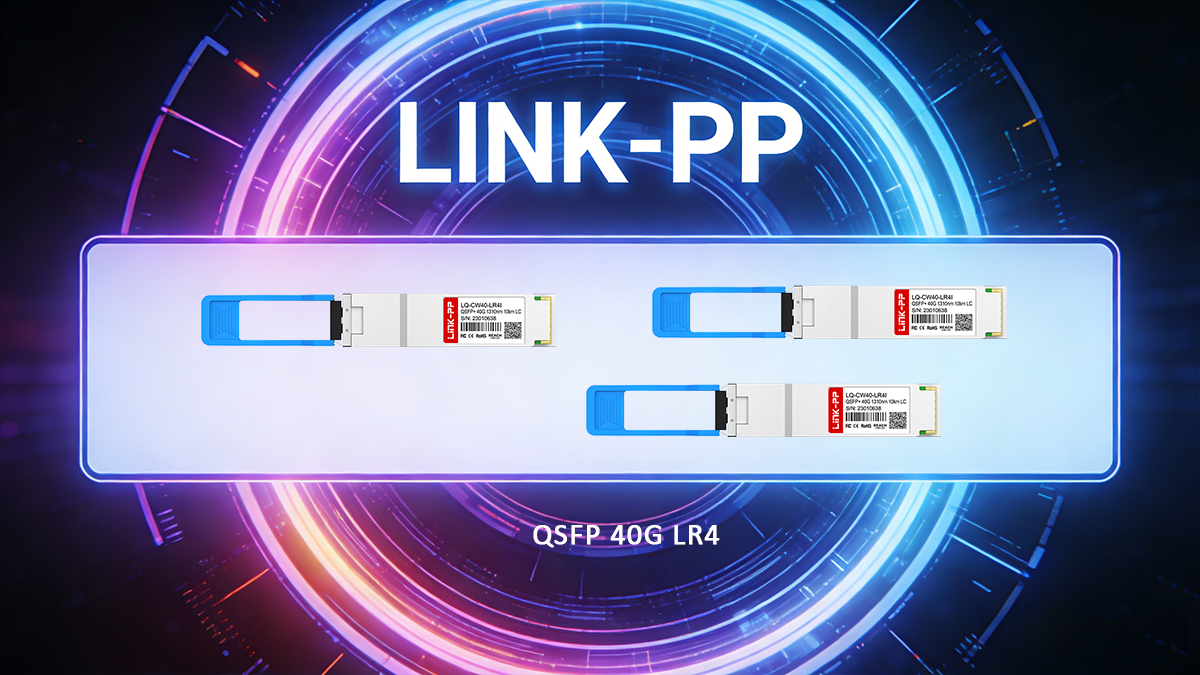
Building a reliable enterprise Ethernet network requires a careful balance between performance, distance, scalability, and long-term cost efficiency. QSFP 40G LR4 plays a critical role in achieving this balance by enabling stable 40GbE transmission over single-mode fiber for distances of up to 10 km. Its CWDM-based architecture allows enterprises to consolidate four 10G channels into a single high-capacity link, significantly reducing fiber consumption while maintaining excellent signal integrity. This makes QSFP 40G LR4 especially valuable for core networks, data center interconnects, and backbone links where reliability performance is non-negotiable.
From an architectural perspective, QSFP 40G LR4 supports cleaner network design and easier scalability. By using duplex LC connectors and standardized wavelengths, it integrates seamlessly with existing single-mode fiber infrastructure and MSA-compliant switches from major vendors. Enterprises can scale bandwidth without redesigning their cabling systems or adding unnecessary intermediate devices, which lowers operational complexity and minimizes potential failure points. In addition, its low bit error rate and mature optical technology help ensure consistent throughput for latency-sensitive applications such as cloud services, virtualization platforms, and real-time communications.
Finally, QSFP 40G LR4 enables enterprises to future-proof their Ethernet networks while maintaining control over deployment costs. It offers a practical middle ground between short-reach SR4 and long-haul ER4 solutions, delivering sufficient reach for most enterprise scenarios without the higher power consumption and expense of extended-reach optics. When paired with high-quality, rigorously tested transceivers, QSFP 40G LR4 becomes a dependable foundation for resilient, high-performance enterprise Ethernet. To explore proven QSFP 40G LR4 solutions designed for demanding enterprise environments, visit the LINK-PP Official Store and discover how LINK-PP can support your 40G enterprise network upgrade.