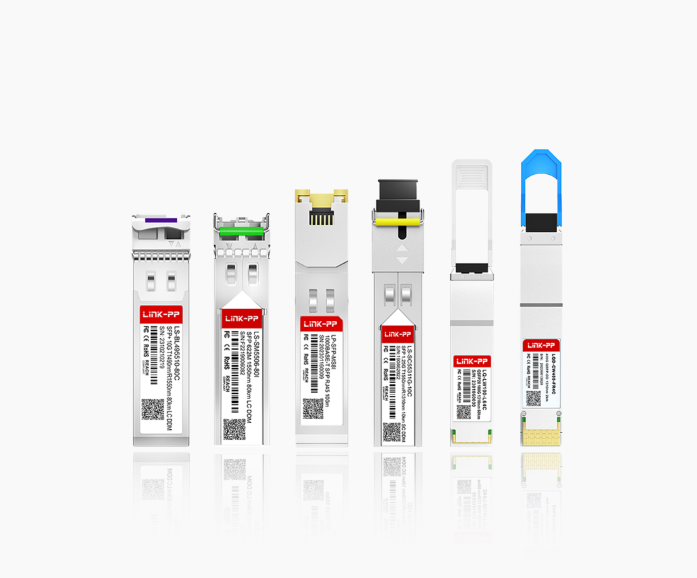
MMF vs SMF: Multimode fiber (MMF) is typically used for short-distance, cost-efficient connections inside data centers and buildings, while single-mode fiber (SMF) is designed for long-distance, high-bandwidth transmission across campuses, metro links, and telecom networks. The right choice depends primarily on required distance, speed, budget, and future scalability.
Fiber optic networks rely on these two core fiber types, and understanding the differences between MMF and SMF is essential for network architects, data center operators, and IT buyers. Although both transmit data using light, they differ in core size, transmission distance, optical module compatibility, and total cost of ownership. These differences directly affect how networks are designed, upgraded, and scaled.
This guide explains the key differences between MMF vs SMF in a structured, decision-oriented way. It compares distance limits, bandwidth potential, cost considerations, and real-world deployment scenarios, helping you determine which fiber type best fits your current infrastructure and long-term network strategy.
🆚 What Is Multimode Fiber (MMF)?
Multimode fiber (MMF) is a fiber optic cable designed for short-distance data transmission, commonly used inside data centers, enterprise buildings, and campus environments where links typically stay within a few hundred meters. It uses a larger core that allows multiple light modes to travel simultaneously, enabling cost-efficient high-speed connectivity over short reaches.
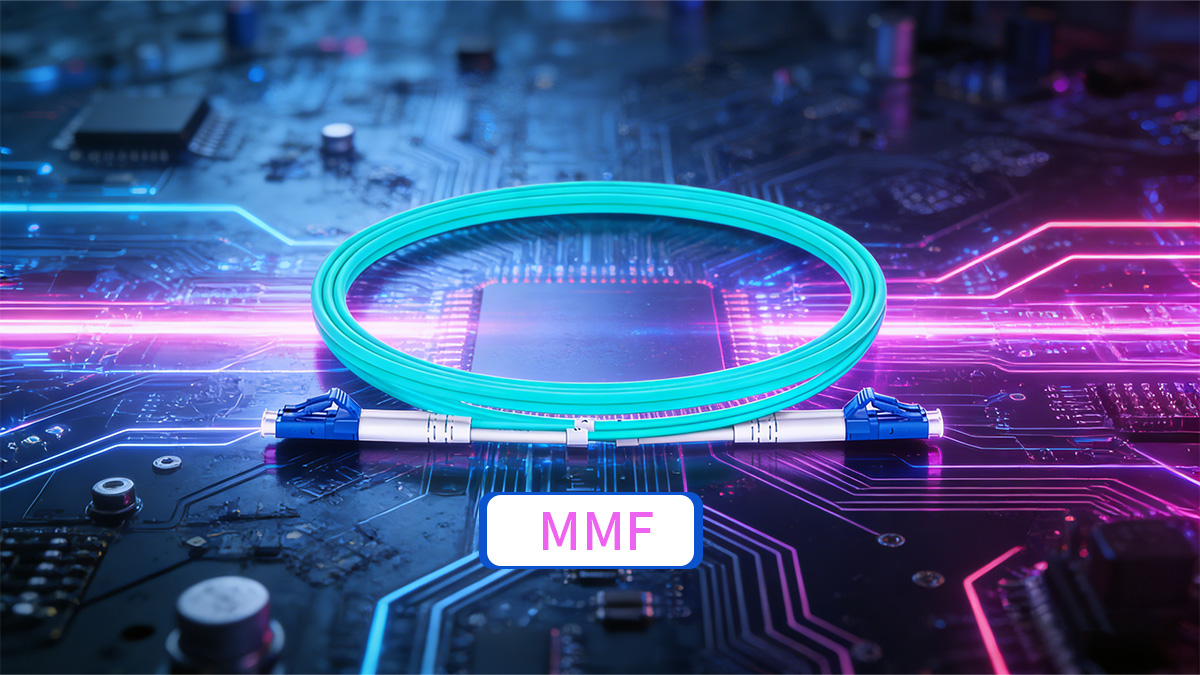
Core Structure and How MMF Works
MMF uses a larger core (50µm or 62.5µm) that allows multiple light paths to propagate, which makes it easier to connect but limits long-distance performance due to modal dispersion.
| Parameter |
Multimode Fiber (MMF) |
| Core size |
50µm / 62.5µm |
| Light propagation |
Multiple modes |
| Typical wavelengths |
850nm, 1310nm |
| Distance focus |
Short-range links |
Because multiple light signals travel through different paths inside the core, they arrive at slightly different times. This phenomenon—modal dispersion—limits the maximum distance at higher speeds but keeps optics simpler and more affordable for short links.
Common MMF Types (OM1–OM5)
Modern MMF is categorized into OM fiber grades, with OM3 and OM4 being the most widely deployed in high-speed data centers today.
| MMF type |
Core size |
Typical use |
| OM1 |
62.5µm |
Legacy systems |
| OM2 |
50µm |
Older enterprise networks |
| OM3 |
50µm |
10G/40G data centers |
| OM4 |
50µm |
40G/100G short reach |
| OM5 |
50µm |
SWDM applications |
OM3 and OM4 are optimized for laser-based transmission and support higher data rates over longer short-reach distances, making them the standard choice for modern switch-to-switch connections inside data centers.
Key Characteristics of MMF
MMF is best suited for high-speed, short-distance connections where lower transceiver cost and high port density are priorities.
Typical advantages:
-
Lower optical transceiver cost (e.g., SR optics)
-
Easier alignment due to larger core
-
Ideal for high-density rack and row connections
-
Widely used in data centers and enterprise LANs
Typical limitations:
-
Shorter transmission distance than SMF
-
Distance decreases as speed increases
-
Less suitable for campus or metro links
In practice, MMF is most often deployed for connections such as switch-to-switch, spine-leaf architectures, and server aggregation within the same data hall. It remains a cost-effective solution for high-bandwidth environments where link distances stay within a few hundred meters.
🆚 What Is Single-Mode Fiber (SMF)?
Single-mode fiber (SMF) is a fiber optic cable designed for long-distance, high-bandwidth transmission, commonly used in campus, metro, and telecom networks where links range from kilometers to tens of kilometers. It uses a much smaller core that allows light to travel in a single path, minimizing signal distortion and enabling significantly longer reach than multimode fiber.
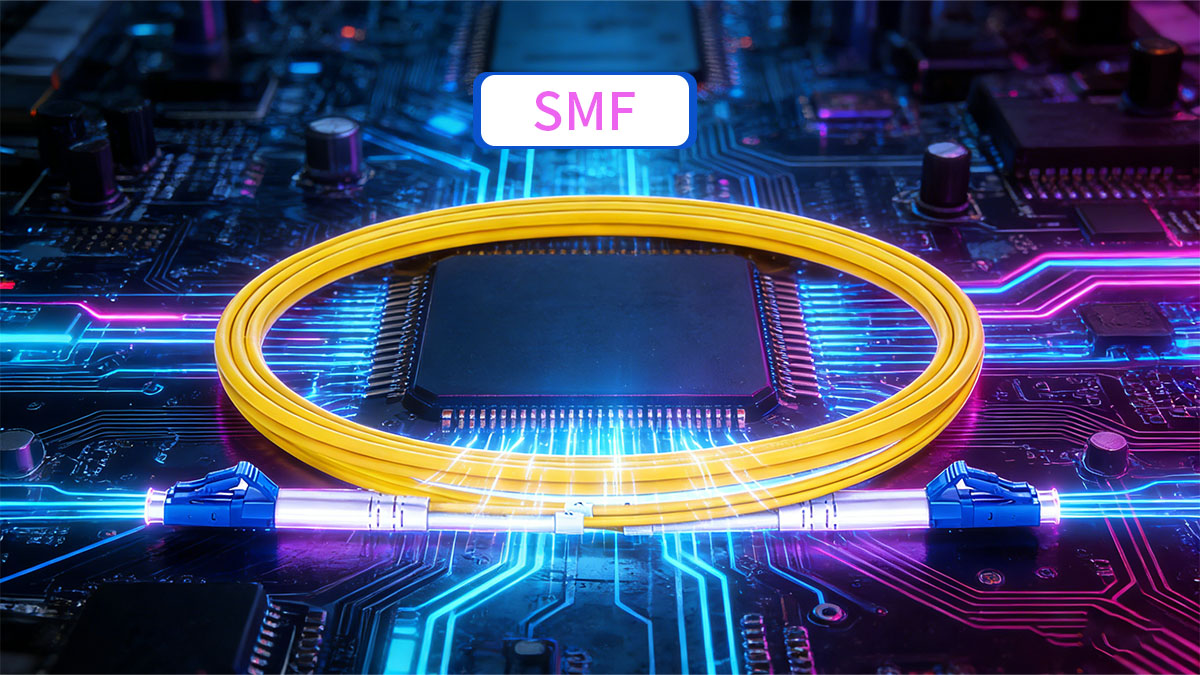
Core Structure and How SMF Works
SMF uses a small core (about 9µm) that supports a single light propagation mode, which reduces dispersion and allows signals to travel much farther with higher bandwidth stability.
| Parameter |
Single-Mode Fiber (SMF) |
| Core size |
≈9µm |
| Light propagation |
Single mode |
| Typical wavelengths |
1310nm, 1550nm |
| Distance focus |
Long-range links |
Because light travels along one primary path, signal spreading is greatly reduced compared with multimode fiber. This enables consistent performance across long distances and supports higher speeds without the same distance limitations seen in MMF deployments.
Common SMF Types
OS1 vs OS2: SMF is generally categorized into OS1 and OS2, with OS2 being the standard choice for modern long-distance and outdoor deployments.
| SMF type |
Typical environment |
Distance capability |
| OS1 |
Indoor |
Shorter long-range |
| OS2 |
Outdoor / campus |
Long-distance links |
OS2 fiber has lower attenuation and is optimized for longer transmission distances, making it the preferred option for campus backbones, inter-building links, and metro networks.
Key Characteristics of SMF
SMF is best suited for long-distance, scalable networks where future bandwidth growth and reach are key considerations.
Typical advantages:
-
Supports transmission over kilometers to tens of kilometers
-
Higher bandwidth scalability
-
Lower attenuation and dispersion
-
More future-proof for high-speed upgrades
Typical limitations:
-
Optical transceivers typically cost more than MMF optics
-
Alignment is more precise due to smaller core
-
Overkill for very short links
In real-world deployments, SMF is widely used for building-to-building connections, campus backbones, metro aggregation networks, and any scenario where distance and scalability outweigh the higher optics cost.
🆚 MMF vs SMF: Side-by-Side Comparison
The key difference between MMF vs SMF is that MMF is optimized for short-distance, lower-cost links inside buildings and data centers, while SMF is designed for long-distance, high-bandwidth transmission across campuses, metro networks, and beyond. The choice usually comes down to distance requirements, optics cost, and long-term scalability.
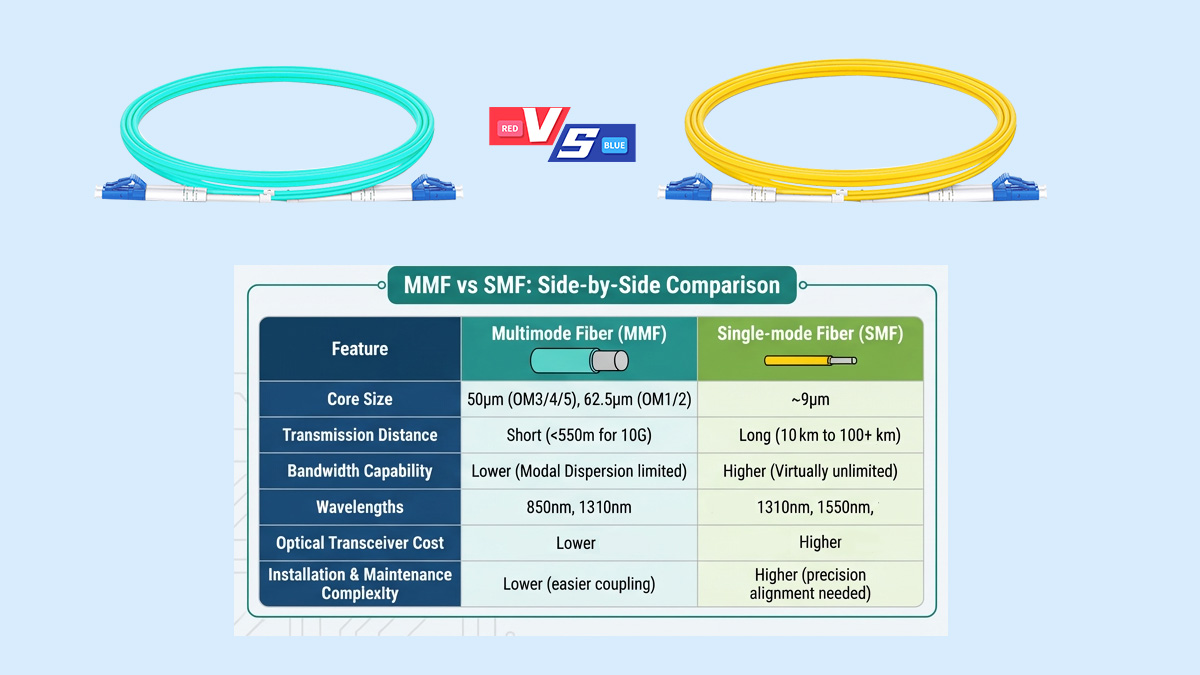
Core Differences at a Glance
MMF is typically used for short-reach high-speed connections, whereas SMF supports longer distances and better future scalability.
| Factor |
MMF (Multimode Fiber) |
SMF (Single-Mode Fiber) |
| Core size |
50µm / 62.5µm |
≈9µm |
| Typical distance |
Up to hundreds of meters |
Kilometers to tens of km |
| Common wavelengths |
850nm, 1300nm |
1310nm, 1550nm |
| Optics cost |
Lower |
Higher |
The larger core of MMF allows multiple light paths, which simplifies optics and reduces cost but limits distance. In contrast, SMF's small core enables a single light path, reducing dispersion and supporting much longer transmission distances.
Performance and Scalability Differences
SMF provides better long-term scalability for higher speeds and longer links, while MMF remains more cost-effective for short-distance high-density deployments.
| Consideration |
MMF |
SMF |
| Distance scalability |
Limited |
High |
| Bandwidth potential |
Moderate–high |
Very high |
| Future upgrades |
Short-range focused |
Long-term scalable |
| Typical deployment |
Data centers |
Campus/metro/backbone |
As network speeds move from 10G to 40G, 100G, and beyond, the distance limits of MMF decrease, whereas SMF can maintain longer reach across speed upgrades. This makes SMF more suitable for backbone and inter-building infrastructure, while MMF continues to dominate inside data halls where distances remain short.
When Each Fiber Type Is Typically Chosen
MMF is usually selected for short, high-density connections where cost per link matters most, while SMF is chosen for longer links and future-proof infrastructure planning.
MMF is commonly used when:
-
Link distance is under ~300m
-
Deployment is inside a data center
-
High port density is required
-
Lower transceiver cost is a priority
SMF is commonly used when:
-
Links span buildings or campuses
-
Distance exceeds a few hundred meters
-
Long-term scalability is important
-
Network backbone is being built
In practice, many modern networks use both fiber types: MMF for short internal connections and SMF for longer backbone links. Understanding these complementary roles is key to designing cost-efficient and scalable fiber infrastructure.
🆚 Transmission Distance and Bandwidth Differences
The most important difference in MMF vs SMF performance is transmission distance: MMF is optimized for short-reach links (typically up to a few hundred meters), while SMF supports distances from several kilometers to tens of kilometers at the same data rates. Bandwidth scalability also favors SMF as speeds increase.
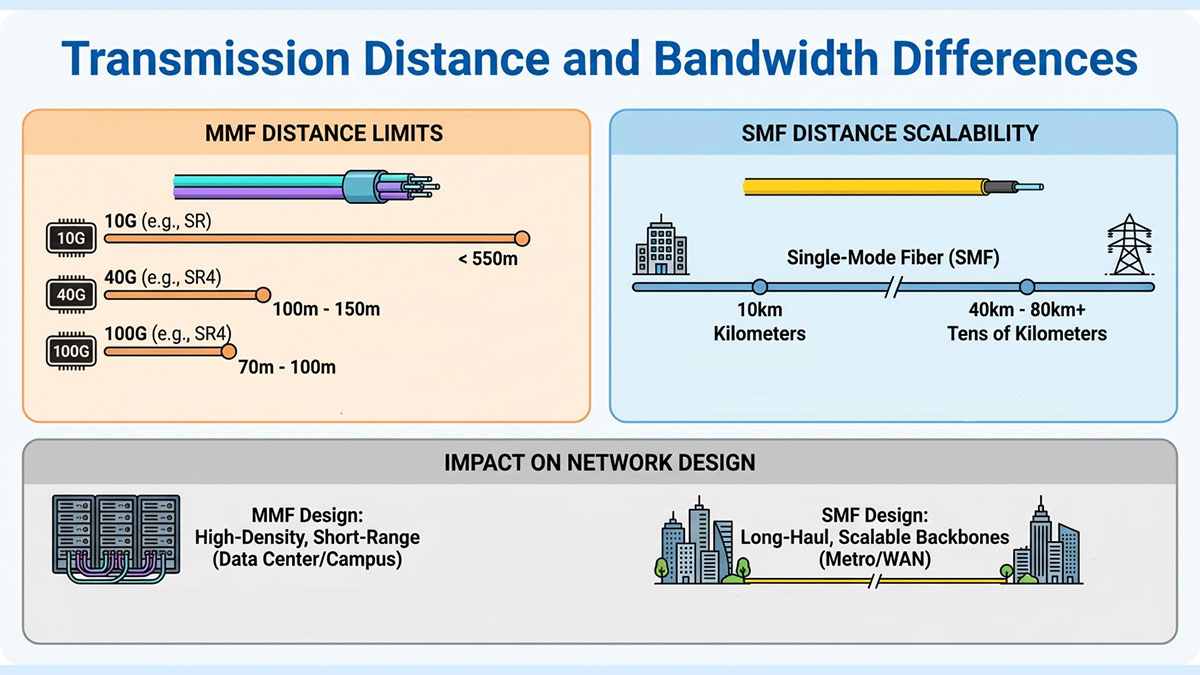
Distance Limits at Common Data Rates
As data rates increase, MMF distance decreases significantly, whereas SMF maintains long reach across speed upgrades.
| Data rate |
MMF typical reach |
SMF typical reach |
| 10G |
up to ~300m |
10km+ |
| 40G |
up to ~150m |
10km+ |
| 100G |
up to ~100m |
10km+ |
| 400G |
tens of meters |
2km–10km+ |
These ranges vary based on fiber grade (OM3/OM4/OM5 for MMF, OS2 for SMF) and SFP transceiver types, but the pattern remains consistent: MMF is designed for short-range high-speed links, while SMF supports much longer distances at the same or higher speeds.
Bandwidth and Signal Integrity
SMF offers higher theoretical bandwidth and better signal integrity over long distances because it eliminates modal dispersion, while MMF is constrained by multiple light paths that limit reach at higher speeds.
-
MMF bandwidth behavior
-
Supports high speeds over short distances
-
Distance decreases as speed increases
-
Ideal for high-density short links
-
SMF bandwidth behavior
-
Maintains performance over long distances
-
Scales more easily to higher speeds
-
Better suited for backbone upgrades
In practical deployments, MMF performs extremely well inside data centers where link lengths are short and predictable. However, when distances exceed a few hundred meters—or when future speed upgrades are expected—SMF becomes the more scalable option.
Impact on Network Design
Distance and bandwidth characteristics directly determine where MMF or SMF should be deployed within a network architecture.
-
Use MMF for:
-
Use SMF for:
Many modern infrastructures adopt a hybrid approach: MMF inside the data center for cost efficiency, and SMF for backbone and longer aggregation links. This combination balances short-term cost with long-term scalability.
🆚 Cost Considerations: MMF vs SMF
From a cost perspective, MMF vs SMF is not just about cable price—MMF typically has lower transceiver costs for short links, while SMF often delivers better total cost efficiency for longer distances and long-term scalability. The right choice depends on link length, upgrade plans, and network lifecycle.
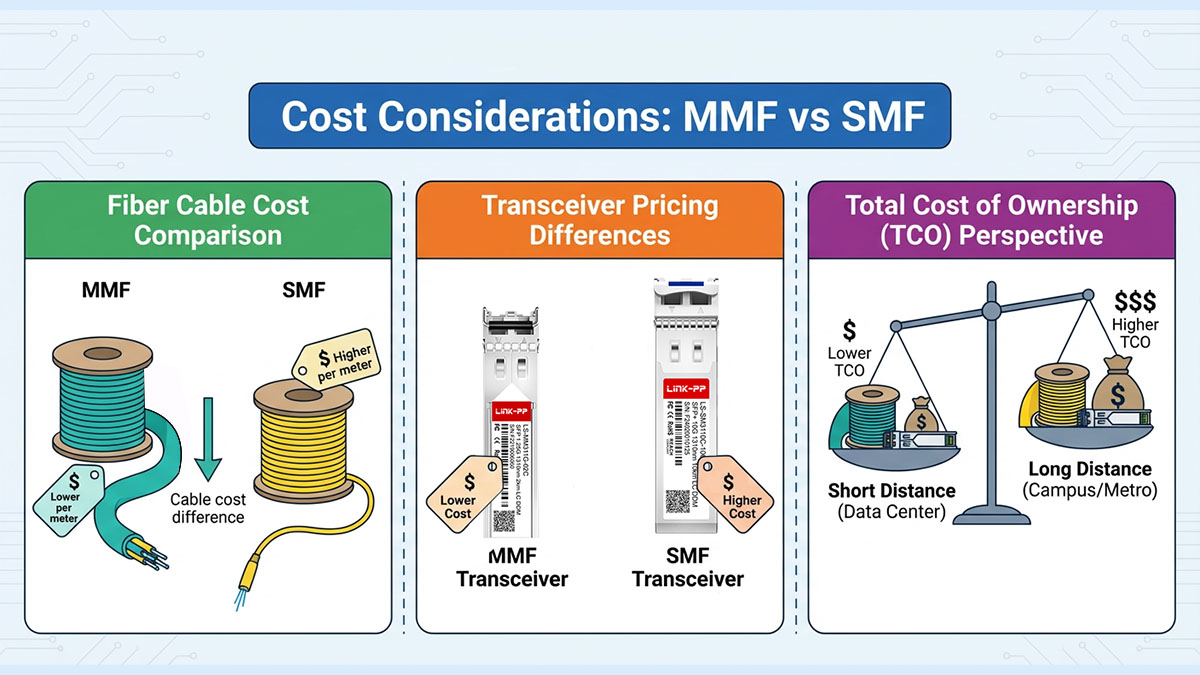
Cable vs Optics Cost
MMF cabling is usually more expensive per meter than SMF, but MMF optical modules (such as SX optics) are typically cheaper than SMF modules for short-reach links.
| Cost factor |
MMF |
SMF |
| Fiber cable |
Higher per meter |
Lower per meter |
| Optical transceivers |
Lower cost |
Higher cost |
| Short-distance deployment |
More economical |
Less economical |
| Long-distance deployment |
Not cost-effective |
More economical |
Although MMF cable can cost more per meter, the overall link cost for short distances is often lower because multimode optics are simpler and less expensive. For long-distance links, however, SMF becomes more cost-effective because MMF cannot support those distances without repeaters or redesign.
Total Cost of Ownership (TCO)
Over the long term, SMF can provide better total cost of ownership when networks require scalability, longer reach, or future speed upgrades.
Key TCO considerations:
-
Upgrade cycles:
SMF infrastructure can often support multiple speed upgrades without replacing the fiber plant.
-
Distance expansion:
If network distances grow, SMF avoids re-cabling.
-
Lifecycle planning:
MMF may require replacement if future speeds exceed its distance limits.
In contrast, MMF remains cost-efficient when:
-
Distances are short and stable
-
Infrastructure is contained within a data hall
-
High port density is required
-
Budget per link is a primary concern
Practical Cost Decision Guidelines
MMF is typically more cost-effective for short, high-density links under a few hundred meters, while SMF is usually the better investment for longer links and future-proof network designs.
Choose MMF when:
-
Links are inside a data center
-
Distance is under ~300m
-
Lower transceiver cost matters
-
High port density is needed
Choose SMF when:
-
Links span buildings or campuses
-
Distance exceeds a few hundred meters
-
Long-term upgrades are expected
-
Fiber plant replacement would be costly
In many modern network designs, organizations deploy MMF for short internal connections and SMF for backbone infrastructure. Evaluating both upfront cost and long-term scalability ensures the most cost-effective fiber strategy.
🆚 Typical Use Cases for MMF
Multimode fiber (MMF) is most commonly used for short-distance, high-speed connections inside data centers and enterprise buildings where link lengths typically remain under a few hundred meters. Its lower-cost optics and support for high port density make it ideal for dense switching environments.
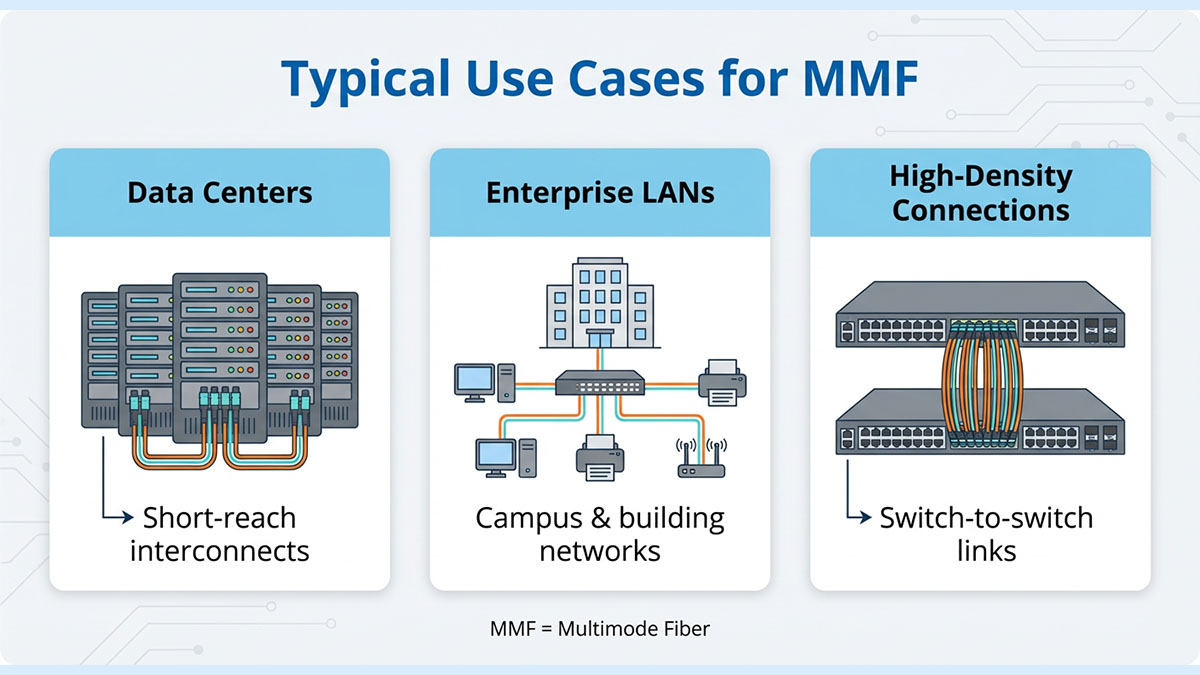
Data Center Interconnects
MMF is widely used for switch-to-switch and switch-to-server links within the same data hall, where distances are short and predictable.
| Scenario |
Typical distance |
Why MMF fits |
| Rack-to-rack links |
5–30m |
Low-cost optics |
| Spine–leaf connections |
30–150m |
High port density |
| Row-to-row links |
50–200m |
Short, stable reach |
| Intra–data hall backbone |
<300m |
Cost-efficient scaling |
In these environments, MMF paired with short-reach optical modules (such as 10GBASE-SR) provides a cost-effective way to support high bandwidth across many ports without the higher optics cost associated with long-reach single-mode solutions.
Enterprise and Building Networks
MMF is also commonly deployed inside office buildings and enterprise campuses for floor-to-floor or equipment-room connections where distances remain relatively short.
Typical enterprise uses include:
-
IDF-to-MDF connections within buildings
-
Floor distribution switches
-
High-speed LAN backbones
-
AV and storage networks inside facilities
Because distances are usually well below the limits of modern MMF (OM3/OM4), it remains a practical and economical choice for internal building infrastructure.
High-Density Short-Reach Deployments
MMF is preferred in environments where many short links are required and minimizing cost per port is critical.
MMF is a strong fit when:
-
Link distance is under ~300m
-
Deployment is contained within a building or data hall
-
Large numbers of optical ports are needed
-
Power consumption and cost per link matter
However, MMF becomes less practical when links must extend beyond a few hundred meters or when long-term upgrades to higher speeds require longer reach. In those cases, SMF is typically used for backbone and inter-building connections, while MMF continues to serve short internal links.
🆚 Typical Use Cases for SMF
Single-mode fiber (SMF) is primarily used for medium- to long-distance links where transmission ranges from several hundred meters to tens of kilometers and where long-term scalability is required. It is the standard choice for campus backbones, inter-building connections, metro aggregation, and telecom infrastructure.
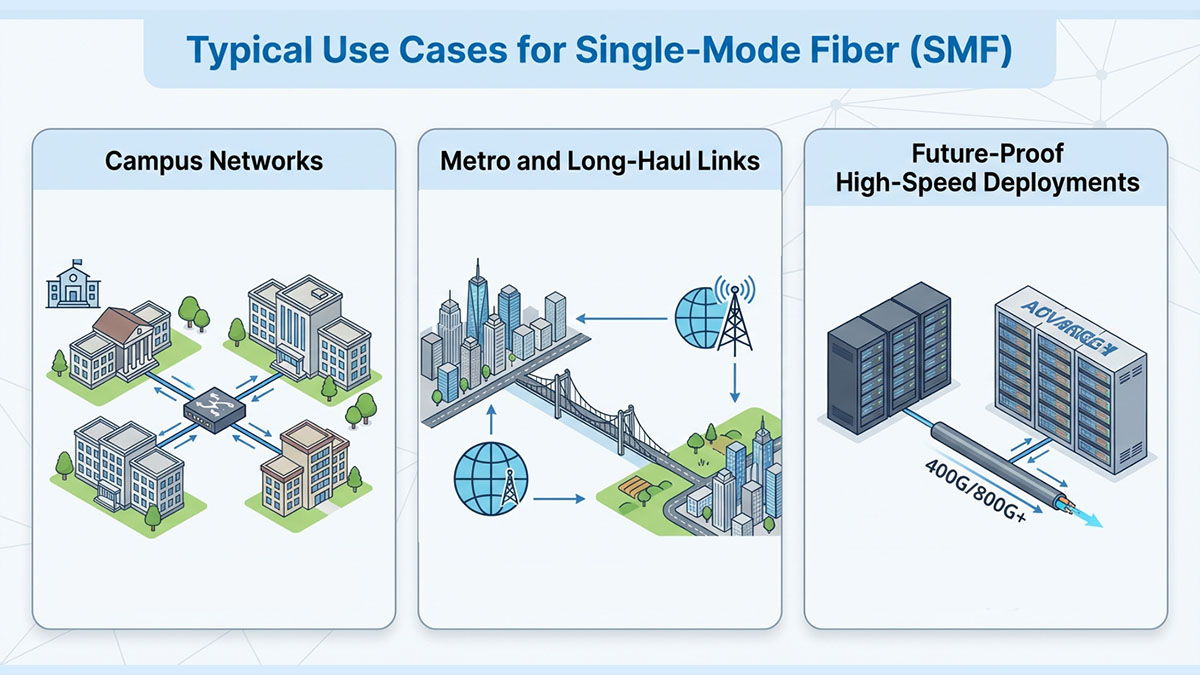
Building-to-Building and Campus Backbones
SMF is the preferred option for connecting buildings across a campus or industrial site because it supports longer distances without repeaters and maintains performance at higher speeds.
| Scenario |
Typical distance |
Why SMF fits |
| Building-to-building links |
300m–2km |
Stable long reach |
| Campus backbone |
1–10km |
Scalable bandwidth |
| Industrial park networks |
1–5km |
Low attenuation |
| Security/monitoring links |
Long outdoor runs |
Reliable signal |
Using SMF for these backbone links allows organizations to scale network speeds over time without replacing the fiber infrastructure, making it a long-term investment for campus networks.
Metro and Long-Distance Networks
SMF is widely used in metro and service provider networks where links extend across cities or between facilities over many kilometers.
Common scenarios include:
-
Data center interconnect (DCI) across campuses
-
Metro aggregation networks
-
Telecom access and transport
-
Long-haul backbone infrastructure
In these environments, SMF's low attenuation and minimal dispersion allow signals to travel long distances with consistent performance, even at higher data rates.
Future-Proof High-Speed Deployments
SMF is often selected when long-term scalability and future upgrades are priorities, even if initial link distances are moderate.
SMF is typically chosen when:
-
Distance exceeds a few hundred meters
-
Network expansion is expected
-
Higher speeds will be deployed later
-
Re-cabling would be costly
Because SMF supports longer reach across multiple speed generations, many organizations deploy it for backbone infrastructure while continuing to use MMF for short internal links. This hybrid approach balances immediate cost efficiency with long-term network scalability.
🆚 MMF vs SMF: Compatibility With Optical Transceivers
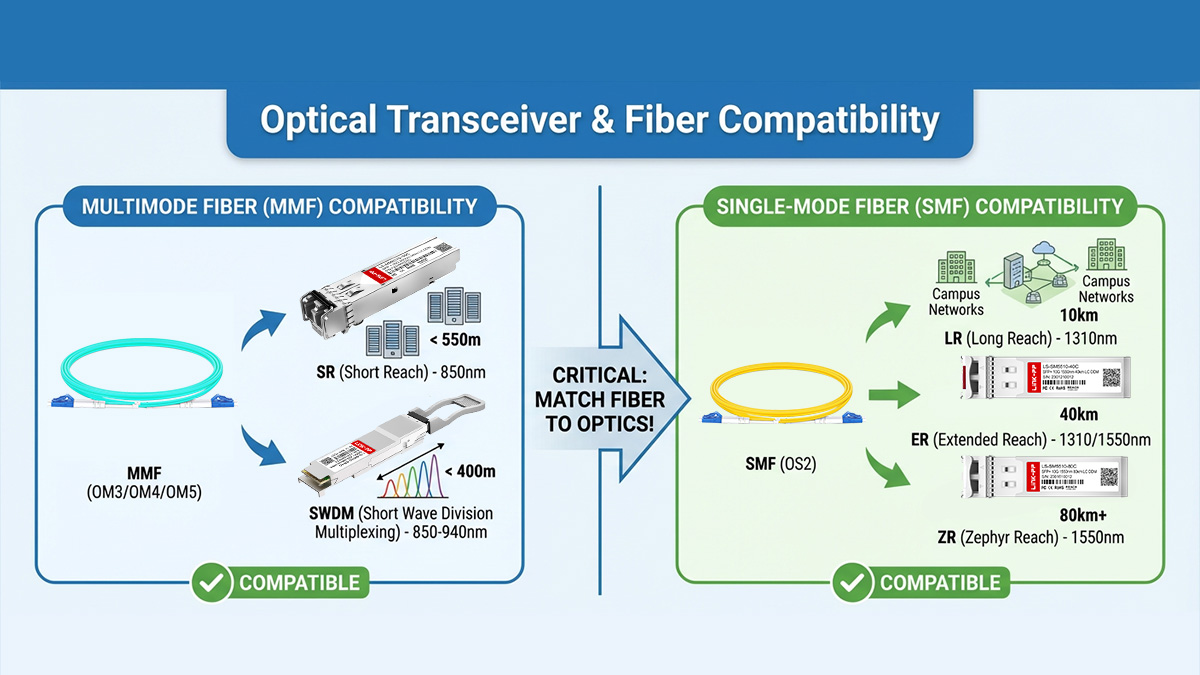
In MMF and SMF deployments, fiber type must always match the optical transceiver type: MMF works with short-reach SR/SWDM optics, while SMF requires LR/ER/ZR long-reach optics. Using the wrong combination will either prevent link establishment or severely limit performance.
MMF vs SMF Transceiver Matching
MMF is typically paired with short-wavelength optics for short distances, while SMF is paired with long-wavelength optics for extended reach.
| Fiber type |
Typical optics |
Wavelength range |
Distance focus |
| MMF |
SR, SR4, SWDM |
850nm |
Short reach |
| SMF |
LR, ER, ZR |
1310nm, 1550nm |
Long reach |
Short-reach (SR) optical modules are optimized for multimode fiber and operate at shorter wavelengths, making them cost-efficient for data center links. Long-reach modules such as LR transceiver or ER transceiver are designed for single-mode fiber and support significantly longer transmission distances.
Why Fiber and Optics Must Match
Optical modules are engineered for specific fiber types, and mixing MMF optics with SMF—or vice versa—typically results in signal loss, link failure, or unstable performance.
Key compatibility rules:
-
MMF optics require multimode fiber core sizes
-
SMF optics require single-mode fiber
-
Connector types may match (e.g., LC), but fiber type must still align
-
Wavelength and launch power differ between MMF and SMF optics
Even when connectors appear identical, the underlying fiber characteristics determine whether a link will function correctly.
Practical Deployment Scenarios
Most networks use different optics for short internal links and longer backbone links, aligning transceiver type with fiber distance requirements.
Typical pairings:
-
MMF + SR optics → rack-to-rack and switch-to-switch links
-
MMF + MPO SR4 optics → high-density data center connections
-
SMF + LR optics → building-to-building links
-
SMF + ER/ZR optics → campus or metro connections
Selecting the correct fiber and optical module combination ensures stable performance, predictable reach, and efficient network scaling. When planning new deployments or upgrades, verifying transceiver compatibility with existing fiber infrastructure is a critical step in avoiding costly redesigns.
🆚 How to Choose Between MMF and SMF
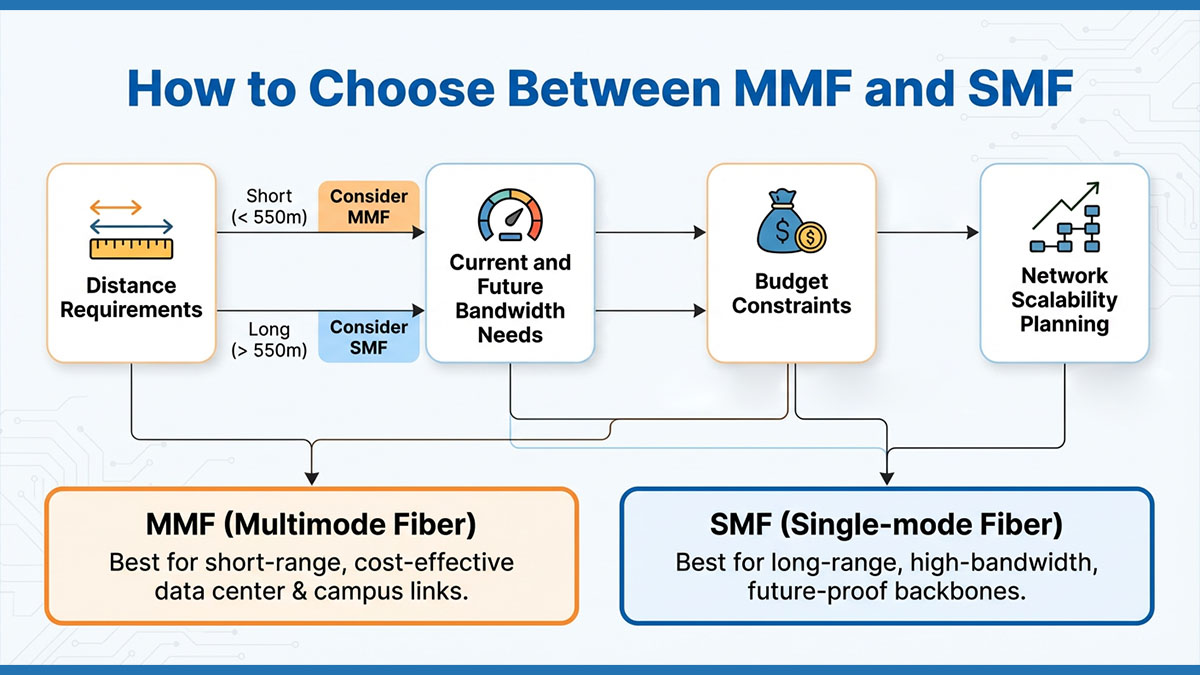
Choosing between MMF vs SMF depends mainly on three factors: link distance, future bandwidth plans, and total cost over time. MMF is usually the best choice for short, high-density links inside buildings, while SMF is better suited for longer distances and long-term scalability.
Quick Decision Guide
If the link is under a few hundred meters and confined to a data center or building, MMF is typically more cost-effective. If the link exceeds a few hundred meters or must scale in the future, SMF is usually the better long-term option.
| Decision factor |
Choose MMF when… |
Choose SMF when… |
| Distance |
<300m |
>300–500m |
| Deployment area |
Inside building |
Between buildings/campus |
| Upgrade horizon |
Short-term stable |
Long-term scaling |
| Optics budget |
Lower per link needed |
Higher upfront acceptable |
This comparison reflects the most common real-world design approach: MMF for short internal links and SMF for backbone or extended connections.
Key Questions to Ask Before Deciding
Start by evaluating distance and growth expectations—these two factors determine most MMF vs SMF decisions.
Consider MMF if:
-
Links remain inside a data hall or building
-
Distances are short and predictable
-
High port density is required
-
Minimizing optics cost per link is important
Consider SMF if:
-
Links connect multiple buildings
-
Distances may grow over time
-
Future speed upgrades are likely
-
Replacing fiber later would be costly
Answering these questions early helps avoid expensive re-cabling or incompatible optics later in the network lifecycle.
Planning for Future Scalability
When long-term upgrades are expected, SMF often provides more flexibility because it can support higher speeds and longer distances without replacing the fiber plant.
Typical planning strategies:
-
Use MMF for short, high-density data center links
-
Use SMF for backbone and aggregation layers
-
Deploy a hybrid approach for balanced cost and scalability
Many modern networks intentionally combine both fiber types: MMF handles short internal connections efficiently, while SMF supports longer backbone links and future expansion. Designing with this layered approach helps maintain cost efficiency today while preserving upgrade options for tomorrow.
🆚 Common Misconceptions About MMF and SMF
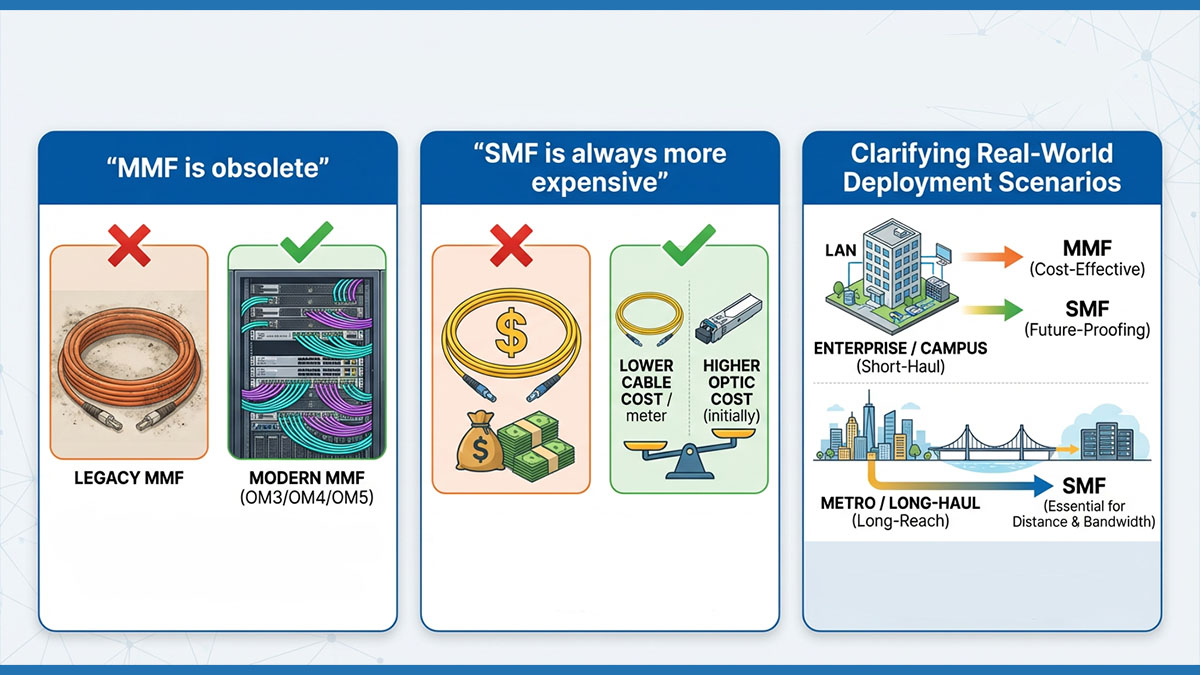
Many MMF and SMF decisions are influenced by outdated assumptions—such as “SMF is always too expensive” or “MMF is obsolete.” In reality, both fiber types remain widely used because they solve different distance, cost, and scalability needs. Understanding these misconceptions helps avoid overbuilding or underbuilding a network.
“MMF Is Obsolete”
MMF is not obsolete; it remains the dominant choice for short-distance, high-density data center links where cost per port matters.
| Claim |
Reality |
| MMF is outdated |
Still widely used in data centers |
| Only SMF supports high speeds |
MMF supports high speeds at short reach |
| MMF cannot scale |
Scales well within short distances |
| SMF replaces MMF everywhere |
Both coexist in modern networks |
Modern OM3/OM4 multimode fiber supports high-speed connections inside data centers and enterprise environments. While SMF dominates long-distance links, MMF continues to be deployed wherever short, predictable distances are required.
“SMF Is Always More Expensive”
SMF optics typically cost more upfront, but SMF can be more cost-effective over time when distance or upgrade flexibility is required.
-
SMF cable is often cheaper per meter than MMF
-
SMF supports longer distances without redesign
-
SMF may avoid future re-cabling costs
-
MMF remains cheaper for short links
The real cost difference depends on deployment scale and lifecycle planning, not just initial module price.
“You Must Choose Only One Fiber Type”
Most modern networks use both MMF and SMF together, assigning each to the environment where it performs best.
Typical hybrid approach:
-
MMF for short in-building links
-
SMF for backbone and inter-building links
-
SMF for future expansion paths
-
MMF for high-density switching layers
Using a hybrid design allows organizations to balance immediate cost efficiency with long-term scalability instead of forcing a single fiber type across all layers.
“Fiber Type Alone Determines Performance”
Performance depends on the combination of fiber type, optical modules, distance, and network design—not just whether the fiber is MMF or SMF.
Important considerations include:
Choosing the right fiber type is only one part of a successful optical network design. Matching fiber, optics, and distance requirements ensures stable and efficient performance across the entire infrastructure.
🆚 FAQs About MMF vs SMF
Q1: Is MMF or SMF better for data centers?
MMF is usually better for short in-rack and row-to-row data center links under a few hundred meters, while SMF is better for data center interconnects or campus-scale connections that require longer reach.
Q2: Can MMF and SMF be used in the same network?
Yes. Most modern networks use MMF for short internal links and SMF for backbone or inter-building connections, as each fiber type is optimized for different distance ranges.
Q3: Should I choose SMF for future-proofing?
If link distances may grow or higher speeds are expected over time, SMF is generally the safer long-term choice because it supports longer reach and multiple upgrade cycles without replacing the fiber.
Q4: Is MMF cheaper than SMF?
MMF links are typically cheaper for short distances due to lower-cost optics, but SMF can be more cost-effective for longer links or networks that will expand in the future.
Q5: Can I use SMF optics on MMF fiber?
No. Optical transceivers must match the fiber type; using SMF optics on MMF or vice versa usually results in link failure or severe signal loss.
Q6: How do I decide between MMF and SMF quickly?
Choose MMF for links under ~300m inside buildings and choose SMF for links beyond that distance or for backbone connections where scalability and reach matter most.
🆚 Conclusion
The core takeways in MMF vs SMF is simple: MMF is best for short-distance, cost-efficient connections within buildings and data centers, while SMF is the preferred choice for long-distance links, backbone networks, and future-proof scalability. Choosing the right fiber type based on distance, bandwidth growth, and lifecycle cost ensures a network that performs reliably today and scales efficiently tomorrow. If you're planning new deployments or upgrades, you can source compatible MMF and SMF transceivers, cables, and connectivity solutions through the LINK-PP Official Store to match the right fiber with the right optics for your infrastructure.