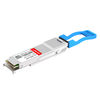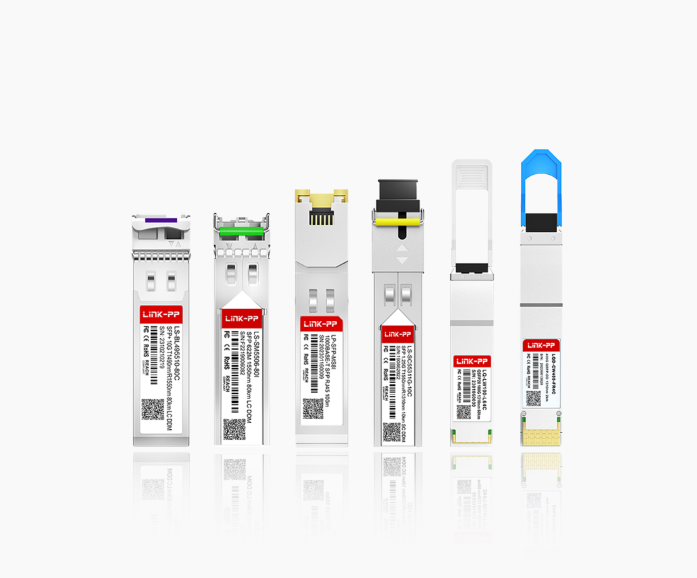
QSFP 40G ER4 is a long-reach 40Gbps optical transceiver designed for up to 40km transmission over single-mode fiber, making it a practical choice for data center interconnection, metro links, and enterprise backbone networks that exceed the 10km range of standard 40G optics. It uses CWDM4 wavelengths (1271nm, 1291nm, 1311nm, 1331nm) to transmit four 10Gbps lanes over a single duplex LC fiber pair, allowing long-distance 40G connectivity without increasing fiber count.
In real deployments, QSFP 40G ER4 is typically selected when 40G links must span between buildings, campuses, or regional data centers while maintaining QSFP+ port density and predictable power budgets. Compared with QSFP 40G LR4—which also uses CWDM4 wavelengths but is designed for 10km transmission—ER4 offers a significantly higher optical budget to support longer spans. For even longer distances such as 80km, QSFP 40G ZR4 modules are used instead and typically rely on LAN-WDM optics with tighter wavelength spacing and higher transmit power.
For network architects and procurement teams, selecting the right QSFP 40G ER4 module involves verifying link distance, fiber loss, platform compatibility, and deployment cost. Understanding how ER4 fits between LR4 and ZR4 in the 40G long-reach spectrum helps ensure stable transmission, controlled budgets, and scalable backbone design.
✅ What Is a QSFP 40G ER4 Transceiver?
A QSFP 40G ER4 transceiver is a 40Gbps long-reach optical module designed for up to 40km transmission over single-mode fiber (SMF), using a QSFP+ form factor and CWDM4 wavelengths to carry four 10Gbps lanes over a duplex LC connection. It is typically deployed when standard 10km 40G modules cannot meet distance requirements but high-density QSFP+ ports must still be used for backbone or inter-site connectivity.
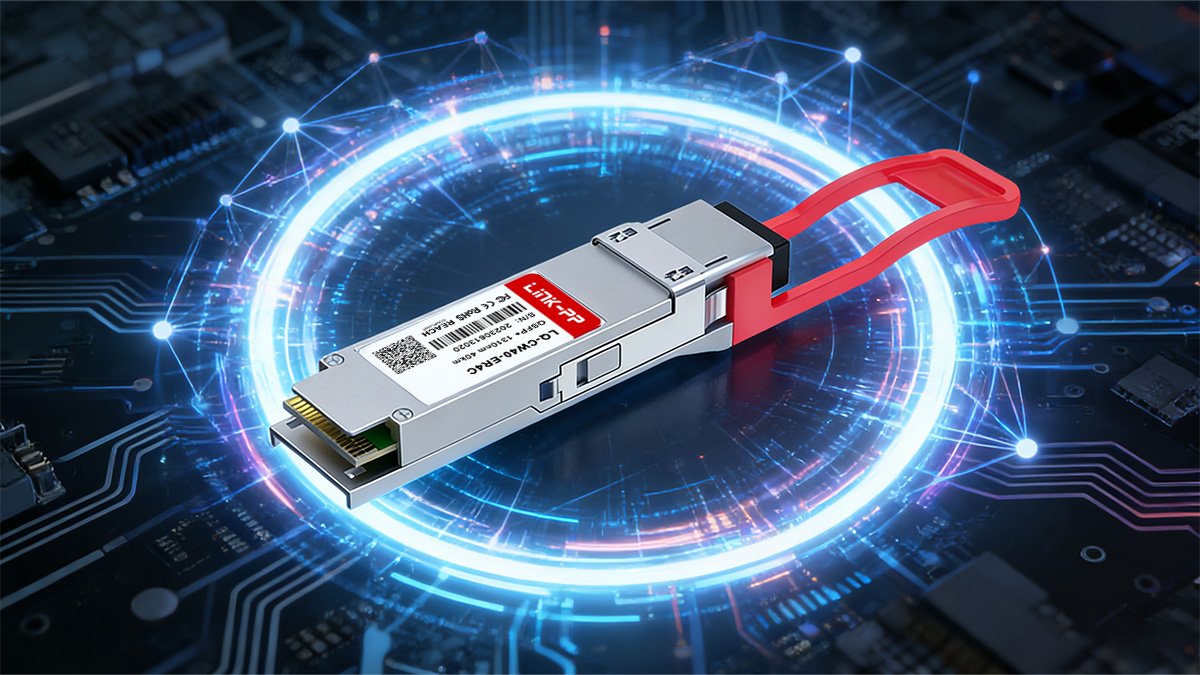
Core Characteristics of QSFP 40G ER4
QSFP 40G ER4 is defined by its 40km reach, CWDM4 optical design, and higher optical power budget compared with shorter-reach 40G modules.
| Parameter |
QSFP 40G ER4 |
| Data Rate |
40Gbps |
| Reach |
up to 40km |
| Wavelengths |
CWDM4 (1271–1331nm) |
| Fiber Type |
SMF |
| Connector |
LC duplex |
| Form Factor |
QSFP+ |
These modules multiplex four CWDM wavelengths internally and transmit them over a single pair of fibers. Compared with parallel-fiber 40G optics such as SR4, ER4 reduces fiber count while supporting much longer distances, which is critical for metro and inter-building deployments.
Why QSFP 40G ER4 Exists
QSFP 40G ER4 fills the distance gap between 10km LR4 transceiver and ultra-long-reach ZR4 optics, providing a balanced solution for 40km 40G Ethernet links.
It is typically chosen when:
- The link distance exceeds 10km but is within 40km
- Fiber infrastructure is limited to duplex SMF
- High-density QSFP+ switch ports must be preserved
- DCI or metro links require stable optical margins
Using ER4 avoids the need for external amplification or moving to higher-cost ultra-long-haul optics while still maintaining predictable performance across long spans.
Position in the 40G Optics Family
QSFP 40G ER4 sits between LR4 and ZR4 in the 40G long-reach hierarchy, offering more reach than LR4 but lower cost and power consumption than ZR4.
| Module Type |
Typical Reach |
Optical Design |
| QSFP 40G LR4 |
10km |
CWDM4 |
| QSFP 40G ER4 |
40km |
CWDM4 |
| QSFP 40G ZR4 |
80km |
LAN-WDM |
This positioning makes ER4 a practical choice for metro-scale 40G networks where LR4 is insufficient and ZR4 would introduce unnecessary cost and power overhead.
Typical Deployment Role
In real-world networks, QSFP 40G ER4 is most commonly used for long-distance data center interconnection, campus backbone links, and service provider aggregation layers.
It allows network designers to:
- Extend 40G connectivity between sites
- Maintain QSFP+ port density
- Avoid additional fiber runs
- Keep optical budgets within predictable limits
As a result, QSFP 40G ER4 has become a standard option for organizations that require stable 40Gbps transmission across tens of kilometers without transitioning to newer form factors or higher-cost long-haul optics.
✅ Key Specifications of QSFP 40G ER4
QSFP 40G ER4 is defined by its 40Gbps data rate, CWDM4 optical design, and optical budget engineered for up to 40km transmission over single-mode fiber. Understanding its core specifications helps determine whether it meets link distance, loss margin, and platform compatibility requirements in real deployments.
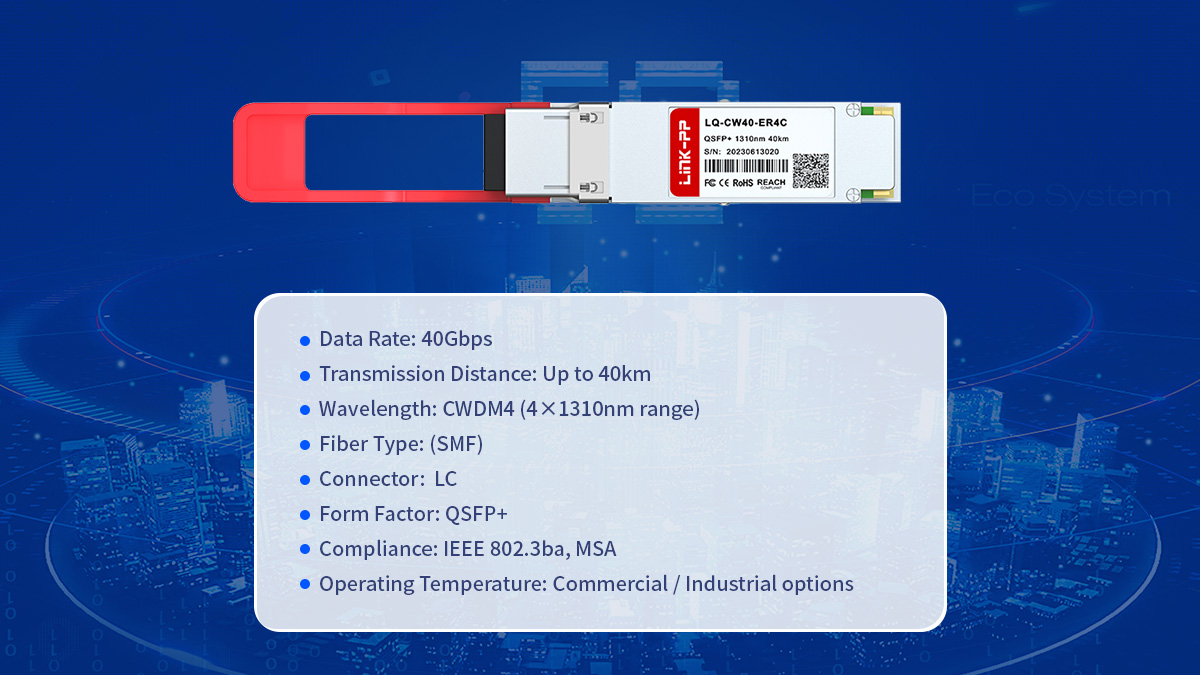
Core Optical and Interface Specifications
QSFP 40G ER4 uses four CWDM wavelengths over duplex SMF and operates within the QSFP+ electrical interface standard.
| Parameter |
QSFP 40G ER4 Specification |
| Data Rate |
40Gbps (4×10Gbps lanes) |
| Reach |
up to 40km |
| Wavelengths |
CWDM4 (1271/1291/1311/1331nm) |
| Fiber Type |
Single-mode fiber (SMF) |
| Connector |
Duplex LC |
| Form Factor |
QSFP+ |
These specifications allow ER4 modules to deliver long-distance transmission while maintaining compatibility with standard QSFP+ ports on switches and routers.
Optical Power Budget and Link Margin
The primary difference between ER4 and shorter-reach modules lies in its higher optical power budget, which enables stable transmission over longer spans.
| Metric |
Typical Value |
| Transmit Power (per lane) |
higher than LR4 |
| Receiver Sensitivity |
enhanced for long reach |
| Optical Budget |
~20dB class |
| Maximum Reach |
up to 40km |
The larger optical budget allows ER4 to tolerate higher fiber attenuation, connector loss, and splice loss compared with LR4. This makes it suitable for metro and inter-building links where fiber paths are longer and loss conditions vary.
Electrical and Compliance Standards
40GBASE-ER4 modules are designed to comply with 40G Ethernet electrical and management standards to ensure interoperability across network platforms.
| Standard |
Support |
| IEEE Ethernet |
40GBASE-ER4 aligned |
| MSA |
QSFP+ MSA compliant |
| Digital Diagnostics |
Supported (DOM/DDM) |
| Hot Pluggable |
Yes |
Compliance with these standards ensures that ER4 modules can operate reliably across different vendor platforms when compatibility coding is properly configured.
Environmental and Operational Specifications
QSFP 40G ER4 modules are available in commercial and extended temperature versions to support different deployment environments.
| Category |
Typical Range |
| Operating Temperature |
0–70°C (commercial) |
| Extended Temp Options |
available |
| Power Consumption |
higher than LR4 |
| Cooling Requirement |
standard QSFP airflow |
Because ER4 modules use higher transmit power to achieve 40km reach, their power consumption is typically higher than LR4 modules, which should be considered in dense switch environments.
Practical Specification Considerations
When evaluating QSFP 40G ER4 specifications, the most critical factors are link distance, total fiber loss, and compatibility with target switching platforms.
Engineers should confirm:
- Total fiber attenuation over the link
- Connector and splice loss
- Required optical margin
- Platform support for ER4 modules
- Temperature environment
These parameters ultimately determine whether a QSFP 40G ER4 module will deliver stable performance across a given 40G long-distance link.
✅ How Does QSFP 40G ER4 Work?
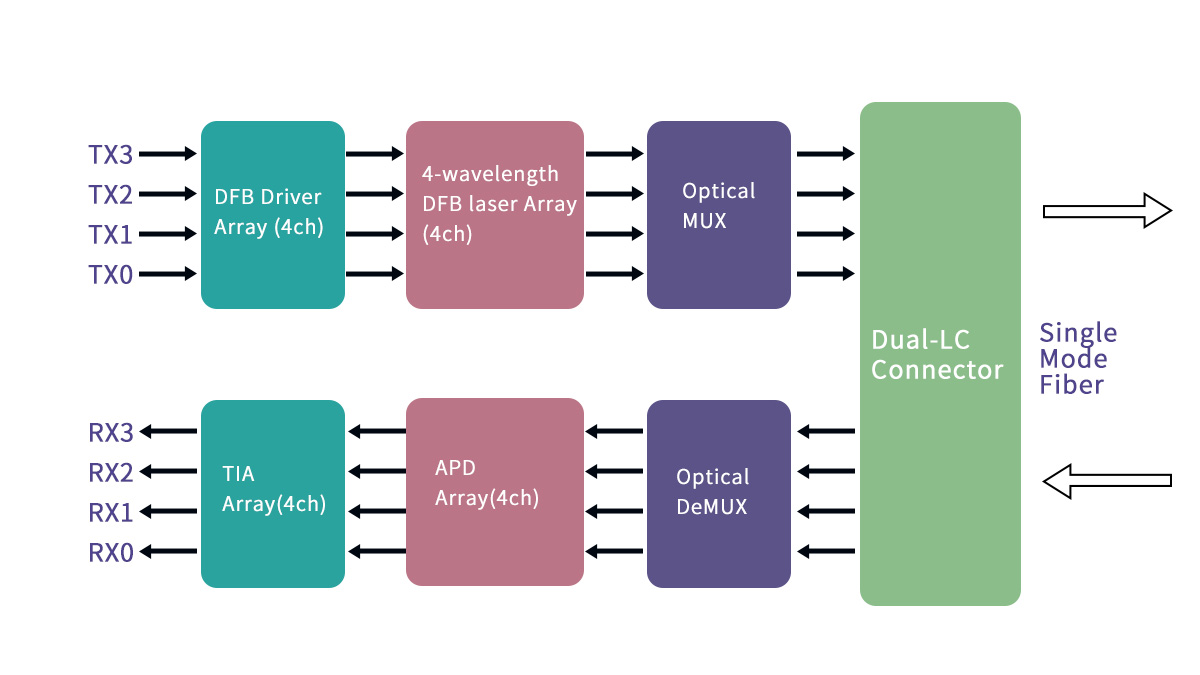
QSFP 40G ER4 works by transmitting four 10Gbps optical lanes over different CWDM wavelengths and multiplexing them onto a single duplex single-mode fiber pair, enabling 40Gbps transmission up to 40km without increasing fiber count. It converts four electrical data channels from the switch into four optical signals, combines them through internal wavelength multiplexing, and sends them across long-distance fiber links with an enhanced optical power budget.
Optical Transmission Architecture
QSFP 40G ER4 uses a 4×10Gbps CWDM4 architecture, where each lane operates on a separate wavelength within the 1271–1331nm range.
| Component |
Function |
| Electrical Interface |
Receives 4×10Gbps signals from switch ASIC |
| CWDM Lasers |
Convert electrical signals to optical wavelengths |
| Optical MUX |
Combines 4 wavelengths into one fiber |
| Optical DEMUX |
Splits wavelengths at receiver |
| Photodiodes |
Convert optical signals back to electrical |
Inside the module, the transmitter converts four parallel electrical lanes into four optical signals. These are multiplexed into a single outgoing fiber. At the receiving end, a demultiplexer separates the wavelengths and converts them back into electrical signals for the switch.
Why Duplex Fiber Is Used
Unlike SR4 transceiver that require parallel fiber, QSFP 40G ER4 transmits all four lanes over a single duplex LC fiber pair using wavelength multiplexing.
This approach provides:
- Lower fiber infrastructure requirements
- Easier long-distance deployment
- Compatibility with existing SMF links
- Simpler cable management
Because long-distance networks typically rely on duplex single-mode fiber rather than multi-fiber trunks, the ER4 architecture is well suited for metro and inter-site links.
Optical Budget and Long-Distance Capability
QSFP 40G ER4 achieves 40km reach by using higher transmit power and more sensitive receivers than shorter-reach 40G modules.
| Factor |
Role in Long-Distance Transmission |
| Higher Transmit Power |
Extends signal reach |
| Sensitive Receiver |
Detects weaker signals |
| CWDM Wavelengths |
Reduce fiber loss |
| Optical Budget Margin |
Supports longer spans |
The module’s optical power budget allows it to tolerate fiber attenuation, connector loss, and splice loss across long links. This makes ER4 suitable for distances that exceed LR4 capabilities without requiring external amplification.
Signal Flow in a Typical Deployment
In a real network link, QSFP 40G ER4 operates as a point-to-point optical bridge between two QSFP+ ports across long-distance SMF.
Typical signal flow:
- Switch sends 4×10Gbps electrical lanes to the module
- Module converts lanes into CWDM optical signals
- Signals are multiplexed onto duplex SMF
- Fiber carries signal up to 40km
- Receiving module demultiplexes wavelengths
- Electrical signals are delivered to destination switch
This process happens in real time and is transparent to higher network layers, allowing ER4 modules to function as plug-and-play long-distance 40G optical interfaces.
How ER4 Differs from LR4 and ZR4 in Operation
While LR4, ER4, and ZR4 all use wavelength multiplexing, ER4 is engineered with a higher optical budget than LR4 and lower complexity than ZR4.
| Module |
Reach |
Optical Design |
| LR4 |
10km |
CWDM4 |
| ER4 |
40km |
CWDM4 |
| ZR4 |
80km |
LAN-WDM |
ER4 maintains the same basic working principle as LR4 but increases transmit power and receiver sensitivity to support longer distances. Compared with ZR4, it avoids the tighter wavelength spacing and higher power requirements associated with ultra-long-haul optics.
✅ QSFP 40G ER4 vs Other 40G Transceivers
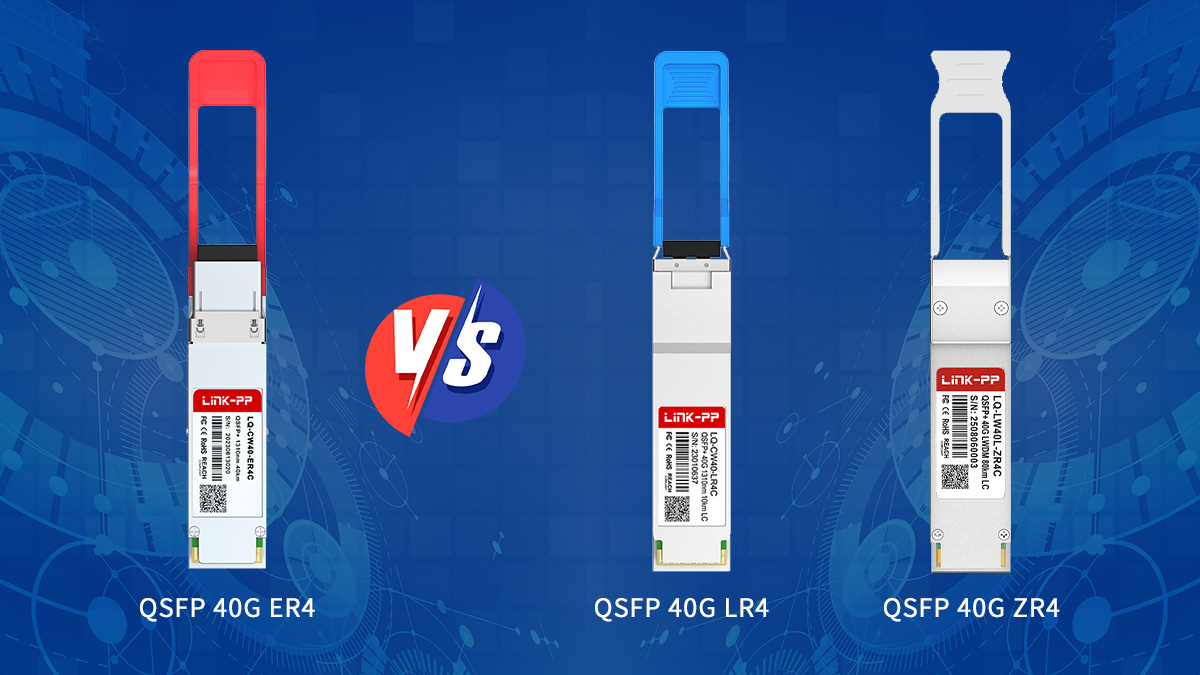
QSFP 40G ER4 is primarily chosen when a 40G link must reach up to 40km over duplex single-mode fiber, placing it between LR4 (10km) and ZR4 (80km) in the 40G long-reach spectrum. The key differences among these modules are transmission distance, optical budget, power consumption, and deployment cost. Selecting the right one depends on link length and optical margin rather than bandwidth, since all support 40Gbps.
QSFP 40G ER4 vs QSFP 40G LR4
QSFP 40G ER4 and LR4 share the same CWDM4 wavelength architecture, but ER4 is designed with a significantly higher optical budget to support longer distances.
| Parameter |
QSFP 40G LR4 |
QSFP 40G ER4 |
| Reach |
10km |
40km |
| Wavelengths |
CWDM4 |
CWDM4 |
| Fiber Type |
SMF |
SMF |
| Optical Budget |
lower |
higher |
| Typical Use |
campus/DCI |
metro/DCI |
LR4 is typically used for campus or intra-metro links up to 10km. When fiber distance exceeds that range or additional loss margin is required, ER4 becomes the practical upgrade without changing form factor or fiber type.
In deployment planning:
- Use LR4 when links are ≤10km
- Use ER4 when links exceed 10km but remain ≤40km
- Avoid using ER4 for short links unless margin is needed
ER4 modules generally consume more power and cost more than LR4, so they are best reserved for links where their extended reach is necessary.
QSFP 40G ER4 vs QSFP 40G ZR4
QSFP 40G ER4 is optimized for 40km links, while ZR4 is engineered for up to 80km and typically uses LAN-WDM optics with tighter wavelength spacing and higher transmit power.
| Parameter |
QSFP 40G ER4 |
QSFP 40G ZR4 |
| Reach |
40km |
80km |
| Optical Design |
CWDM4 |
LAN-WDM |
| Power Consumption |
moderate |
higher |
| Cost |
lower |
higher |
| Deployment Scope |
metro |
regional/long-haul |
ZR4 modules are used when links approach or exceed 40km and require higher optical budgets. However, they introduce:
- Higher module cost
- Increased power draw
- More stringent optical requirements
For most metro-scale 40G deployments within 40km, ER4 offers a more balanced solution in terms of cost, reach, and power efficiency.
When ER4 Is the Best Choice
QSFP 40G ER4 is the most suitable option when link distance falls between 10km and 40km and duplex SMF infrastructure must be preserved.
Choose ER4 when:
- The link is longer than LR4 capability
- Fiber attenuation requires extra margin
- Duplex SMF is already deployed
- QSFP+ port density must be maintained
- ZR4 would exceed budget or power limits
Avoid ER4 when:
- Links are under 10km (LR4 is more cost-efficient)
- Links exceed 40km (ZR4 or amplified solutions needed)
- Only short-range data center links are required
Practical Comparison Summary
Among 40G duplex-fiber optics, ER4 serves as the middle-distance solution that balances reach and cost without moving into ultra-long-haul complexity.
| Module |
Best Use Case |
Decision Trigger |
| SR4 |
short MMF links |
within data center |
| LR4 |
≤10km SMF |
campus/DCI |
| ER4 |
≤40km SMF |
metro/inter-site |
| ZR4 |
≤80km SMF |
long-haul |
Understanding this positioning ensures that ER4 modules are used where their extended reach provides real value, rather than being deployed unnecessarily in shorter or much longer links.
✅ Typical Applications of QSFP 40G ER4
QSFP 40G ER4 is typically deployed in network scenarios where 40Gbps links must span up to 40km over duplex single-mode fiber, especially between sites, campuses, or metro locations where LR4 cannot provide sufficient reach. Its CWDM4 design and higher optical budget make it well suited for stable long-distance connections without requiring additional fiber pairs or external amplification.
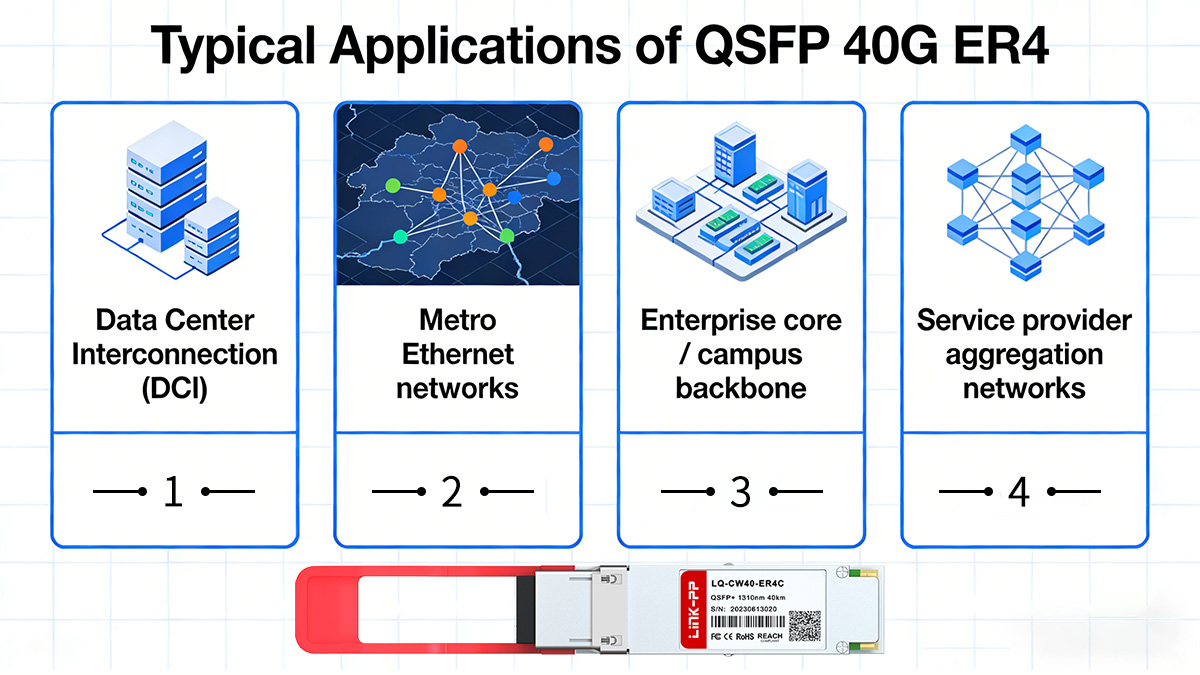
Data Center Interconnection (DCI)
QSFP 40G ER4 is commonly used for data center interconnection when two facilities are separated by more than 10km but within a 40km range.
| Scenario |
Why ER4 Fits |
| Metro DCI |
supports up to 40km SMF |
| Inter-campus DC |
maintains QSFP+ density |
| Regional DC links |
avoids extra fiber runs |
In metro DCI environments, fiber routes often include multiple splices and patch panels, increasing total link loss. ER4’s higher optical budget helps maintain stable transmission across these paths while preserving duplex fiber infrastructure.
Engineers typically choose ER4 for DCI when:
- Distance exceeds LR4 limits
- Fiber paths include multiple connection points
- Redundant long-distance links are required
- High port density must be maintained
Enterprise Campus Backbone
Large enterprise or university campuses often use QSFP 40G ER4 for backbone links between buildings, data halls, or remote facilities within a metropolitan area.
Typical uses include:
- Core-to-core building links
- Disaster recovery site connectivity
- Long campus ring topologies
- High-capacity aggregation links
Because many campuses rely on existing single-mode fiber routes, ER4 allows network upgrades to 40Gbps without installing new multi-fiber infrastructure. This makes it a practical step between 10G and higher-speed backbone upgrades.
Service Provider and Metro Networks
Service providers deploy QSFP 40G ER4 in metro aggregation and access networks where 40Gbps links must span across urban fiber routes.
| Deployment Area |
ER4 Role |
| Metro aggregation |
connects PoPs |
| Access ring |
long-span links |
| Regional backbone |
intermediate reach |
In these environments, ER4 modules provide sufficient reach for most intra-city fiber routes while avoiding the higher cost and power draw of 80km optics.
They are often used to:
- Connect aggregation routers
- Extend backbone capacity
- Support enterprise customer links
- Maintain duplex SMF infrastructure
Inter-Building and Multi-Site Networks
Organizations with multiple facilities across a city or industrial zone use QSFP 40G ER4 to connect network cores over long distances.
Common scenarios:
- Headquarters to branch campus
- Industrial park networks
- Government or healthcare campuses
- Multi-building data environments
ER4 modules allow these sites to maintain high-throughput connectivity without migrating to newer form factors or installing additional fiber pairs.
When ER4 Is Preferred Over Other 40G Optics
QSFP 40G ER4 is preferred in applications where distance falls between 10km and 40km and duplex SMF must be retained.
Use ER4 when:
- Fiber distance is beyond LR4 capability
- Stable long-distance 40G is required
- Optical loss margin must be increased
- Fiber infrastructure cannot be changed
- Metro-scale connectivity is needed
Avoid ER4 when:
- Links are within a single data hall
- Distance is under 10km
- Cost optimization for short links is priority
✅ Compatibility and Interoperability Considerations
QSFP 40G ER4 modules are generally interoperable across major switching platforms when they follow QSFP+ MSA and 40G Ethernet standards, but real-world compatibility still depends on vendor coding, firmware support, and optical link conditions. Verifying these factors before deployment helps avoid link failures, DOM mismatches, or platform alarms in long-distance 40G environments.
Platform Compatibility
Most modern switches and routers support QSFP 40G ER4, but vendor-specific EEPROM coding is often required for the module to be recognized without warnings.
| Platform Vendor |
ER4 Support |
Notes |
| Cisco |
widely supported |
may require coded modules |
| Juniper |
supported |
check optics matrix |
| Arista |
supported |
DOM compatibility important |
| Huawei |
supported |
version-dependent |
| HPE |
supported |
verify firmware |
Even though ER4 follows QSFP+ standards, many vendors enforce transceiver validation. Using properly coded or approved compatible modules ensures:
- No “unsupported transceiver” alarms
- Full DOM/DDM visibility
- Stable link initialization
- Firmware-level recognition
Before deployment, engineers should confirm the switch compatibility list or test modules in a staging environment.
Interoperability Between Vendors
QSFP 40G ER4 modules from different vendors can interoperate as long as optical specifications and wavelength alignment match.
| Requirement |
Why It Matters |
| Same wavelength grid |
CWDM4 alignment |
| Matching reach class |
both sides ER4 |
| Optical budget margin |
ensures stability |
| DOM calibration |
monitoring accuracy |
In most cases, ER4 modules from different manufacturers can link successfully if both comply with CWDM4 wavelength spacing and 40GBASE-ER4 optical parameters. However, mismatched reach types—such as ER4 on one side and LR4 on the other—can result in unstable links due to insufficient optical power budget.
Fiber and Link Compatibility
QSFP 40G ER4 requires duplex single-mode fiber with sufficient optical margin to support up to 40km transmission.
| Factor |
Recommendation |
| Fiber Type |
OS2 SMF |
| Connector |
LC duplex |
| Link Loss |
within ER4 budget |
| Patch Panels |
minimize excess loss |
Engineers should calculate total link loss by including:
- Fiber attenuation
- Connector insertion loss
- Splice loss
- Patch panel loss
Ensuring the total loss remains within the ER4 optical budget is critical for stable long-distance operation.
DOM/DDM and Monitoring Support
Most QSFP 40G ER4 modules support digital optical monitoring (DOM/DDM), enabling real-time visibility into transmit power, receive power, temperature, and voltage.
This allows operators to:
- Verify optical margin
- Detect degradation early
- Troubleshoot long-distance links
- Monitor environmental conditions
However, DOM reporting accuracy can vary between vendors. Some platforms may display warning thresholds differently depending on module coding and firmware support.
Firmware and Software Considerations
Switch firmware versions can affect how QSFP 40G ER4 modules are recognized and monitored.
Before deployment:
- Check platform firmware compatibility
- Confirm transceiver support lists
- Update switch OS if required
- Validate DOM readings
Firmware mismatches may cause:
- DOM data not displayed
- Warning messages
- Link initialization delays
These issues are usually resolved through firmware updates or properly coded modules.
Deployment Best Practices
Ensuring compatibility for QSFP 40G ER4 involves verifying platform support, optical parameters, and link budget before installation.
Recommended steps:
- Confirm switch compatibility matrix
- Use correctly coded modules
- Validate fiber link loss
- Test modules before large rollout
- Monitor DOM after deployment
Following these steps reduces the risk of interoperability issues and helps maintain stable 40Gbps transmission across long-distance fiber links.
✅ Pricing Factors of QSFP 40G ER4 Transceivers
QSFP 40G ER4 transceivers are typically priced higher than LR4 modules because they require stronger optical components and tighter calibration to support up to 40km transmission over single-mode fiber. Their cost is primarily influenced by optical power budget, component quality, compatibility requirements, and supplier type rather than bandwidth, since all 40G transceiver deliver the same 40Gbps rate.
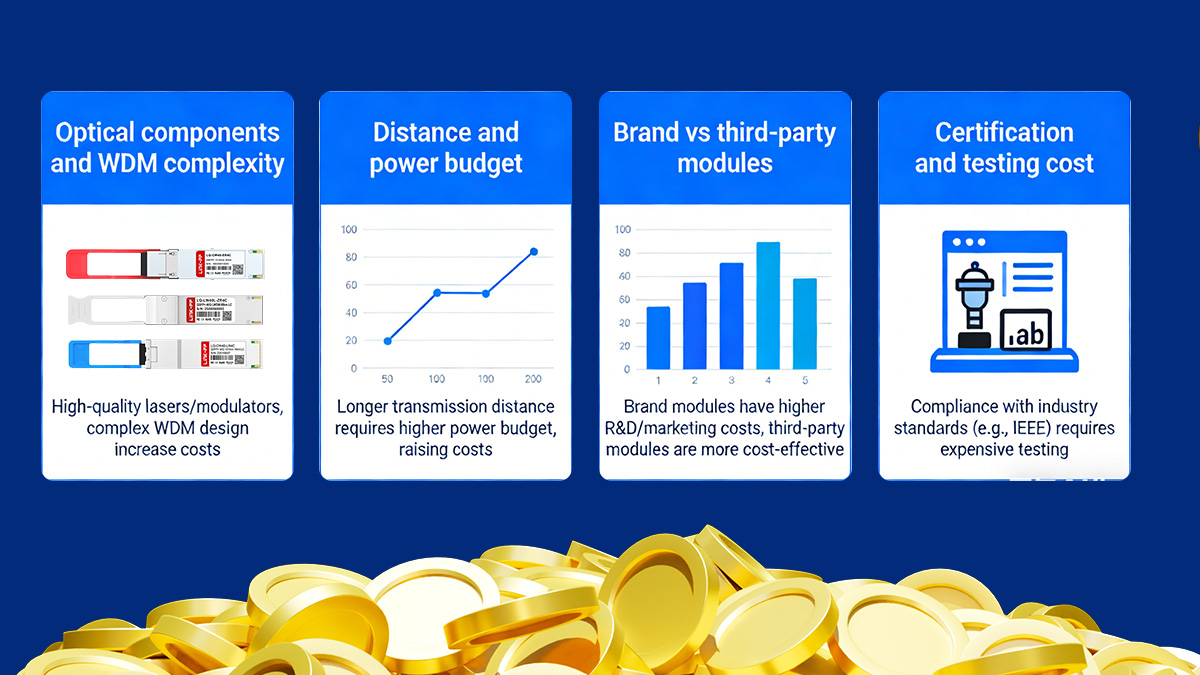
Optical Components and Power Budget
The largest cost driver of QSFP 40G ER4 modules is the higher optical power budget needed for 40km reach.
| Cost Factor |
Impact on Price |
| High-power lasers |
increases cost |
| Sensitive receivers |
increases cost |
| Optical calibration |
adds manufacturing complexity |
| Testing for long reach |
raises production cost |
Compared with 10km LR4 modules, ER4 requires stronger transmit power and more sensitive receivers to maintain signal integrity across longer fiber spans. This increases both component cost and testing requirements.
Modules designed with tighter optical tolerances and higher reliability typically command higher pricing due to:
- More rigorous calibration
- Extended burn-in testing
- Higher-quality laser components
- Lower failure rates
Vendor Type: OEM vs Compatible
Original vendor modules are usually priced significantly higher than third-party compatible QSFP 40G ER4 modules, even when optical specifications are similar.
| Module Type |
Typical Price Position |
| OEM branded |
highest |
| Certified compatible |
mid-range |
| Generic compatible |
lower |
OEM modules often include vendor branding and official support but may not provide functional advantages for standard ER4 links. Certified compatible modules that follow MSA standards and undergo interoperability testing can offer similar performance at lower cost.
When evaluating price differences, you should consider:
- Warranty and support
- Compatibility testing
- Return policies
- Supplier reliability
Compatibility Coding and Testing
Modules that are pre-coded and tested for specific switch vendors may cost more due to additional validation and EEPROM programming.
| Feature |
Pricing Effect |
| Vendor coding |
slight increase |
| Interop testing |
increases reliability cost |
| Quality assurance |
adds manufacturing cost |
| Certification |
may raise price |
Compatibility testing ensures the module works reliably across target platforms without warnings or link issues. While this adds cost, it can reduce deployment risk and troubleshooting time.
Volume and Supply Chain Factors
Bulk purchasing and supply chain stability also influence QSFP 40G ER4 pricing.
| Factor |
Effect |
| Order volume |
lowers unit price |
| Inventory availability |
affects lead time cost |
| Component supply |
impacts market price |
| Long-term contracts |
stabilizes pricing |
Organizations deploying multiple long-distance links can often negotiate lower per-unit pricing through volume orders or long-term supplier agreements.
Total Cost of Ownership
The effective cost of a QSFP 40G ER4 module should be evaluated based on reliability, compatibility, and long-term stability rather than purchase price alone.
Lower-cost modules may reduce upfront expense but could introduce:
- Compatibility issues
- Higher failure rates
- Limited support
- Inconsistent performance
Higher-quality modules may cost more initially but can reduce downtime, replacement cycles, and operational risk across long-distance links.
✅ How to Choose the Right QSFP 40G ER4 Module
The right QSFP 40G ER4 module is determined by link distance, total fiber loss, switch compatibility, and reliability requirements rather than bandwidth, since all ER4 modules support 40Gbps over up to 40km. A structured selection process ensures stable long-distance operation and avoids unnecessary cost or deployment risk.
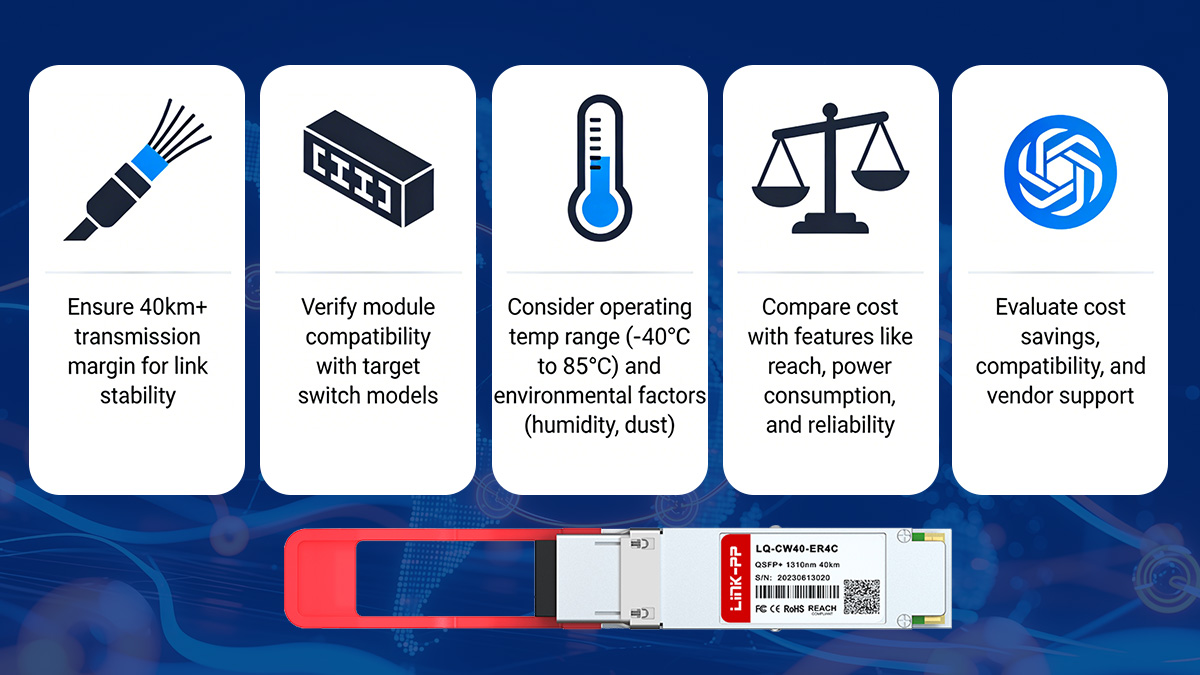
Step 1: Confirm Link Distance and Optical Loss
QSFP 40G ER4 should be selected when the total link distance and loss exceed LR4 capability but remain within the ER4 optical budget.
| Link Condition |
Recommendation |
| ≤10km |
use LR4 instead |
| 10–40km |
use ER4 |
| >40km |
consider ZR4 |
| High connector loss |
ensure extra margin |
In addition to physical distance, engineers must calculate total link loss by including:
- Fiber attenuation
- Connector insertion loss
- Splice loss
- Patch panel loss
If total loss approaches the upper limit of ER4’s optical budget, choosing a higher-quality module with stronger output and better sensitivity can improve stability.
Step 2: Verify Switch and Router Compatibility
Compatibility with target network platforms is critical, as some switches require vendor-coded QSFP 40G ER4 modules for full functionality.
| Check Item |
Why It Matters |
| Vendor support list |
ensures recognition |
| Firmware version |
affects module detection |
| EEPROM coding |
avoids warnings |
| DOM support |
enables monitoring |
Before purchasing, confirm:
- Supported optics matrix
- Required coding type
- Firmware compatibility
- DOM/DDM visibility
Testing modules on the actual switch platform prior to large deployment helps prevent interoperability issues.
Step 3: Evaluate Optical Performance and Quality
Not all ER4 modules provide identical optical margins; component quality and calibration directly affect link stability.
| Quality Factor |
Selection Impact |
| Laser stability |
long-distance reliability |
| Receiver sensitivity |
link margin |
| Calibration accuracy |
consistent performance |
| Burn-in testing |
lower failure rate |
For links approaching 40km or involving multiple patch points, modules with stronger optical output and better receiver sensitivity provide additional margin and reduce the risk of intermittent link drops.
Step 4: Consider Deployment Environment
Environmental conditions influence module selection, especially in non-data-center deployments.
| Environment |
Consideration |
| Standard data center |
commercial temp |
| Outdoor cabinet |
extended temp |
| High-density switch |
power/heat |
| Long metro fiber |
higher margin |
Higher-power ER4 modules typically consume more energy than LR4 modules, so thermal management and airflow should be considered in dense switch environments.
Step 5: Balance Cost and Reliability
The most suitable QSFP 40G ER4 module balances price with compatibility, optical margin, and supplier reliability.
When comparing options, consider:
- Compatibility testing
- Warranty coverage
- Technical support
- Supplier track record
- Lead time stability
Lower-cost modules may work in short or clean links but could introduce risk in longer metro spans. For critical backbone connections, proven reliability often outweighs minimal cost savings.
✅ Third-Party vs Original QSFP 40G ER4 Modules
In most 40km deployments, high-quality third-party QSFP 40G ER4 modules can deliver performance and interoperability comparable to original vendor modules at a significantly lower cost, but mission-critical networks may still prefer OEM optics for support and policy reasons.
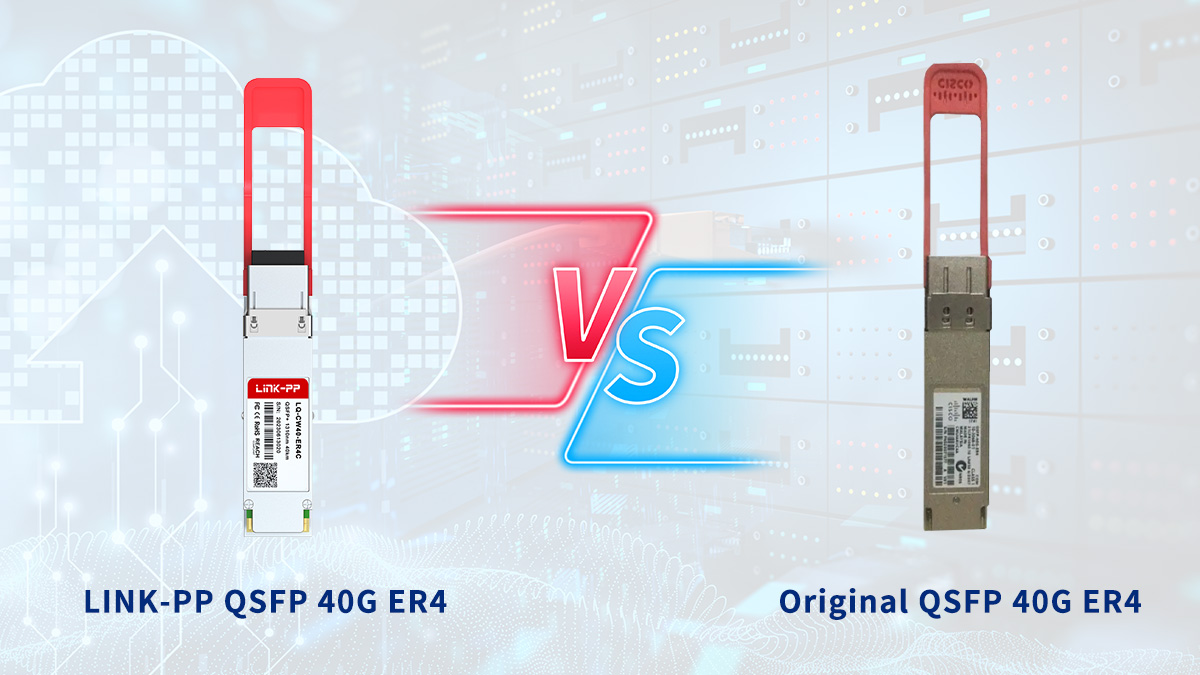
Core Differences Between OEM and Third-Party Modules
Original (OEM) modules provide official vendor support and guaranteed compatibility, while certified third-party modules focus on cost efficiency and multi-vendor interoperability.
| Factor |
Original (OEM) |
Third-Party Compatible |
| Purchase Cost |
highest |
significantly lower |
| Vendor Support |
official support |
supplier support |
| Compatibility Coding |
native |
pre-coded/tested |
| Lead Time |
often longer |
typically faster |
OEM modules are sold through vendor channels and include official support contracts. Third-party module is built to MSA standards and programmed to match specific platforms, allowing them to function identically in most environments.
Cost Considerations
The most noticeable difference between OEM and third-party QSFP 40G ER4 modules is pricing.
| Cost Driver |
Impact |
| Brand premium |
raises OEM price |
| Optical components |
affects both |
| Coding/testing |
slight cost increase |
| Volume purchasing |
lowers price |
Because ER4 modules require higher optical budgets and tighter calibration, they are inherently more expensive than short-reach optics. However, OEM pricing often includes brand and support premiums, making compatible modules a cost-effective alternative for large deployments.
For organizations deploying multiple 40km links, the total cost savings from using certified compatible modules can be substantial without affecting performance.
Performance and Reliability
When manufactured to proper specifications, high-quality third-party QSFP 40G ER4 modules can provide optical performance comparable to OEM modules.
| Performance Factor |
Importance |
| Optical power stability |
critical for 40km links |
| Receiver sensitivity |
ensures margin |
| Calibration accuracy |
affects reliability |
| Burn-in testing |
reduces failure rate |
Reliable suppliers typically perform:
- Multi-vendor interoperability testing
- Optical calibration
- Thermal testing
- Batch consistency validation
Low-quality modules, however, may introduce link instability in long-distance deployments. For 40km links, consistent optical performance is more important than branding.
Compatibility and Support Policies
Compatibility issues are usually related to vendor policies rather than technical limitations.
Check the following before choosing module type:
- Whether the switch enforces OEM optics
- Firmware restrictions
- Support contract terms
- Monitoring requirements
Typical deployment patterns:
| Environment |
Common Choice |
| Data centers |
third-party widely used |
| Enterprise backbone |
mixed approach |
| Carrier networks |
often OEM |
| Lab/testing networks |
third-party |
Some organizations use OEM modules for core infrastructure while deploying third-party modules for non-critical links or expansion.
When to Choose Original Modules
Choose OEM QSFP 40G ER4 modules when:
- Vendor support contracts require them
- Network uptime is mission-critical
- Equipment enforces optics validation
- Regulatory or compliance rules apply
When to Choose Third-Party Modules
Choose certified compatible modules when:
- Large-scale deployment is planned
- Cost efficiency is important
- Multi-vendor networks are used
- Rapid availability is needed
- Backup inventory is required
Practical Procurement Strategy
Many organizations adopt a hybrid strategy that balances cost and risk.
Common approach:
- OEM modules for critical backbone links
- Third-party modules for expansion or edge links
- Pre-deployment compatibility testing
- Standardized supplier selection
- Maintain spare inventory
This approach ensures stable performance while optimizing overall deployment cost.
✅ Why Choose a Reliable QSFP 40G ER4 Supplier
Selecting a reliable QSFP 40G ER4 supplier is just as important as choosing the right technical specifications. Because ER4 modules are designed for long-distance 40km transmission over single-mode fiber, any inconsistency in optical performance, compatibility, or quality control can directly impact link stability and network uptime.
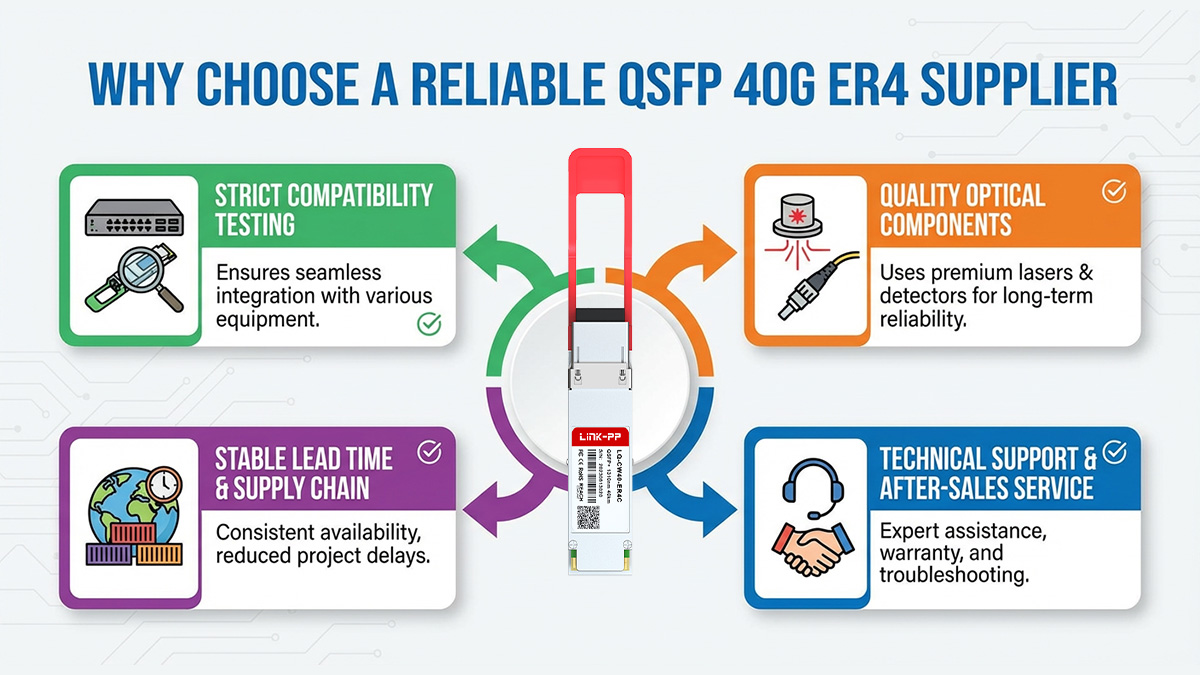
1. Guaranteed Optical Performance and Compliance
A trustworthy supplier ensures that each QSFP 40G ER4 module meets IEEE 802.3ba and MSA standards, with verified CWDM4 wavelengths, output power, receiver sensitivity, and dispersion tolerance.
Reliable vendors typically provide:
- Factory calibration and full optical testing
- DOM/DDM monitoring support
- Compliance with temperature and voltage tolerances
- Clear specification sheets and test reports
This reduces the risk of link failure in metro, DCI, or carrier-grade deployments.
2. Broad Compatibility Across Major Platforms
Interoperability is critical in mixed-vendor networks. A reputable supplier offers modules coded and tested for compatibility with major switch and router brands such as Cisco, Juniper, Arista, HPE, and others.
Look for suppliers that provide:
- Multi-vendor compatibility options
- Field-proven interoperability
- Firmware customization if required
- Fast replacement in case of compatibility issues
This ensures smooth deployment without vendor lock-in.
3. Consistent Quality Control and Reliability
High-quality QSFP 40G ER4 modules require precise optical components, including CWDM lasers and high-sensitivity receivers. Reliable suppliers implement strict quality assurance processes such as:
- 100% burn-in testing
- Optical eye-diagram and BER testing
- Environmental and aging tests
- Traceable serial numbers and QC reports
Consistent manufacturing standards directly translate into longer module lifespan and lower failure rates.
4. Cost Efficiency Without Compromising Performance
While original vendor modules can be significantly more expensive, a reliable third-party supplier can deliver fully compatible QSFP 40G ER4 modules at a lower cost without sacrificing performance.
Benefits include:
- Lower cost per link for long-distance deployment
- Faster availability and shorter lead times
- Bulk pricing for data center or ISP projects
- Equivalent functionality to OEM modules
This makes large-scale 40km 40G deployments more economically viable.
5. Technical Support and After-Sales Service
Long-distance optical links often require careful planning and validation. A dependable supplier provides:
- Pre-sales technical consultation
- Compatibility and deployment guidance
- Quick troubleshooting support
- Warranty and replacement services
Strong technical support ensures smoother integration into existing network architectures.
6. Supply Stability for Long-Term Projects
For enterprise, ISP, and data center expansions, consistent supply is essential. Reliable suppliers maintain stable inventory and production capacity, helping prevent deployment delays or unexpected sourcing issues.
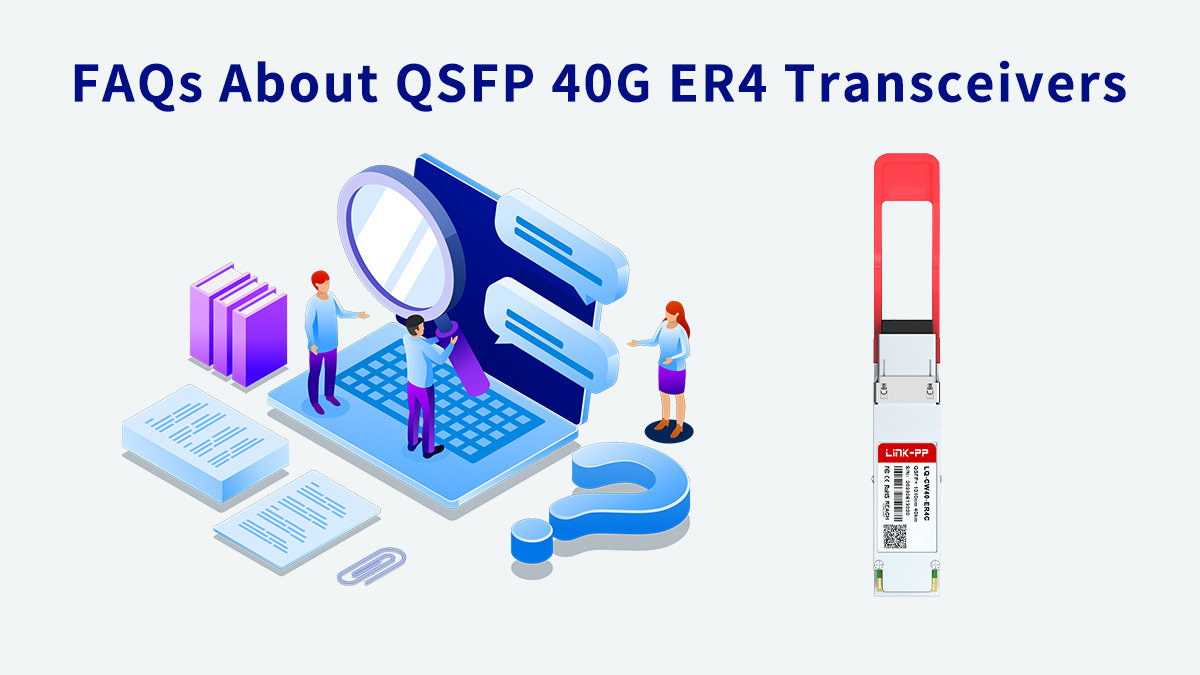
✅ FAQs About QSFP 40G ER4 Transceivers
Q1: What is the maximum distance of a QSFP 40G ER4 transceiver?
QSFP 40G ER4 modules support up to 40km transmission over single-mode fiber using duplex LC connectors.
Q2: What wavelengths does QSFP 40G ER4 use?
QSFP 40G ER4 uses CWDM4 wavelengths (around 1271nm, 1291nm, 1311nm, and 1331nm) over a duplex SMF pair.
Q3: Is QSFP 40G ER4 compatible with QSFP 40G LR4?
They are not directly interchangeable for distance, but both use CWDM4 wavelengths. ER4 supports up to 40km, while LR4 is typically limited to 10km.
Q4: What fiber type is required for QSFP 40G ER4?
It requires duplex single-mode fiber (OS2) with LC connectors for optimal long-distance performance.
Q5: Does QSFP 40G ER4 support Digital Optical Monitoring (DOM)?
Yes. Most QSFP 40G ER4 modules support DOM/DDM for real-time monitoring of temperature, voltage, transmit power, and receive power.
Q6: When should I choose QSFP 40G ER4 over ZR4?
Choose ER4 for distances up to 40km using CWDM4 wavelengths. ZR4 is typically used for longer distances (up to ~80km) and often uses LAN-WDM wavelengths.
✅ Conclusion
QSFP 40G ER4 is the most practical 40Gbps optical solution for stable long-distance connectivity up to 40km over single-mode fiber, combining CWDM4 wavelength efficiency, high port density, and cost-effective deployment for DCI and metro networks. For network upgrades that require reliable 40G transmission beyond 10km, choosing a compatible, fully tested QSFP 40G ER4 module ensures predictable performance, interoperability with major switch platforms, and long-term operational stability.
If you’re planning a 40km 40G link or sourcing high-quality compatible optics, explore verified QSFP 40G ER4 solutions and deployment support at the LINK-PP Official Store to match your network distance, budget, and compatibility requirements with confidence.