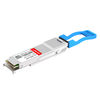
Aruba J4858D remains one of the most widely deployed 1Gbps 1000BASE-SX SFP transceiver in enterprise and campus networks, but in 2026 many buyers are actively seeking reliable alternatives that offer the same performance at a lower cost and with faster availability. The best Aruba J4858D alternatives are fully Aruba-compatible 1Gbps SFP modules that match 850nm wavelength, 550m multimode reach, and LC duplex connectivity while reducing procurement costs and supporting bulk deployment across multi-vendor environments.
Organizations typically look for J4858D replacements when scaling switch ports, standardizing optics across different brands, or avoiding OEM lead-time constraints. Modern third-party compatible transceivers can now deliver identical link stability, digital diagnostics monitoring (DDM), and plug-and-play interoperability when properly coded for Aruba switches, making them a practical option for system integrators, resellers, and IT procurement teams.
This guide focuses on the top Aruba J4858D alternatives in 2026, comparing compatible options, cross-vendor substitutes, and buying considerations for enterprise deployments. It is designed to help network buyers quickly identify safe replacements, understand compatibility requirements, and choose cost-effective modules that can be deployed at scale without sacrificing performance or reliability.
↪️ What Is the Aruba J4858D SFP Transceiver?
The Aruba J4858D is a 1Gbps 1000BASE-SX SFP transceiver designed for short-reach multimode fiber connections in Aruba switches, supporting 850nm wavelength, LC duplex connectivity, and up to 550m transmission distance. It is commonly used for switch-to-switch links, access layer uplinks, and enterprise campus fiber runs where stable 1G optical connectivity is required.
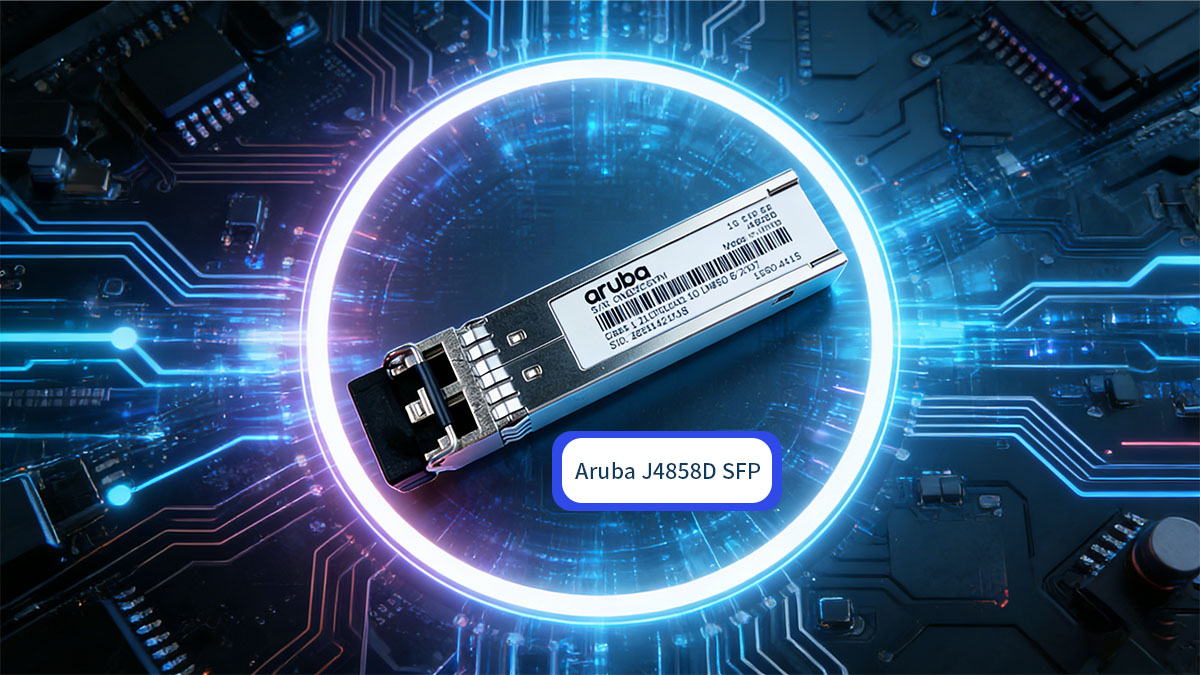
Core Specifications of Aruba J4858D
The most important requirement when evaluating J4858D or its alternatives is matching the exact optical and interface specifications used in Aruba networks.
The J4858D follows standard 1000BASE-SX parameters for short-range multimode deployment.
| Parameter |
Specification |
| Data rate |
1Gbps |
| Wavelength |
850nm |
| Fiber type |
Multimode (OM2/OM3) |
| Max distance |
Up to 550m |
| Connector |
LC duplex |
These specifications make the J4858D suitable for short-distance fiber links inside buildings, data halls, and campus environments where multimode cabling is already deployed.
Typical Deployment Scenarios
The J4858D is primarily used in environments where Aruba switches require reliable 1G optical uplinks over multimode fiber.
Common use cases include:
- Access switch uplinks to aggregation switches
- Campus building-to-building multimode runs
- Data center top-of-rack interconnects
- Spare optics for network maintenance
- Standardized 1G fiber ports across enterprise switches
Because it uses multimode fiber and short-reach optics, it is typically deployed inside facilities rather than for long-distance metro links.
Why It Remains Widely Used
Even as higher-speed optics become common, many enterprise networks still rely on 1G SFP ports for access and aggregation layers. The J4858D remains a standard choice because it offers predictable compatibility with Aruba switches and stable performance in existing multimode infrastructure.
For organizations running large Aruba switch deployments, the J4858D serves as a baseline specification when selecting compatible replacements or planning cost-optimized alternatives.
↪️ Why Consider Aruba J4858D Alternatives in 2026?
Most buyers consider Aruba J4858D alternatives in 2026 to reduce cost per port, avoid OEM lead times, and standardize optics across large deployments without sacrificing compatibility or link stability. Modern Aruba-compatible 1000BASE-SX SFP module can deliver identical performance and plug-and-play operation, making them a practical option for enterprise upgrades and bulk procurement.

Cost and Procurement Efficiency
For networks deploying dozens or hundreds of 1G fiber links, OEM optics can significantly increase total project cost. Compatible J4858D replacements are often selected to optimize budget while maintaining the same transmission specifications and switch interoperability.
The main difference between OEM and compatible modules is procurement cost and supply flexibility, not optical performance.
| Factor |
OEM J4858D |
Compatible Alternative |
| Performance |
1Gbps SX standard |
Same 1Gbps SX standard |
| Switch compatibility |
Native |
Pre-coded compatible |
| Unit cost |
Higher |
Lower |
| Bulk availability |
Limited by vendor stock |
Widely available |
For large-scale campus networks and switch rollouts, the cost difference becomes substantial when multiplied across many ports.
Lead Time and Availability
OEM optics may involve longer procurement cycles, especially during large infrastructure upgrades. Compatible suppliers typically maintain ready stock of standard 1G SX modules, allowing faster deployment and easier inventory planning.
Buyers usually consider alternatives when:
- Expanding switch ports across multiple sites
- Preparing spare optics inventory
- Facing OEM backorder delays
- Standardizing modules across projects
Faster availability helps keep installation timelines predictable and reduces downtime risk during maintenance or expansion.
Multi-Vendor Network Standardization
Many enterprises operate mixed switch environments rather than a single vendor. Compatible SFP module can be coded for multiple platforms, allowing the same hardware type to be used across Aruba and other switch brands.
Alternatives are commonly chosen when:
- Networks include multiple switch vendors
- Integrators manage different client environments
- Procurement teams want unified inventory
- Standardized spare modules are required
This flexibility simplifies logistics and reduces the need to stock multiple OEM part numbers.
Scalability for Ongoing Deployments
In 2026, J4858D alternatives are often selected not just for one-time replacement but for long-term scalability. Enterprises and integrators prefer suppliers that can support repeated orders, consistent batch quality, and predictable pricing over time.
As networks continue to expand access-layer fiber connections, choosing a compatible J4858D alternative becomes a strategic procurement decision rather than a simple one-to-one replacement.
↪️ Key Specs to Match When Choosing an Aruba J4858D Alternative
The correct Aruba J4858D alternative must match the original module’s transmission standard, optical parameters, and Aruba switch compatibility to ensure stable plug-and-play operation. If these core specifications are aligned, a compatible replacement can deliver identical link performance in enterprise networks.
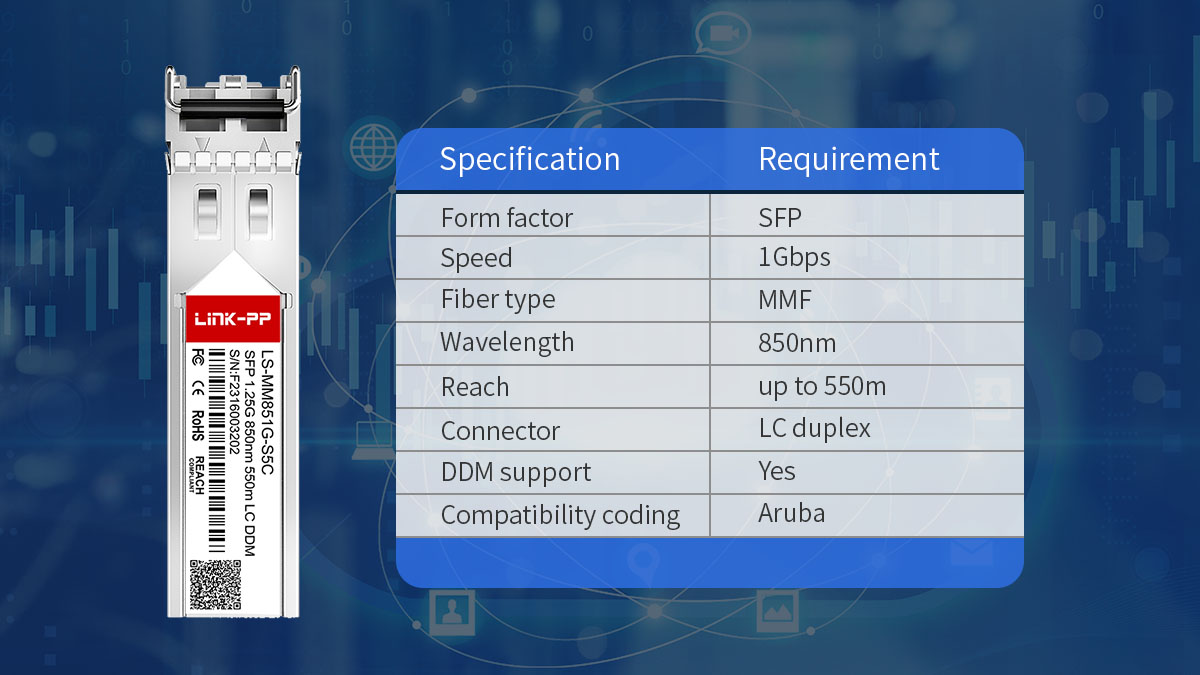
Transmission Standard and Optical Parameters
A replacement must follow the same 1000BASE-SX optical standard used by the J4858D. Matching the wavelength, fiber type, and reach ensures the module will work with existing multimode cabling and switch ports.
The essential optical specifications must be identical to J4858D for reliable operation.
| Specification |
Required Match |
| Data rate |
1Gbps |
| Standard |
1000BASE-SX |
| Wavelength |
850nm |
| Fiber type |
Multimode fiber |
| Max distance |
Up to 550m |
| Connector |
LC duplex |
If any of these parameters differ, the module may not link properly or could cause unstable connections in the network.
Aruba Switch Compatibility and Coding
Beyond optical specs, the module must be recognized by Aruba switches. This requires correct EEPROM coding and interoperability validation so the switch accepts the transceiver without warnings.
Compatibility checks should focus on:
- Aruba-coded module recognition
- Plug-and-play operation in Aruba switches
- No unsupported transceiver alerts
- Stable link establishment
- Proper DOM/DDM reporting
Using pre-coded compatible modules helps ensure seamless deployment across Aruba switch models.
Monitoring and Operational Features
Enterprise networks often rely on monitoring functions to maintain link visibility and troubleshoot issues. A suitable alternative should support the same operational features as the original module.
Key functional features to match:
- DOM/DDM monitoring support
- Hot-swappable operation
- Standard operating temperature range
- Stable power output and sensitivity
- Consistent performance across batches
These features ensure that compatible modules behave like OEM optics in day-to-day network operation.
Deployment Environment Alignment
The chosen alternative must also fit the physical deployment environment where the original J4858D is used. This includes matching fiber type and expected link distance.
Typical deployment conditions:
- Short-range multimode links inside buildings
- Campus fiber runs under 550m
- Switch-to-switch interconnects
- Access-layer uplinks
When the replacement module matches both the technical specifications and the deployment scenario, it can function as a direct J4858D substitute without requiring network changes.
↪️ Top Aruba J4858D Alternatives in 2026
The best Aruba J4858D alternatives in 2026 are fully Aruba-coded 1000BASE-SX SFP modules that match 1Gbps speed, 850nm wavelength, and 550m MMF reach while offering lower cost and broader availability. For most enterprise networks, a tested compatible J4858D replacement delivers identical link performance and monitoring support, making it the most practical drop-in option.
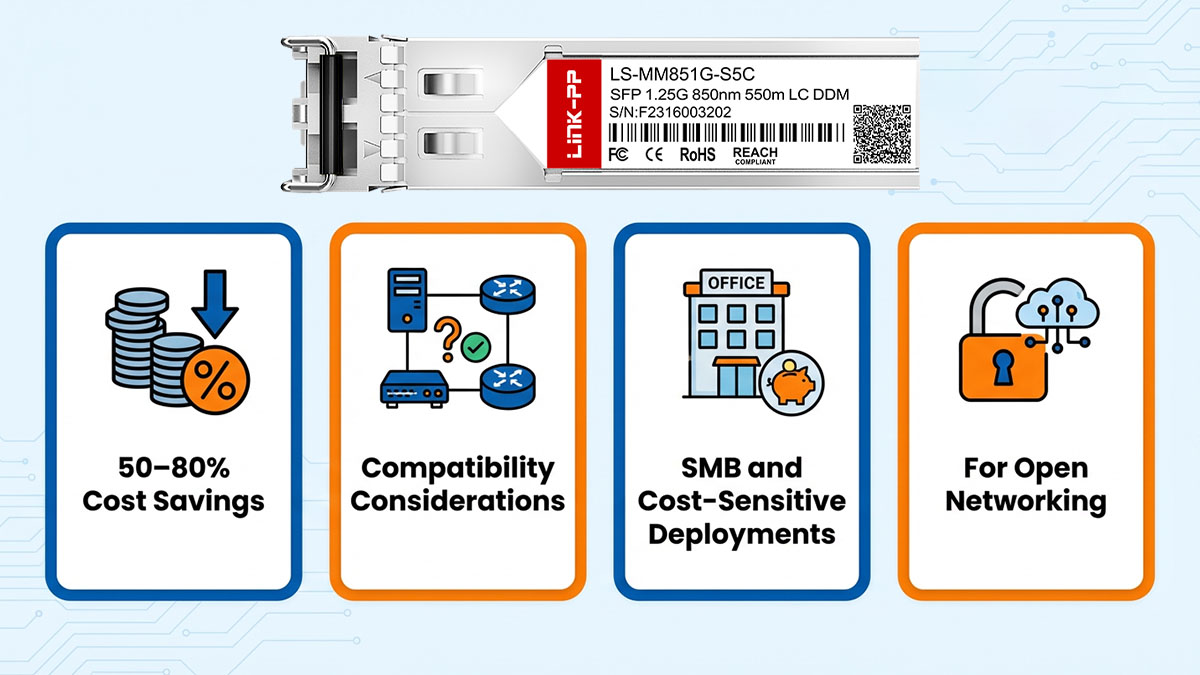
1. Aruba-Compatible J4858D Replacement
A properly coded Aruba-compatible 1000BASE-SX SFP is the most direct alternative because it matches all optical and interoperability requirements of the original module.
| Spec |
Aruba J4858D |
Compatible Replacement |
| Data rate |
1Gbps |
1Gbps |
| Wavelength |
850nm |
850nm |
| Reach |
up to 550m |
up to 550m |
| Connector |
LC duplex |
LC duplex |
When sourced from a reliable supplier, this type of module provides plug-and-play operation in Aruba switches, full DOM/DDM visibility, and stable performance across firmware versions. It is the preferred choice for campus networks, enterprise access layers, and bulk deployments.
Best for
- Large-scale switch rollouts
- Cost-optimized upgrades
- Spare inventory standardization
- Integrators and resellers
2. Cisco GLC-SX-MMD
The Cisco GLC-SX-MMD is a widely deployed 1000BASE-SX SFP used in multi-vendor environments. It can function as an alternative in networks where optics are standardized across different switch brands.
| Feature |
J4858D Compatible |
Cisco GLC-SX-MMD |
| Standard |
1000BASE-SX |
1000BASE-SX |
| Wavelength |
850nm |
850nm |
| Reach |
550m MMF |
550m MMF |
| Use case |
Aruba-focused |
Multi-vendor |
This option is most useful when:
- Networks include both Cisco and Aruba switches
- Spare optics are shared across platforms
- Procurement standardizes on common SKUs
However, for Aruba-only environments, an Aruba-coded compatible module remains the safer and simpler choice.
3. Generic or Programmable MSA-Compliant SFP Modules
MSA-compliant 1G SX SFP modules can also serve as J4858D alternatives when they are programmed for Aruba compatibility. These are typically used in lab environments, open networking deployments, or cost-sensitive projects.
| Factor |
Programmable SFP |
| Cost |
Lower |
| Flexibility |
High |
| Coding required |
Yes |
| Enterprise use |
Conditional |
They are suitable when:
- IT teams manage their own coding
- Networks are vendor-agnostic
- Deployment scale is moderate
- Budget constraints are strict
For mission-critical enterprise networks, pre-coded Aruba-compatible modules are generally preferred over manually programmed optics.
4. Choosing the Right Alternative by Deployment Type
The most suitable Aruba J4858D alternative depends on deployment scale, vendor mix, and procurement strategy.
| Scenario |
Recommended Alternative |
| Aruba-only network |
Aruba-compatible J4858D SFP |
| Multi-vendor environment |
Cisco GLC-SX-MMD or coded SFP |
| Large bulk rollout |
Tested compatible module |
| Lab or test environment |
Programmable MSA SFP |
In 2026, most organizations choose tested Aruba-compatible J4858D replacements because they provide the same technical performance as OEM optics while improving cost efficiency and supply availability.
↪️ Compatibility Considerations Before Buying Aruba J4858D alternative
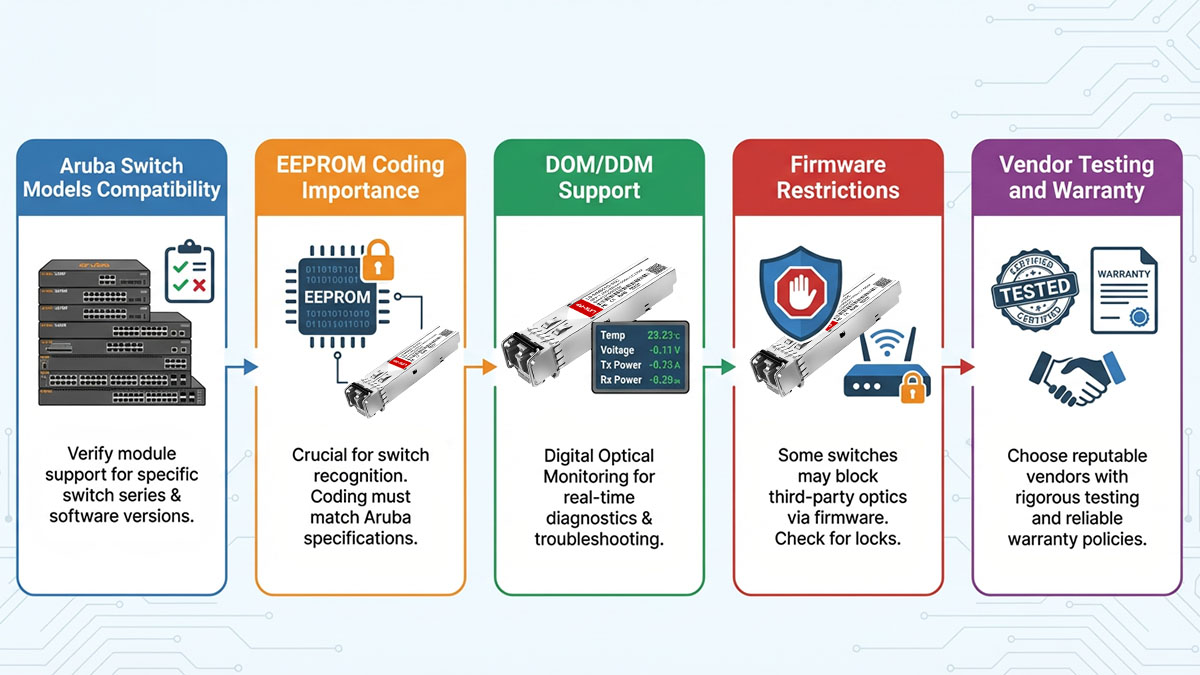
Before purchasing an Aruba J4858D alternative, the module must be verified for Aruba coding, firmware recognition, and optical spec alignment to ensure plug-and-play operation and stable monitoring. Most compatibility issues arise from incorrect EEPROM coding rather than optical hardware differences, so selecting a properly tested module is critical.
Switch Model and Firmware Recognition
A compatible module must be recognized correctly by Aruba switches without triggering warnings or port shutdown behavior. Modern Aruba platforms typically accept third-party optics when they are correctly coded, but firmware behavior can vary.
| Check item |
Why it matters |
| Aruba EEPROM coding |
Ensures switch recognition |
| Firmware compatibility |
Prevents warning logs |
| DOM/DDM support |
Enables monitoring |
| Platform testing |
Confirms interoperability |
If a module is coded specifically for Aruba and tested on common switch models, it will usually behave identically to the original J4858D.
EEPROM Coding and Vendor Identification
The most important compatibility factor is EEPROM programming. Even if two modules share the same optical specs, a generic or incorrectly coded module may show errors or lack diagnostics.
Choose a module that provides:
- Aruba vendor ID coding
- Correct part number mapping
- DOM/DDM visibility
- No unsupported-transceiver alerts
Proper coding ensures the switch treats the module as a native Aruba optic, allowing full monitoring and normal operation.
DOM/DDM Monitoring Support
Most enterprise environments rely on digital diagnostics monitoring to track optical power levels and temperature. A replacement module should support full DDM visibility to maintain operational transparency.
| Feature |
Required support |
| Tx optical power |
Yes |
| Rx optical power |
Yes |
| Temperature |
Yes |
| Voltage |
Yes |
Without DDM support, troubleshooting fiber links becomes more difficult, especially in large campus deployments.
Fiber Type and Distance Matching
An alternative must support the same multimode fiber types and distance limits as the Aruba J4858D to avoid link instability.
| Fiber type |
Supported distance |
| OM1 |
up to 275m |
| OM2 |
up to 550m |
| OM3/OM4 |
up to 550m |
If the network already uses OM3 or OM4 fiber, any compliant 1000BASE-SX module with correct coding will achieve the expected distance and performance.
Vendor Testing and Quality Assurance
Compatibility is more reliable when modules are tested with real Aruba switches rather than only meeting MSA optical standards. Pre-deployment testing reduces risk in large rollouts.
Confirm that the supplier provides:
- Switch compatibility testing
- Batch consistency
- Firmware interoperability validation
- Warranty and support
- Stable supply for future purchases
This ensures that replacement modules behave consistently across different switch models and firmware versions.
Pre-Purchase Checklist
Before buying an Aruba J4858D alternative, confirm the following:
- Matches 1000BASE-SX spec (1Gbps, 850nm, MMF)
- Aruba-coded EEPROM
- DOM/DDM supported
- Tested on Aruba switches
- Compatible with current firmware
- Supplier provides warranty
- Same SKU available for future spares
If all items above are satisfied, the alternative will typically function as a direct and reliable replacement for the Aruba J4858D in enterprise and campus network deployments.
↪️ OEM vs Third-Party J4858D Alternatives
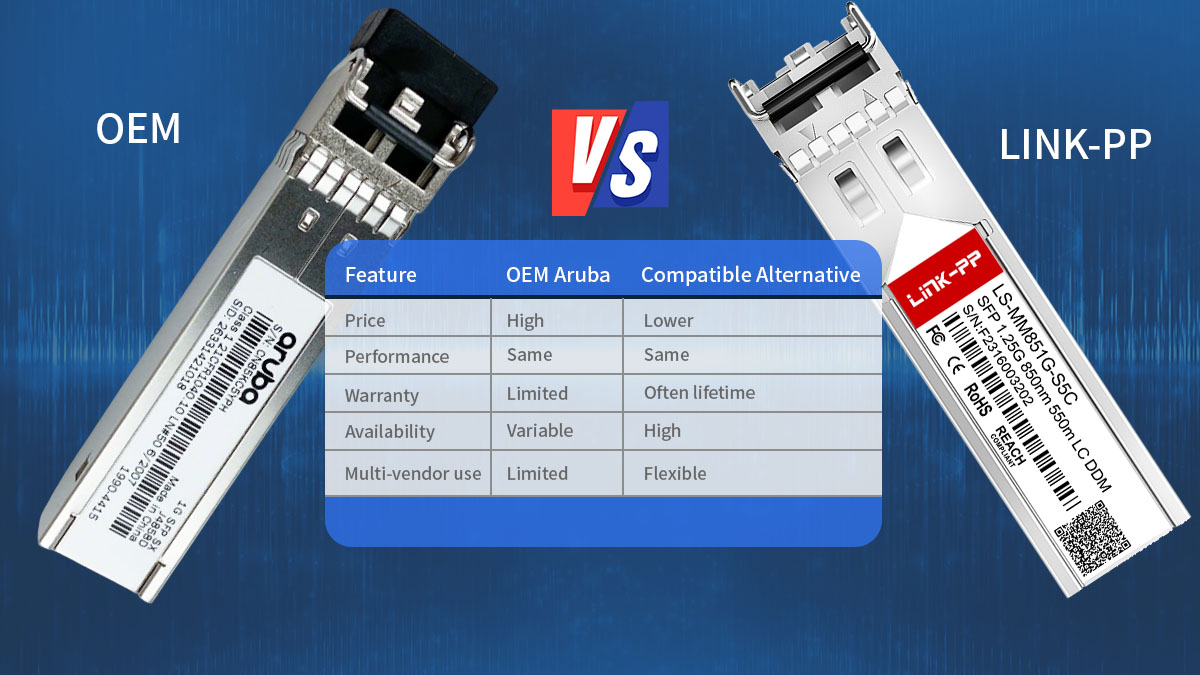
For most enterprise networks in 2026, a high-quality third-party Aruba-compatible J4858D SFP delivers the same optical performance as the OEM module while significantly reducing cost and improving availability. The OEM Aruba J4858D remains the safest option for environments requiring strict vendor support, but compatible alternatives are now widely used in production networks when properly coded and tested.
Performance and Specification Differences
In terms of optical transmission, OEM and reputable compatible modules follow the same 1000BASE-SX standard. When specifications match, link stability and distance performance are effectively identical.
| Specification |
OEM Aruba J4858D |
Compatible Alternative |
| Data rate |
1Gbps |
1Gbps |
| Wavelength |
850nm |
850nm |
| Reach |
up to 550m |
up to 550m |
| Connector |
LC duplex |
LC duplex |
Because both module types follow the same MSA and Ethernet standards, the primary differences are not in performance but in pricing, coding, and vendor support.
Cost and Procurement Considerations
Cost is the main reason organizations consider third-party alternatives. In large deployments, replacing OEM optics with compatible modules can significantly reduce total project cost.
| Factor |
OEM Module |
Compatible Module |
| Unit price |
Higher |
Lower |
| Bulk pricing |
Limited |
Flexible |
| Availability |
Vendor-dependent |
Usually in stock |
| Lead time |
Variable |
Shorter |
For campus networks or multi-site rollouts, the cost difference becomes substantial when deploying dozens or hundreds of ports. This makes compatible modules the preferred option for large-scale procurement.
Compatibility and Support Differences
Compatibility between OEM and third-party modules depends primarily on EEPROM coding and testing rather than hardware differences. Properly coded compatible modules are recognized by Aruba switches and provide full DOM/DDM monitoring.
| Aspect |
OEM Aruba |
Compatible Alternative |
| Switch recognition |
Guaranteed |
Requires correct coding |
| DOM/DDM support |
Yes |
Yes (if supported) |
| Firmware compatibility |
Native |
Tested required |
| Vendor support |
Full OEM support |
Supplier support |
OEM modules offer guaranteed support from the switch vendor. Compatible modules rely on supplier testing and warranty but generally function identically in day-to-day operation when sourced from reliable vendors.
When to Choose OEM J4858D
Choose the original Aruba module when:
- Vendor support policies require OEM optics
- The network is highly sensitive to risk
- Procurement standards mandate original parts
- Core infrastructure links must remain fully vendor-supported
OEM modules are typically used in environments where operational risk must be minimized and vendor troubleshooting support is critical.
When to Choose Third-Party Alternatives
Choose a compatible J4858D alternative when:
- Deploying large numbers of optics
- Optimizing budget across multiple sites
- Maintaining spare inventory
- Operating in mixed-vendor environments
- Lead time and availability are priorities
In most access-layer and campus deployments, compatible modules provide the same functional performance as OEM optics while improving procurement flexibility.
Practical Deployment Strategy
Many organizations use a mixed approach to balance cost and support.
| Network layer |
Recommended choice |
| Core or critical links |
OEM J4858D |
| Access layer |
Compatible modules |
| Spare inventory |
Compatible modules |
| Lab/testing |
Compatible modules |
This approach allows networks to maintain vendor support where necessary while reducing costs in large-scale deployments.
↪️ How to Choose the Right Aruba J4858D Alternative
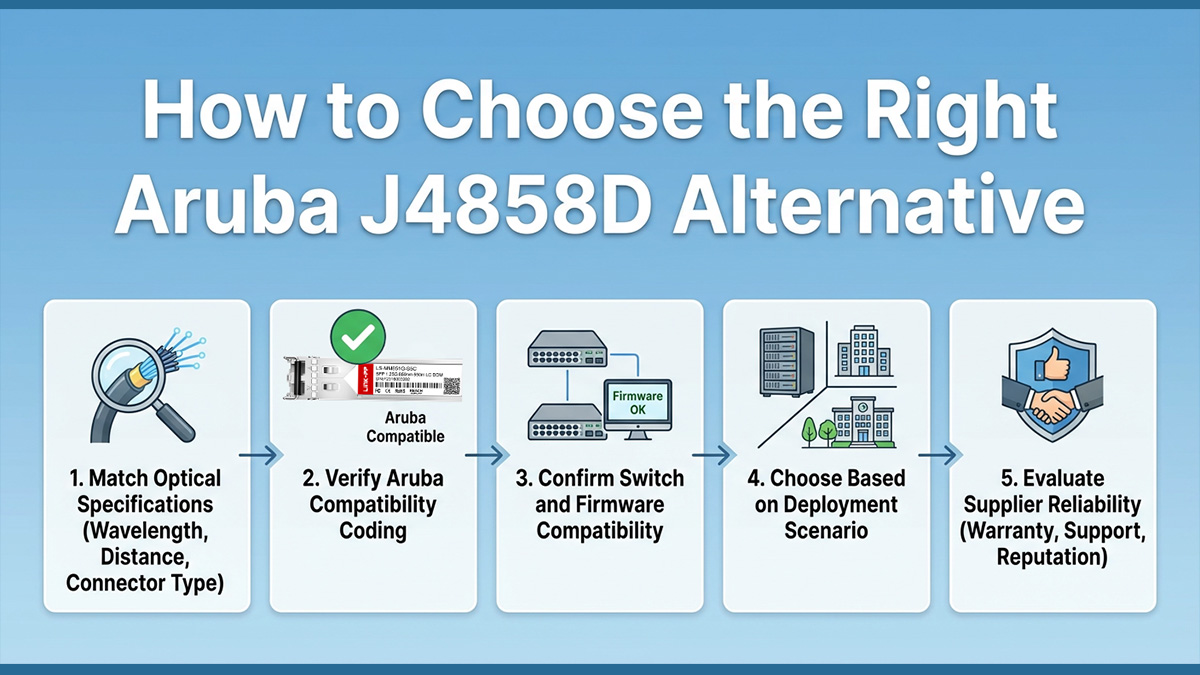
The right Aruba J4858D alternative is a 1Gbps 1000BASE-SX SFP that matches 850nm wavelength, 550m MMF reach, and includes Aruba-compatible coding for plug-and-play operation. If these requirements are met and the module is tested for Aruba switches, it will typically function as a direct replacement in enterprise networks.
Step 1: Match the Core Optical Specifications
Start by confirming that the alternative matches the transmission parameters of the original module. Without these, compatibility cannot be guaranteed.
| Specification |
Required value |
| Data rate |
1Gbps |
| Standard |
1000BASE-SX |
| Wavelength |
850nm |
| Fiber type |
MMF |
| Reach |
up to 550m |
| Connector |
LC duplex |
If all parameters match, the module will support the same link distances and fiber infrastructure as the Aruba J4858D.
Step 2: Verify Aruba Compatibility Coding
Optical specs alone are not enough. The module must be coded for Aruba switches so it can be recognized correctly and provide full monitoring support.
Choose a module that offers:
- Aruba-compatible EEPROM coding
- Correct vendor identification
- DOM/DDM monitoring visibility
- No unsupported-transceiver warnings
Proper coding ensures the switch treats the module as a native optic and allows normal operation across firmware versions.
Step 3: Confirm Switch and Firmware Compatibility
Before purchasing in bulk, confirm that the module has been tested with your specific Aruba switch models and firmware versions.
| Check item |
Why it matters |
| Switch model testing |
Ensures recognition |
| Firmware compatibility |
Prevents alerts |
| DOM visibility |
Enables monitoring |
| Batch consistency |
Avoids variation |
This is especially important for large deployments where consistent behavior across many switches is required.
Step 4: Choose Based on Deployment Scenario
The best alternative depends on how and where the module will be used.
| Scenario |
Recommended choice |
| Aruba-only network |
Aruba-coded compatible SFP |
| Multi-vendor network |
Vendor-coded modules per platform |
| Large campus rollout |
Bulk-tested compatible modules |
| Lab/testing |
Programmable MSA SFP |
Selecting based on deployment type helps reduce troubleshooting and simplifies inventory management.
Step 5: Evaluate Supplier Reliability
The reliability of a compatible module depends heavily on the supplier’s testing and quality control processes. Choose vendors that provide consistent coding, warranty, and long-term availability.
Confirm the supplier offers:
- Aruba compatibility testing
- Stable supply for repeat orders
- Warranty and replacement support
- Consistent batch quality
This ensures that future purchases will behave the same as initial deployments.
↪️ Pricing Guide for Aruba J4858D Alternatives in 2026
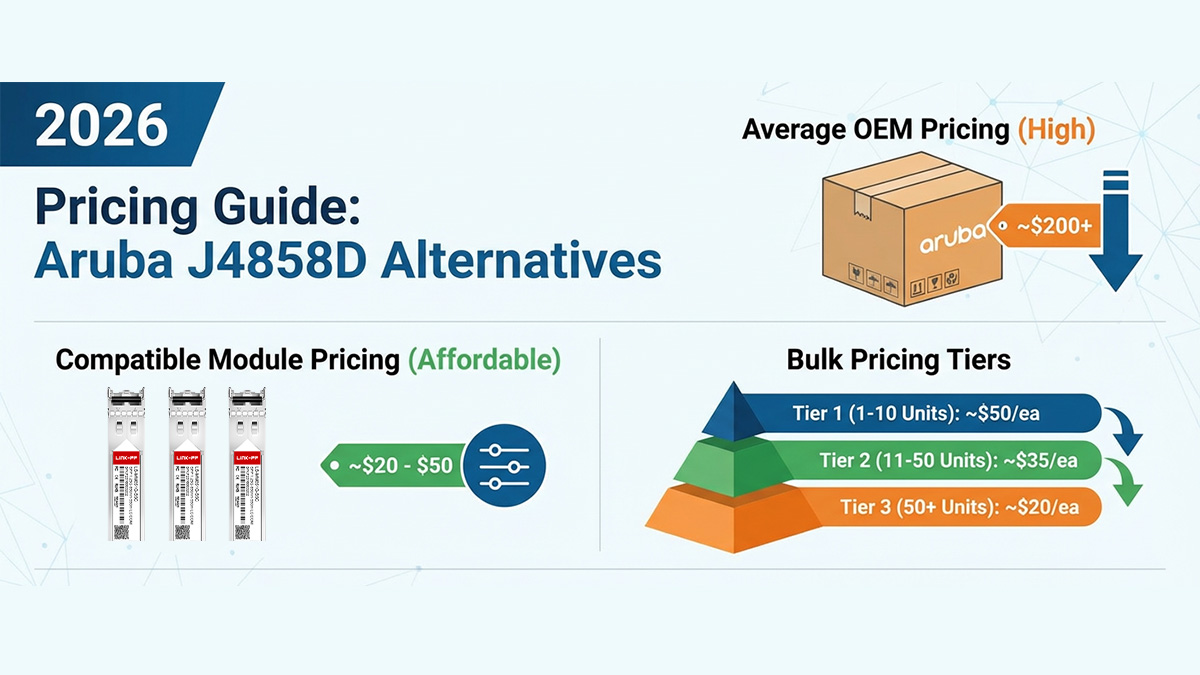
In 2026, Aruba J4858D alternatives vary in price based on coding quality, testing level, warranty, and procurement volume rather than optical performance. Most 1000BASE-SX compatible modules share identical transmission specs, so pricing differences mainly reflect supplier reliability, compatibility assurance, and support.
Typical Price Ranges by Module Type
For enterprise buyers, understanding price tiers helps determine whether OEM or compatible modules align with budget and deployment scale.
| Module type |
Typical price level |
Best use case |
| OEM Aruba J4858D |
Highest |
Support-critical networks |
| Tested compatible SFP |
Mid–low |
Enterprise bulk deployment |
| Generic MSA SFP |
Lowest |
Lab or small-scale use |
OEM modules typically carry the highest unit cost due to branding and official support coverage. Tested compatible modules offer the best balance of cost and reliability for most production networks. Ultra-low-cost generic modules may work but are usually reserved for non-critical environments.
Volume Pricing and Bulk Procurement
Pricing for J4858D alternatives decreases significantly when purchased in volume. Enterprise and campus projects often benefit from bulk procurement agreements.
| Quantity tier |
Pricing trend |
| 1–10 units |
Standard pricing |
| 10–50 units |
Moderate discount |
| 50–200 units |
Bulk pricing |
| 200+ units |
Project pricing |
Bulk purchasing not only lowers per-unit cost but also ensures consistent module batches, which helps maintain compatibility across large deployments.
Factors That Influence Price
Several non-spec factors affect the cost of a J4858D alternative in 2026.
Key pricing drivers:
- EEPROM coding quality
- Aruba compatibility testing
- DOM/DDM support
- Warranty length
- Supplier reputation
- Stock availability
Modules that include full Aruba coding, DOM support, and enterprise testing typically cost slightly more than generic MSA modules but offer greater deployment reliability.
Cost vs Risk Considerations
Lower price does not always mean better value. Choosing extremely low-cost modules without compatibility testing may lead to troubleshooting time and replacement costs.
| Price level |
Risk level |
Recommendation |
| Very low |
Higher |
Lab/testing only |
| Moderate |
Low |
Most deployments |
| High (OEM) |
Lowest |
Support-critical links |
For most organizations, mid-priced compatible modules provide the best total cost of ownership because they balance reliability and budget efficiency.
Budget Planning for Large Deployments
When planning a large switch rollout, optics can represent a significant portion of the hardware budget. Choosing compatible J4858D alternatives can reduce total project cost without affecting link performance.
Best practices:
- Standardize on one compatible SKU
- Order initial batch for testing
- Validate across switch models
- Lock in pricing for future orders
- Maintain spare inventory consistency
This approach ensures predictable costs and consistent behavior across all installed modules.
↪️ Recommended Supplier: LINK-PP Aruba Compatible SFP Solutions
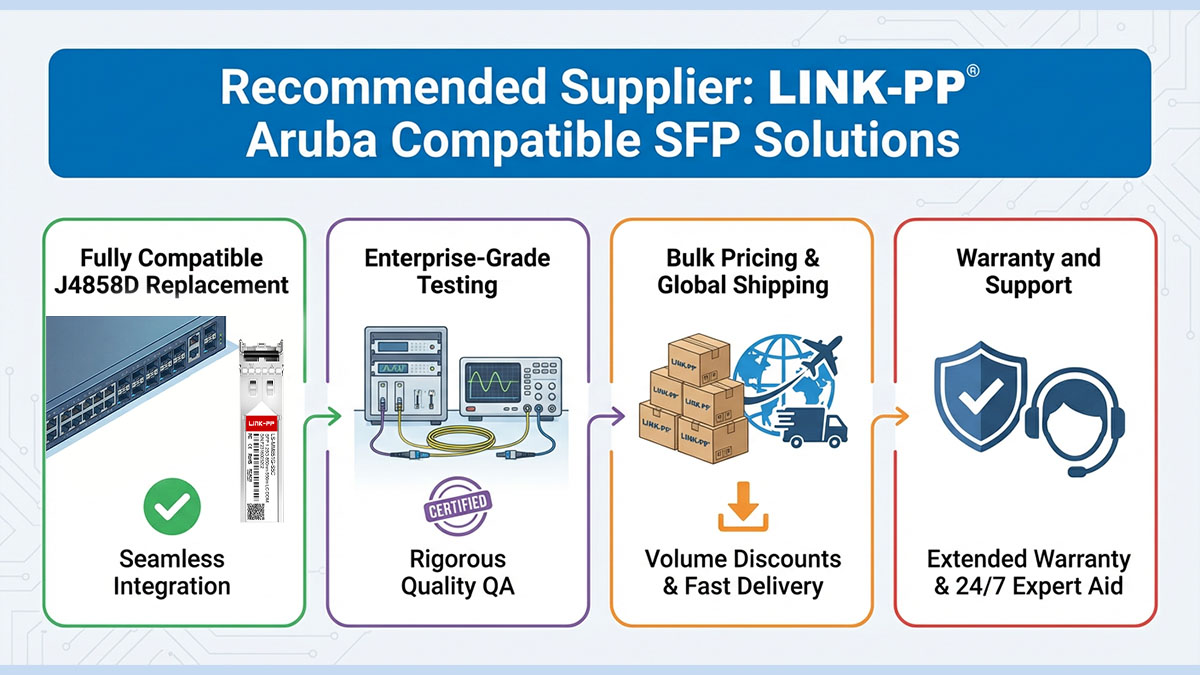
For buyers planning to replace or bulk-deploy Aruba J4858D optics, a reliable compatible supplier must deliver identical performance, stable coding, and predictable supply. LINK-PP provides Aruba-compatible 1G SFP modules designed as direct J4858D replacements while supporting enterprise procurement requirements in 2026.
Fully Compatible J4858D Replacement
The primary requirement when selecting an alternative is seamless interoperability with Aruba switches. LINK-PP compatible modules are pre-coded to match Aruba J4858D specifications, including 850nm wavelength, multimode fiber support, LC duplex interface, and up to 550m reach.
These modules are designed for plug-and-play deployment, allowing network teams to install replacements without firmware changes or switch configuration adjustments. This ensures stable link establishment across access switches, aggregation layers, and campus network environments.
Enterprise-Grade Testing
Consistent performance across large deployments depends on strict testing and validation. Enterprise-grade compatibility testing helps ensure modules behave like OEM optics under real-world conditions.
Typical validation focus:
| Test Area |
Purpose |
| Coding verification |
Ensures Aruba switch recognition |
| Optical performance |
Confirms power and sensitivity stability |
| DOM/DDM checks |
Verifies monitoring accuracy |
| Batch consistency |
Supports large-scale rollouts |
This testing approach helps reduce the risk of unsupported module warnings, unstable links, or inconsistent behavior across switch models.
Bulk Pricing for Large Deployments
Cost per port becomes a major factor when deploying hundreds or thousands of 1G links. Compatible J4858D alternatives are often selected to optimize procurement budgets while maintaining identical network performance.
Bulk purchasing advantages typically include:
- Lower unit cost for multi-site projects
- Predictable pricing across batches
- Simplified inventory planning
- Reduced total network upgrade cost
For system integrators and enterprise IT teams, bulk-ready supply is often more important than single-unit pricing.
Global Shipping and Supply Availability
Lead time and availability can impact deployment schedules. A supplier with stable inventory and international shipping capability helps avoid delays during switch rollouts or expansion projects.
Common supply-chain priorities include:
- Ready-to-ship inventory for standard modules
- Support for scheduled bulk deliveries
- International logistics coverage
- Consistent availability across procurement cycles
These factors are especially relevant for distributed enterprises and multi-region integrators.
Warranty and Technical Support
Reliable compatible optics should be backed by clear warranty policies and responsive technical support. This ensures that any compatibility or performance issues can be resolved quickly without disrupting network operations.
Typical support expectations:
- Multi-year product warranty
- Pre-sales compatibility guidance
- Post-deployment technical support
- Batch traceability for large orders
A defined support structure helps enterprises adopt third-party optics with confidence.
Ideal for Resellers, Integrators, and MSPs
Aruba-compatible J4858D alternatives are widely used by channel partners managing multi-customer deployments. LINK-PP solutions are particularly suitable for:
- IT resellers building repeatable optical supply
- System integrators handling switch rollouts
- MSPs managing ongoing network maintenance
- Enterprises standardizing optics across sites
For these buyers, a consistent compatible supplier enables scalable deployment, predictable cost control, and long-term supply stability across Aruba-based network infrastructures.
↪️ FAQs About Aruba J4858D Alternatives
Are third-party Aruba J4858D compatible modules safe to use?
Yes. Properly coded Aruba-compatible 1000BASE-SX SFP modules are designed to match J4858D specifications and can operate reliably in Aruba switches when sourced from a tested supplier.
What specifications must match a J4858D replacement?
The replacement must support 1Gbps speed, 850nm wavelength, multimode fiber, LC duplex connector, and up to 550m reach, along with Aruba-compatible coding for switch recognition.
Will Aruba switches block non-OEM SFP modules?
Most Aruba switches accept compatible SFPs when they are correctly coded. Using pre-validated modules helps avoid unsupported transceiver warnings or link instability.
Can J4858D alternatives support DOM/DDM monitoring?
Yes. Most enterprise-grade compatible modules support DOM/DDM, allowing monitoring of optical power, temperature, and voltage just like OEM optics.
When should I choose OEM instead of a compatible alternative?
OEM modules are typically chosen for strict vendor-compliance policies or small deployments. Compatible alternatives are preferred for large-scale rollouts, cost control, and faster availability.
Are J4858D alternatives suitable for bulk deployment?
Yes. Compatible modules are widely used for campus networks, data centers, and switch expansion projects where consistent performance and lower per-port cost are required.
Do compatible modules work in mixed-vendor networks?
Many suppliers provide multi-vendor coding options, allowing the same 1G SX SFP module type to be used across Aruba and other switch platforms in standardized deployments.
↪️ Conclusion
Choosing the right Aruba J4858D alternative in 2026 comes down to matching core specifications, ensuring Aruba switch compatibility, and selecting a supplier that can support large-scale deployment with stable quality and pricing. Modern Aruba-compatible 1G SFP modules now deliver the same 850nm multimode performance, plug-and-play operation, and monitoring capabilities as OEM optics, making them a practical option for enterprises, integrators, and resellers looking to control cost without sacrificing reliability.
For most network upgrades, switch expansions, and spare inventory planning, a tested Aruba J4858D compatible module provides the best balance of performance, availability, and procurement efficiency. By standardizing on fully compatible replacements and working with a supplier that offers enterprise-grade testing, bulk pricing, and global delivery, organizations can deploy fiber links at scale with confidence.
If you are sourcing reliable Aruba-compatible J4858D SFP modules for upcoming projects, explore the LINK-PP Official Store to find fully compatible options designed for enterprise networks, bulk deployment, and fast worldwide shipping.